

The first thing to check before buying land isn’t the view, the soil, or the price per acre. It’s what’s been dumped, buried, or leaked within a few miles of the property line.
When we first started looking for our property a few years ago we did exactly this. I consulted every map I could find, looked through every database, poured over USGS and satellite maps of the area, and drove the roads to see what was there.
This is part 1 of a new series that covers everything you need to know when purchasing property. I’ll be publishing the rest of the series over the next few weeks.
As of March 2025, the EPA’s National Priorities List contains 1,340 active Superfund sites across the United States. Another 41 are proposed. And 459 have been “deleted,” which does not mean what you think it means. Approximately 21 million people live within a single mile of a Superfund site. One in six Americans lives within three miles. Many of them have no idea.
These sites represent the worst of the worst: contamination so severe that even the EPA, an agency with a long track record of downplaying environmental hazards, had to flag it for long-term cleanup. They don’t represent the full picture. For every listed Superfund site, there are thousands of contaminated properties that never made the cut, never got investigated, or were handled (loosely) under state programs with less stringent standards. The NPL is the tip of an iceberg made of trichloroethylene and corporate negligence.
If you’re buying raw land for homesteading, off-grid living, or an intentional community, this is where your due diligence starts. Not with the realtor’s glossy photos. Not with the county zoning map. With the EPA’s Cleanups in My Community tool and a healthy suspicion of anything labeled “remediation complete.”
What’s in the Ground
The chemicals contaminating these sites read like a catalog of industrial recklessness. The headliners: trichloroethylene (TCE), a degreasing solvent found at over 1,045 of 1,699 Superfund sites, meaning it shows up at more than 60% of them. Polychlorinated biphenyls (PCBs), dumped by General Electric into the Hudson River for decades. Per- and polyfluoroalkyl substances (PFAS), the “forever chemicals” that DuPont and 3M manufactured for decades while burying evidence of their toxicity. Heavy metals: lead, arsenic, cadmium, mercury, chromium. Benzene. Vinyl chloride. Dioxins.
These aren’t abstract threats. TCE evaporates from contaminated soil and groundwater and seeps into buildings through cracks in foundations, a process called soil vapor intrusion. In Johnson County, Indiana, where a pediatric cancer cluster prompted investigation, about one-third of 30 tested homes had detectable levels of TCE and PCE in their indoor air. The families living there had no idea they were breathing carcinogens that had migrated from decades-old industrial contamination. The contamination was underground, invisible, and had been known to the EPA for years.
PFAS contamination is in a class by itself. The Environmental Working Group has mapped 9,728 PFAS contamination sites across all 50 states, and their data confirms that 176 million Americans have drinking water that has tested positive for PFAS. The Department of War has confirmed PFAS contamination at 455 military installations, with investigations ongoing at over 700 total. The source: AFFF firefighting foam, which the military sprayed on training fields for decades. These chemicals don’t break down. That’s why they’re called “forever chemicals.” They’re in the groundwater around virtually every military base in the country, and they’re migrating outward.
Here’s what happens when people buy land without researching it first
The textbook example is Love Canal. From 1942 to 1953, Hooker Chemical buried 21,800 tons of toxic chemicals in an abandoned canal in Niagara Falls, New York. The chemicals included at least 12 known carcinogens: halogenated organics, chlorobenzenes, and dioxin. In 1953, Hooker sold the 16-acre property to the Niagara Falls School Board for $1, with a deed that included a liability disclaimer. The school board built the 99th Street Elementary School directly on top of the dump.
Hundreds of homes went up around it. By the late 1970s, chemicals were leaking into basements and backyards. Children were playing in puddles of toxic waste. In 1978, President Carter declared a federal emergency, the first ever for a toxic waste site. Residents were evacuated. The disaster led directly to the passage of CERCLA, the Superfund law, in 1980.
Here’s the part that should concern you as a land buyer. The EPA deleted Love Canal from the National Priorities List in 2004. The area was renamed “Black Creek Village.” Homes were resold. The containment system and monitoring continue. “Deleted” doesn’t mean clean. It means the EPA determined no further remedial action was needed under the Superfund program. The chemicals are still there, under a cap, with monitoring wells checking that the cap holds. For how long? As long as the institutional controls remain in place. And institutional controls have a way of being forgotten.
Camp Lejeune is the military version. From 1953 to 1987, drinking water at this Marine Corps base in North Carolina was contaminated with TCE, PCE, benzene, and vinyl chloride at concentrations 240 to 3,400 times the levels permitted by regulatory standards. Up to one million Marines, their families, and civilian workers drank, cooked, bathed, and swam in that water for 34 years. The Marine Corps knew. It kept the contaminated wells pumping. It took until 2022 for the Camp Lejeune Justice Act to allow victims to file claims.
A million people poisoned for three decades by the institution that swore to protect them, on a military base where refusing the water wasn’t exactly an option. And the relevant detail for land buyers: military bases contaminate the surrounding area too. Groundwater plumes don’t respect fence lines.
In Woburn, Massachusetts, wells G and H were contaminated with TCE from industrial dumping by W.R. Grace & Co. and Beatrice Foods. By 1980, 12 cases of childhood leukemia were confirmed in East Woburn, a cluster far above normal rates. Between 1964 and 1986, 28 children contracted leukemia in this Boston suburb of 35,000. The case became the basis for Jonathan Harr’s book and the film A Civil Action. Woburn isn’t a rural backwater. It’s a suburb. The families had municipal water. They had every reason to assume it was safe. The contamination had been migrating underground for decades before anyone noticed the children dying.
And then there’s General Electric and the Hudson River. GE discharged PCBs into the river from two capacitor plants for decades, contaminating 200 miles of waterway and making it the largest Superfund site in the country. After years of legal battles, GE spent $1.6 billion on dredging operations between 2009 and 2015. The EPA branded this a “Superfund Success Story.” The fish in the Hudson are still too contaminated to eat safely. EPA said it would take 15 to 30 more years after the dredging to bring PCB levels in fish down to safe levels. The floodplain contamination investigation is still ongoing as of 2025. “Success story.”
The Settlements Tell the Story
The companies that created these messes don’t contest the science anymore. They settle.
In June 2023, 3M agreed to pay $10.3 billion (potentially up to $12.5 billion depending on how many water systems detect PFAS) over 13 years to resolve claims by public water suppliers. The same month, DuPont, Chemours, and Corteva settled for $1.185 billion with US water systems. Chemours contributed roughly $592 million. Chemours is the company DuPont created in 2015 specifically to spin off its PFAS liabilities. They literally incorporated a new company, loaded it with the toxic legacy, and waved goodbye. In August 2025, the same three companies proposed an additional $875 million settlement with New Jersey alone.
For context: 3M’s total annual revenue is around $32 billion. DuPont reported $12.1 billion in 2023. These are not crippling penalties. They’re rounding errors. The cost of doing business. Contaminate millions of people’s drinking water for decades, write a check that amounts to a few months of revenue, and keep operating. No executive sees a courtroom. No factory shuts down. The settlement explicitly resolves their liability, meaning they can never be sued again for the same contamination. They bought permanent legal immunity.
How Contamination Moves (And Why Distance Matters)
If contamination stayed put, proximity would be the whole story. It doesn’t stay put.
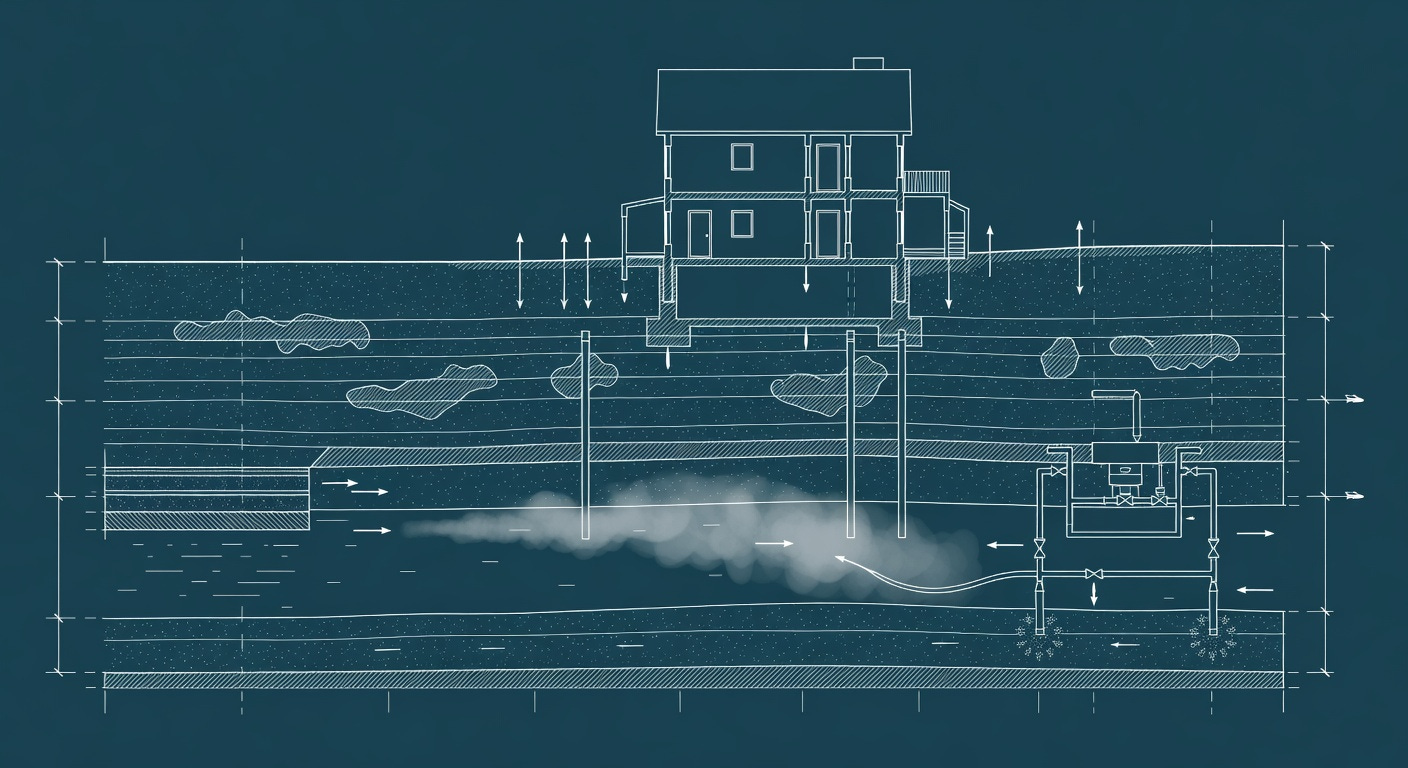
Groundwater plumes are the primary mechanism. Contaminants dissolve into groundwater and spread underground, traveling in the direction of groundwater flow. The speed depends on geology, soil type, and the water table. Plumes can migrate miles from the original source over decades, contaminating wells and aquifers far from the site that caused them. You might be three miles from a Superfund site, uphill, with a lovely view, and the plume can still reach your well because groundwater doesn’t follow surface topography.
Soil vapor intrusion is the mechanism nobody thinks about. Volatile organic compounds (TCE, PCE, benzene) evaporate from contaminated soil and groundwater, rise through the soil as vapor, and enter buildings through foundation cracks, sump pits, and utility penetrations. Your house can be sitting on top of a contaminated groundwater plume and the carcinogens literally come up through the floor. The Johnson County, Indiana cases showed this happening in ordinary family homes, with families breathing TCE-contaminated air for years without knowing it.
Surface water runoff carries contaminated soil into streams, rivers, and ponds during rain events. Contaminants accumulate in sediment over time (the Hudson River is a 200-mile example). Any property downstream of a contaminated site can be affected.
This is why buffer zones matter, and why there’s no officially established “safe distance.” The research suggests health impacts within 1.8 miles, but groundwater plumes can extend much further. The practical minimum for buying land near a known Superfund site is 3-5 miles.
How to Actually Protect Yourself
The good news: the tools exist to investigate a property before you buy it. The bad news: nobody’s going to do it for you.
Step 1: Run the Databases
Before you even visit a property, run it through every available environmental database:
- EPA Cleanups in My Community: Interactive map showing all Superfund sites, brownfields, and other cleanup sites. Enter the address or zoom to the area. Check a 5-mile radius minimum.
- EPA ECHO Database: Enforcement and Compliance History Online. Shows which facilities near you have environmental violations and what they’re emitting.
- EWG PFAS Contamination Map: 9,728 known PFAS sites mapped. Overlay this with your property search.
- EWG TCE Contamination Map: 470 drinking water systems in 46 states with TCE detections.
- State environmental database: Every state has one. Search “[your state] DEP site remediation” or “[your state] DEQ contaminated sites.” These often catch sites that didn’t make the federal NPL.
- Historical aerial photos: Google Earth Pro has free historical imagery going back decades. Look for what was on or near your property before: factories, dumps, gas stations, dry cleaners, military facilities, agricultural operations. All are contamination risks.
Step 2: Check Groundwater Direction
If you find any contamination site within 5 miles, determine which direction groundwater flows. Your state geological survey or local USGS office can help. If you’re down-gradient (downstream in the water table) from a contaminated site, you are at elevated risk, regardless of surface distance.
Step 3: Test the Water
If the property has a well or you plan to drill one, test the water before you buy.
- Basic panel (bacteria, nitrates, minerals, pH): $15-100
- VOC panel (TCE, PCE, benzene, etc.): ~$70-80
- Heavy metals panel (lead, arsenic, cadmium, chromium, mercury): ~$70-80
- PFAS testing: $275-400+ per sample. There are no home test kits for PFAS. It requires certified lab analysis.
- Comprehensive well test (everything above): $500-1,000+
Send samples to a certified lab, not a home test kit for the serious stuff.
Step 4: Test the Soil
If you plan to grow food, test the soil. Your county agricultural extension office will do a basic nutrient test for $20-50. For contaminants (heavy metals, pesticide residues), you’ll need a private lab. Budget $50-150 for a metals panel, $200-500+ for VOCs and industrial chemicals.
Step 5: Consider a Phase I Assessment
For any property with the slightest whiff of historical contamination risk, a Phase I Environmental Site Assessment is a formal review of historical records, regulatory databases, aerial photographs, and site conditions. Cost: $1,500-6,000+. It doesn’t include physical testing (that’s a Phase II, $5,000-25,000+), but it tells you whether testing is warranted.
Step 6: Drive the Roads
No database replaces eyes on the ground. Drive every road within 3-5 miles of the property. Look for:
- Industrial facilities (active or abandoned)
- Chemical storage tanks
- Junkyards and dump sites
- Agricultural operations (pesticide drift, fertilizer runoff)
- Dry cleaners (PCE contamination is nearly universal at former dry cleaner sites)
- Gas stations (underground storage tank leaks are epidemic)
- Anything that smells wrong
Talk to your future neighbors. They know things that databases don’t. Ask about former businesses, dumping activity, water quality problems, unexplained health issues. Buy them coffee. It’s the cheapest due diligence you’ll ever do.
Step 7: Check Deed Restrictions
Properties near (or on) cleaned-up contamination sites often carry deed restrictions: no drilling wells, no disturbing subsurface soil, no building without approval. These are “institutional controls” that are part of the remedy. If you have these restrictions, there’s a very good chance you’re dealing with contamination.
The Checklist
Print this. Use it for every property you evaluate.
Before visiting:
- [ ] EPA Cleanups in My Community: check 5-mile radius
- [ ] EPA ECHO database: check 5-mile radius for violating facilities
- [ ] EWG PFAS map: check for contamination sites nearby
- [ ] EWG TCE map: check for contaminated water systems
- [ ] State DEP/DEQ contaminated sites database
- [ ] Google Earth Pro: review historical aerial photos of site and surroundings
- [ ] County records: any deed restrictions related to environmental controls?
During site visit:
- [ ] Drive every road within 3-5 miles: industrial sites, tanks, dumps, ag operations?
- [ ] Talk to at least 3 neighbors about property history, water quality, health concerns
- [ ] Note any unusual smells, discoloration, stressed vegetation, or surface water oddities
- [ ] Identify any dry cleaners, gas stations, industrial sites past or present within 2 miles
Before making an offer:
- [ ] Water test: basic panel + VOCs + heavy metals (and PFAS if within 10 miles of military base or industrial site)
- [ ] Soil test: heavy metals + pesticides (minimum for food production)
- [ ] Determine groundwater flow direction relative to any contamination sources
- [ ] Consider Phase I Environmental Site Assessment
- [ ] Review all deed restrictions in full title search
Dealbreakers:
- [ ] Active Superfund site within 3 miles (down-gradient)
- [ ] Deleted Superfund site within 1 mile (containment systems can fail)
- [ ] PFAS detection in well water above 4 ppt (PFOS/PFOA)
- [ ] Any VOC detection in well water
- [ ] Deed restrictions prohibiting well drilling or subsurface disturbance
- [ ] Unable to verify what was on or near the property historically
The good news is, there’s still plenty of untouched, clean land. Find a place further away from farmland, away from major cities, military bases, and industrial facilities (present or historic) and you’ll be most of the way there already.
Next in the series: The Invisible Dangers: Cell Towers, EMF, and Industrial Neighbors
Sources
1. GAO-25-108408, “Superfund: Many Factors Can Affect Cleanup of Sites Across the U.S.” (March 2025) - https://files.gao.gov/reports/GAO-25-108408/index.html
2. Housing Matters / Urban Institute, “Millions of Americans Live Near Toxic Waste Sites” (2022) - https://housingmatters.urban.org/articles/millions-americans-live-near-toxic-waste-sites-how-does-affect-their-health
3. EPA, “About the Superfund Cleanup Process” - https://www.epa.gov/superfund/about-superfund-cleanup-process
4. EPA, “Superfund Landowner Liability Protections” - https://www.epa.gov/enforcement/superfund-landowner-liability-protections
5. EPA, “Superfund Five-Year Reviews” - https://www.epa.gov/superfund/superfund-five-year-reviews
6. EPA, “Cleanups in My Community” - https://www.epa.gov/cleanups/cleanups-my-community
7. EWG, “PFAS Contamination Crisis: 9,728 Sites in 50 States” - https://www.ewg.org/interactive-maps/pfas_contamination/
8. EWG, “TCE Contamination: 470 Drinking Water Systems in 46 States” - https://www.ewg.org/interactive-maps/tce/map/
9. Holland & Knight, “EPA Finalizes PFAS Drinking Water Regulation” (April 2024) - https://www.hklaw.com/en/insights/publications/2024/04/epa-finalizes-pfas-drinking-water-regulation
10. Reuters, “3M’s $10.3 Billion PFAS Settlement” (August 2023) - https://www.reuters.com/legal/government/us-states-withdraw-objections-3ms-103-billion-pfas-settlement-2023-08-29/
11. DuPont, “Chemours, DuPont, and Corteva PFAS Settlement” (June 2023) - https://www.dupont.com/news/chemours-dupont-and-corteva-reach-comprehensive-pfas-settlement-with-us-water-systems.html
12. Manufacturing Dive, “DuPont, Corteva and Chemours $875M NJ Settlement” (August 2025) - https://www.manufacturingdive.com/news/dupont-corteva-chemours-pfas-settlement-new-jersey-environmental-protection/756729/
13. SUNY Geneseo, “Love Canal: A Brief History” - https://www.geneseo.edu/history/love_canal_history/
14. Buffalo Niagara Waterkeeper, “Learning about Love Canal” - https://bnwaterkeeper.org/love-canal/
15. Levin Center for Oversight and Democracy, “Love Canal” - https://levin-center.org/what-is-oversight/portraits/love-canal/
16. National Geographic Education, “Superfund” - https://education.nationalgeographic.org/resource/superfund/
17. VA Public Health, “Camp Lejeune: Past Water Contamination” - https://www.publichealth.va.gov/exposures/camp-lejeune/
18. Wikipedia, “Camp Lejeune Water Contamination” - https://en.wikipedia.org/wiki/Camp_Lejeune_water_contamination
19. House Committee Hearing, “Camp Lejeune: Contamination and Compensation” - https://www.govinfo.gov/content/pkg/CHRG-111hhrg58485/html/CHRG-111hhrg58485.htm
20. Environment & Society Portal, “Leukemia Cluster in Woburn” - https://www.environmentandsociety.org/tools/keywords/leukemia-cluster-woburn-us-linked-chemical-leakage-and-tainted-water
21. Carleton College, “A Civil Action Summary” - https://serc.carleton.edu/woburn/Summary_ACA.html
22. Mass Moments, “Complaint Filed on Toxic Pollution in Woburn” - https://www.massmoments.org/moment-details/complaint-filed-on-toxic-pollution-in-woburn.html
23. NOAA, “Hudson River” - https://darrp.noaa.gov/hazardous-waste/hudson-river
24. Scenic Hudson, “Hudson River Toxic PCB Cleanup” - https://www.scenichudson.org/our-work/advocacy/pcbs/
25. Poughkeepsie Journal, “Hudson River Cleanup: GE Could Owe Billions” (April 2022) - https://eu.poughkeepsiejournal.com/story/tech/science/environment/2022/04/13/hudson-river-scenic-hudson-says-general-electric-owes-billions/7301071001/
26. CBS News, “Seeking to Solve a Pediatric Cancer Mystery” (December 2020) - https://www.cbsnews.com/news/seeking-to-solve-a-pediatric-cancer-mystery-johnson-county-indiana/
27. Weitz & Luxenberg, “Toxic Exposure to TCE” - https://www.weitzlux.com/environmental/toxic-chemicals/tce/
28. Inhabitat, “Living Near Superfund Sites Could Shorten Life Expectancy” (April 2021) - https://inhabitat.com/living-near-superfund-sites-could-shorten-life-expectancy-by-1-year/
29. GAO Testimony, “Cleanup of Superfund Sites” (April 2025) - https://www.gao.gov/video/testimony-cleanup-superfund-sites
30. SoftPro Water Systems, “Water Testing Costs for Homeowners” - https://www.softprowatersystems.com/pages/understanding-water-testing-costs-for-homeowners
31. LawForPeople, “Trichloroethylene (TCE) Lawsuit” - https://www.lawforpeople.com/trichloroethylene-tce-lawsuit/
15 years in the Environmental HazMat Remediation Industry in a technical role. I learned a few things...
It wasn't on the front lines of GWOT, but I saw things that should never have been....