


In Part 1, we covered the basics: what electromagnetic fields are, the four types hiding in your home, and why the safety standards are a regulatory joke built on five monkeys and eight rats. If you haven’t read it, start there. Everything in this piece builds on that foundation.
Now we get practical.
This is the article I wish someone had handed me when I first started measuring my house. No jargon mazes, no sales pitches for magic crystals. Just the tools you need, the numbers that matter, and a clear walkthrough of every room so you can find out what’s actually going on in the place where you sleep, work, and raise your kids.
By the end, you’ll know exactly what meters to buy, what the readings mean, and how to fix the most common problems. Most of them are easier and cheaper than you’d expect.
The Meters: What to Buy (and Why There’s No Shortcut)
Here’s the uncomfortable truth from Part 1: there is no single device that accurately measures all four types of EMF. Anyone selling you an all-in-one solution for $30 is selling you a toy that will give you false confidence and miss the exposures that actually matter. This is physics, not marketing. Each type of field has different frequencies, different units, and different measurement techniques.
You need dedicated meters. The good news: you don’t need to spend $10,000 on a professional Building Biology kit. A set of reliable, accurate consumer meters runs between $500 and $1,100 depending on the package you choose. That’s a one-time investment to protect your family for years.
Here’s what to get, starting with the most important.
RF Meter: Safe and Sound Pro II (~$399)
This is your wireless radiation detector. It picks up WiFi, Bluetooth, cell towers, some 5G (sub-6 GHz bands, as “true” 5G bands are still outside the detection range of most affordable meters), smart meters, cordless phones, baby monitors, and every other radio frequency source in your environment, from 200 MHz to 8 GHz.
Why this meter specifically:
- Numerical display showing peak, max hold, and average readings in µW/m² (the unit the Building Biology guidelines use)
- Sound signature analysis: each RF source has a distinct audio pattern. With a little practice, you can hear the difference between a WiFi router, a smart meter, and a cell tower signal. This is incredibly useful for tracking down the source of a reading
- High sensitivity: detects signals down to 0.005 µW/m², which matters when you’re trying to get your bedroom into the “no anomaly” range
This is the meter that Jeromy Johnson at EMF Analysis (one of the most respected independent EMF consultants in North America) recommends as the minimum for professional-level accuracy. It’s also the meter recommended by the EMF Center run by certified Building Biologist Satya Giordano.
Budget alternative: Safe and Sound Classic III (~$139-$169). Same frequency range (200 MHz to 8 GHz), same audio feature for source identification, but uses an LED bar graph instead of a numerical display. You lose the exact numbers, but you get the same detection range and sensitivity for about a third of the price. A solid starting point if money is tight.
AC Electric + Magnetic Field Meter: Gigahertz Solutions ME3830B (~$272)
This single-axis meter from the German company Gigahertz Solutions measures both AC electric fields (in V/m) and AC magnetic fields (in nT or mG) across a frequency range of 16 Hz to 100 kHz. It’s the meter Building Biology consultants train on.
What you’ll use it for:
- AC electric fields from wiring in your walls, extension cords, lamps, and chargers. These are present even when nothing is turned on, because the wiring carries voltage 24/7 as long as the circuit breaker is on
- AC magnetic fields from power lines, appliance motors, and wiring errors that create elevated fields in rooms where you’d never expect them
Important note: you must ground the meter for accurate electric field readings. It comes with a grounding cable. Plug it into the ground pin of any properly grounded outlet before taking electric field measurements. Ungrounded readings will be inaccurate. Jeromy Johnson has a video walkthrough of this process.
The ME3830B is a single-axis meter, which means you’ll need to rotate it in three orientations (X, Y, Z) and take the highest reading, or calculate the composite. This sounds fussy but becomes second nature after a few minutes.
AC Magnetic Field Meter: Alpha Labs UHS2 Gaussmeter (~$389)
If you want to go deeper on magnetic fields, the UHS2 is a true 3-axis gaussmeter that gives you the composite magnitude automatically. No rotating needed. Frequency range: 13 Hz to 75 kHz covering both ELF and VLF magnetic fields. It also has a VLF-only mode (1 kHz to 75 kHz) for isolating higher-frequency magnetic pollution from things like solar inverters and switching power supplies.
The EMF Center calls it “the lowest-cost gaussmeter available with triple-axis antenna, ELF + VLF range, and accuracy you can trust.”
Note for budget-conscious readers: the ME3830B also measures magnetic fields (single-axis). If you’re starting out, the ME3830B alone covers both electric and magnetic, and you can add the UHS2 later if you want faster, more convenient magnetic field measurements. You don’t need both on day one.
Dirty Electricity Meter: Alpha Labs Line EMI Meter (~$165)
Dirty electricity is the one most people don’t know about. These are high-frequency voltage transients (10 kHz to 10 MHz) riding on your household wiring, created by solar inverters, LED dimmers, laptop chargers, and virtually every device with a switching power supply. Your whole house wiring becomes a broadcasting antenna for this electromagnetic noise.
The Line EMI Meter plugs into any wall outlet and gives you a reading in millivolts peak-to-peak (mV p-p). Walk through your house, plug it into every outlet, and you’ll quickly see which circuits and rooms have the highest dirty electricity levels.
Pair it with a cheap AM radio (~$30). Tune the radio to a frequency with no station (just static) and walk around your house. Where the static gets louder and more agitated, you’ve found a dirty electricity source. The AM radio doesn’t give you numbers, but it’s remarkably effective at pinpointing the specific device creating the problem. Jeromy Johnson at EMF Analysis calls it his favorite tool for tracking down EMI sources.
The Upgrade Path: Safe and Sound EM3 (~$649)
This is the newer option from Safe Living Technologies that replaces both the UHS2 and the ME3830B in one device. True 3-axis for magnetic, plus accurate electric field measurement. If you’re buying fresh and want the cleanest setup, the EM3 paired with the Pro II and the Line EMI Meter is the current gold standard for consumer-level accuracy. The Advanced Package from EMF Analysis bundles this combination for about $1,070 after a 10% discount.
Where to Buy
All of these meters are available from Safe Living Technologies (SLT) in Toronto. SLT is one of the most established EMF equipment suppliers in North America, has been in business for years, and ships worldwide. They’re not a random Amazon seller. They also carry shielding materials, remote cutoff switches, and educational resources.
Note that I have no affiliation with any of these companies, I purchased my meters with my own money years ago, and get no referral bonuses from any of these recommendations.
How to Read the Numbers: Building Biology Guidelines
You’ve got meters. Now you need to know whether your readings are cause for concern or whether you can relax.
The Building Biology Institute (originally the Institut fur Baubiologie + Nachhaltigkeit in Germany) has maintained the gold standard for residential EMF guidelines since 1992, now updated to the SBM-2024 evaluation guidelines. Unlike the FCC’s thermal-only standards (which, as we covered in Part 1, are based on whether radiation heats monkey tissue enough to stop them pressing a lever for food), the Building Biology guidelines are specifically designed for long-term exposure in sleeping areas based on precautionary science and decades of real-world home assessments.
The guidelines use four levels of concern. Think of them as a traffic light system with an extra red:
RF (Radio Frequency): Sleeping Areas
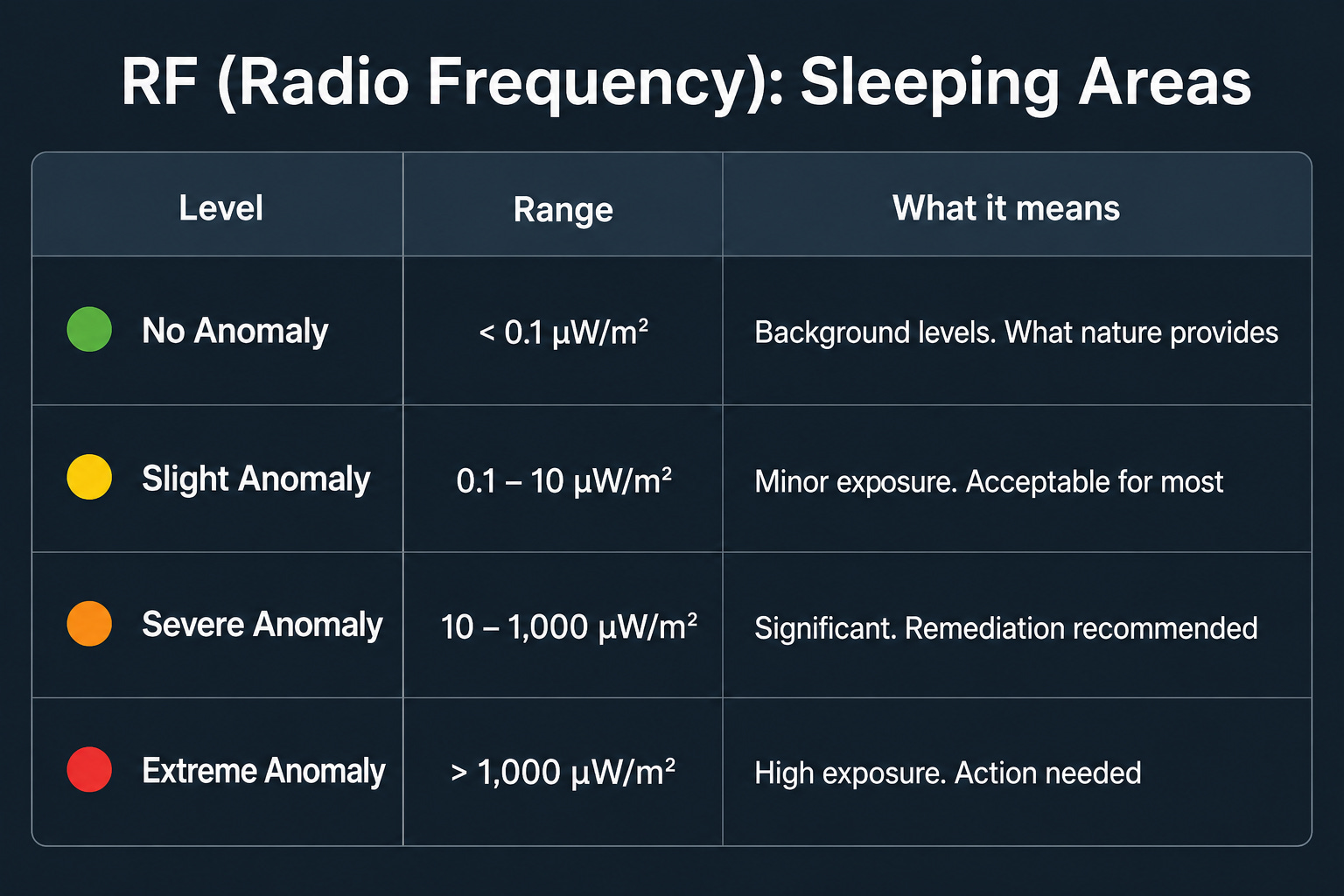
For context: a WiFi router at close range can push 10,000+ µW/m². A smart meter on the other side of your bedroom wall can spike into the thousands during its transmission bursts. Your goal for sleeping areas is 10 µW/m² or less. For sensitive individuals or children’s rooms, aim for below 1 µW/m².
AC Magnetic Fields: Sleeping Areas
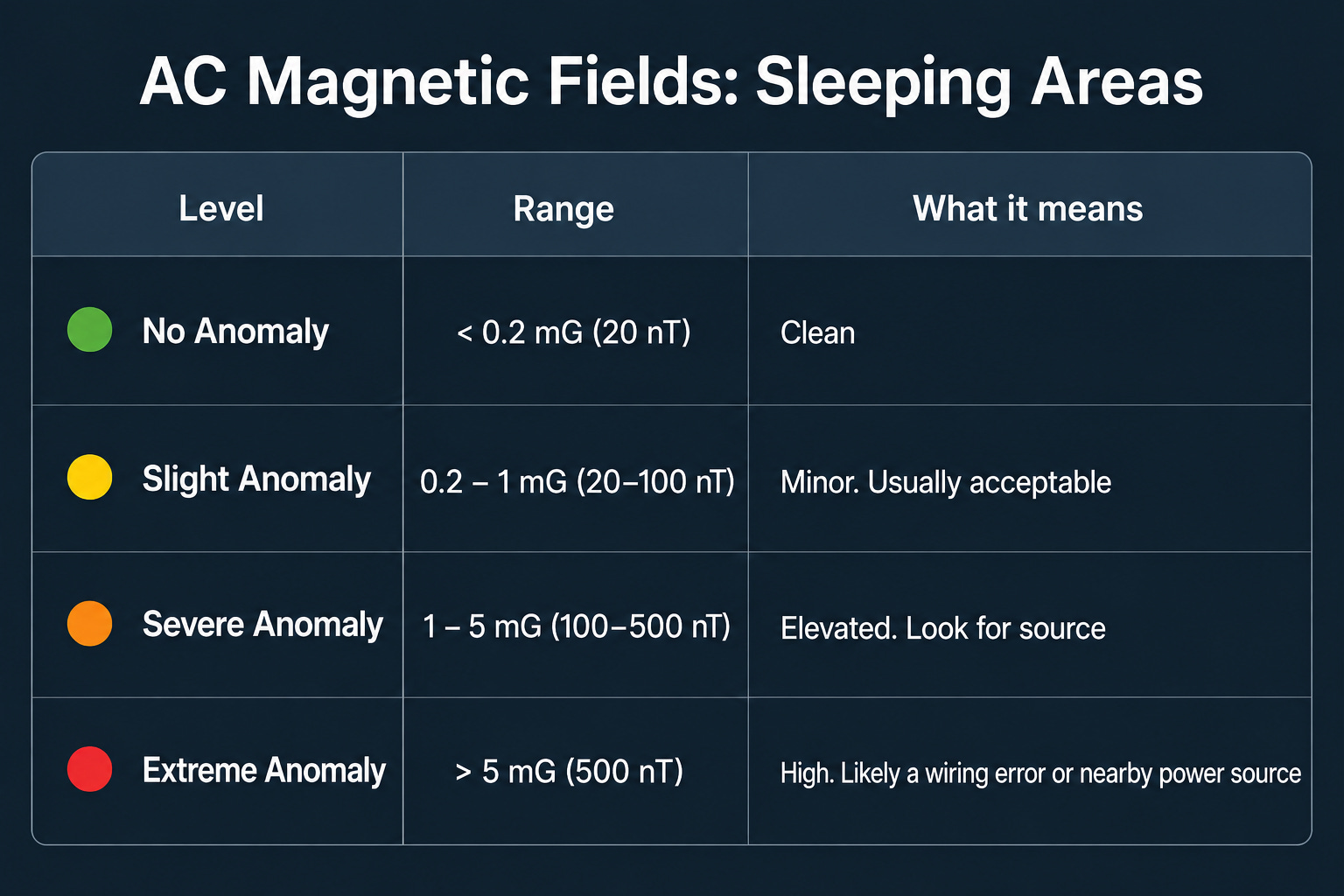
Note: epidemiological studies have consistently found increased childhood leukemia risk at magnetic field exposures above 3-4 mG. That’s well within the “severe anomaly” range. Many bedrooms read 1-3 mG from wiring errors the homeowner has no idea about.
AC Electric Fields: Sleeping Areas
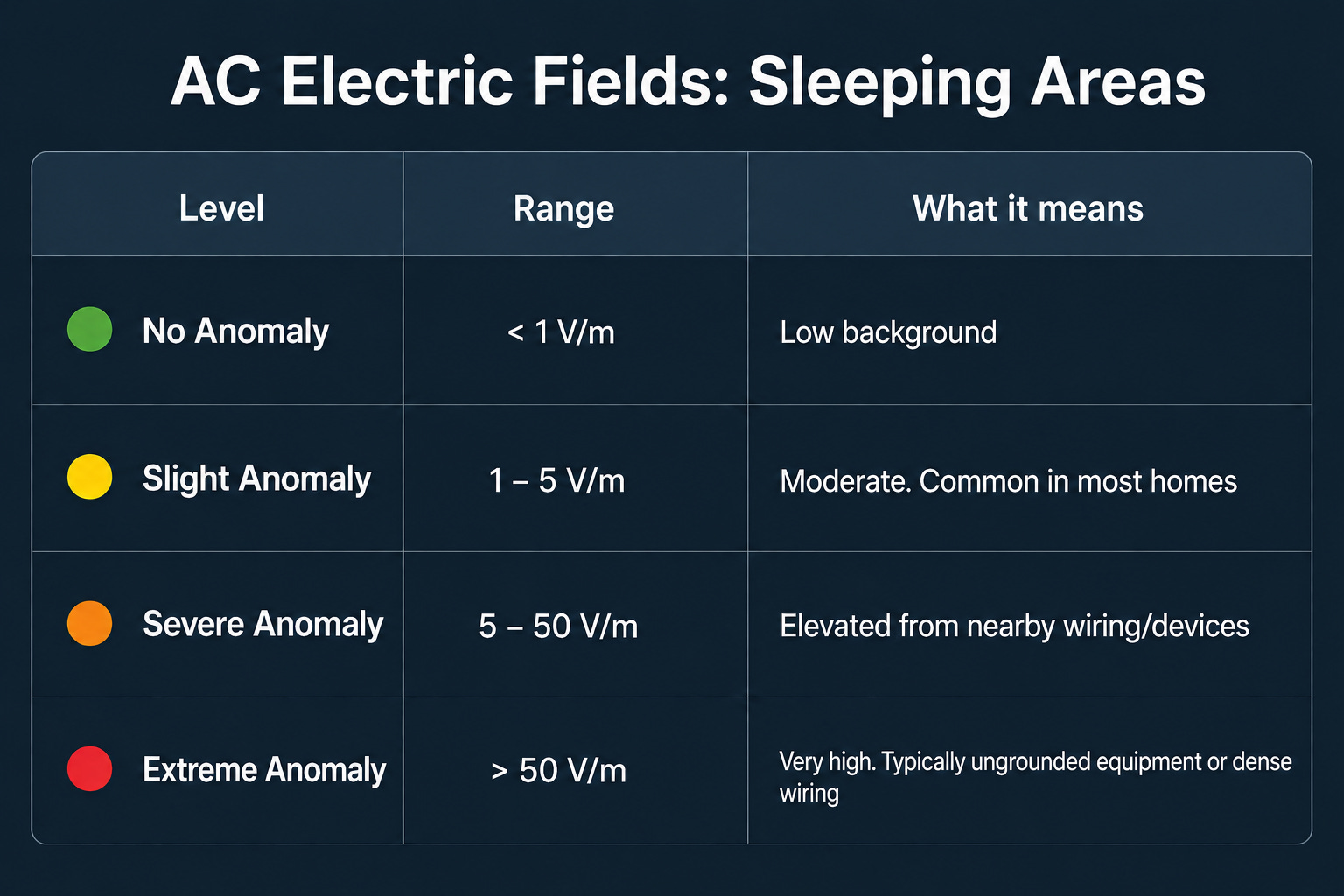
The Building Biology Institute recommends sleeping area body voltage below 100 mV (measured with a body voltage meter while lying in bed). Most people find their readings are well above 2,000 mV before remediation. The primary tool to bring these numbers down is the bedroom kill switch (more on that below).
If using a standalone electric field meter like the ME3830B, aim for approximately 1-1.5 V/m at your bed.
Dirty Electricity / Line EMI
The Building Biology guidelines don’t provide a separate table for dirty electricity specifically, but note that for electromagnetic fields at frequencies above the standard 50/60 Hz, the biological impact may be more significant and the thresholds should be adjusted more conservatively.
Practical targets for your Line EMI Meter:
Under 50 mV: Good. Clean power.
50 – 100 mV: Moderate concern. Look for sources.
Over 100 mV: Elevated. Find and address sources.
Over 500 mV: Severe. Common in homes with solar inverters, certain HVAC systems, or dense LED/CFL lighting.
The Stetzer and Greenwave plug-in meters use slightly different units but publish similar guidance: under 25 = ideal, 25-50 = average, over 50 = undesirable.
Room-by-Room Walkthrough
Here’s where the meters meet reality. Grab your kit and let’s walk through your house.
Bedroom (Start Here)
This is the most important room. You spend roughly eight hours per night here, your body is in repair mode (cellular cleanup, hormone production, immune system restoration), and your defenses against environmental stressors are lower during sleep. If you only optimize one room, make it this one.
What to measure:
1. RF (Safe and Sound Pro II or Classic): Turn the meter on, slowly sweep the room. Check at pillow height on both sides of the bed. Move along each wall. The meter’s audio feature will help you identify sources by their sound signature.
Common culprits:
WiFi router in the bedroom or on the other side of a wall.
Smart meter mounted on the exterior wall behind your headboard (a remarkably common finding).
Cordless DECT phone base station on the nightstand (these transmit continuously, not just during calls).
Bluetooth-enabled alarm clocks, speakers, or sleep trackers.
Baby monitor (a constant RF transmitter sitting feet from a sleeping infant).
Your phone, if it’s not in airplane mode with bluetooth and Wi-Fi turned off.
2. AC Electric Fields (ME3830B, grounded): Hold the grounded meter at mattress level and sweep along the bed surface. Walk along each wall. The wiring inside your walls radiates electric fields 24/7.
Common culprits:
Extension cords or power strips under or behind the bed.
Lamp cords running along the headboard.
Phone/tablet chargers on the nightstand (even if nothing is plugged into them).
The wiring in the walls, floor, and ceiling surrounding your bed.
3. AC Magnetic Fields (ME3830B or UHS2): Sweep the room at bed height. Pay special attention near walls shared with the breaker panel, the kitchen (refrigerator motor), or a bathroom (if it has electric radiant floor heating).
Common culprits:
Wiring errors creating net current (the big one; more on this below).
Clock radio or other motorized device on the nightstand.
Electric radiant floor heating in an adjacent bathroom.
Power lines outside the wall.
4. Dirty Electricity (Line EMI Meter): Plug into each bedroom outlet. Note the readings. Compare with outlets in other rooms.
Common culprits:
Dimmer switches (a major dirty electricity generator).
LED or CFL bulbs with cheap electronic ballasts.
Phone chargers and laptop adapters.
Solar inverter feeding back onto the circuit.
Target readings for your bedroom:
RF: < 10 µW/m² (ideally < 1 µW/m²)
AC Magnetic: < 1 mG (ideally < 0.2 mG)
AC Electric: < 1.5 V/m (body voltage < 100 mV)
Dirty Electricity: < 50 mV
Home Office
After the bedroom, this is typically the highest-exposure room because of device density. You may spend 6-10 hours here daily if you work from home.
What to measure:
RF: WiFi router (if hardwired ethernet isn’t your setup yet), Bluetooth keyboard/mouse/headphones, wireless printer. Check the meter at your desk position where you sit for hours.
AC Electric Fields: Ungrounded laptop or monitor. This is a very common finding: if your laptop charger has a two-prong plug (no ground pin), the laptop radiates significant electric fields into your hands and body. A grounded power cord can eliminate this.
AC Magnetic Fields: Check around the back of your monitor, near power adapters, and at desk level. Transformers and power bricks are common magnetic field sources.
Dirty Electricity: Check outlets powering your computer setup. SMPS (switching mode power supplies) in laptop chargers are significant dirty electricity generators.
Quick wins:
Switch from WiFi to ethernet. USB ethernet adapters are $15-20.
Replace Bluetooth peripherals with wired.
Ground your laptop (3-prong power cord).
Move transformers/power bricks away from your body. A couple feet of distance makes an enormous difference with magnetic fields (they drop off rapidly with distance following the inverse-square law).
Kitchen
Most people don’t linger in the kitchen for eight hours, so it’s a lower priority than bedroom and office. But it’s worth checking because some kitchen appliances produce surprisingly high readings.
Key items to check:
- Microwave oven: Can produce very high RF readings while running (check with your RF meter during operation; stand several feet away). Zero RF when off. The question is how much leaks through the shielded door. Older microwaves leak more, but every microwave I’ve ever tested registered off the scale.
- Refrigerator motor: Produces a magnetic field that radiates several feet. If your fridge shares a wall with a bedroom, check the bedroom side.
- Induction cooktop: Produces very high AC magnetic fields during operation. If you use one, the Building Biology recommendation is to stand at arm’s length when possible, and check readings at waist height.
- Smart appliances: Many modern refrigerators, ovens, and dishwashers have WiFi modules transmitting continuously. Check with your RF meter.
Kids’ Rooms
This section matters more than most people realize.
Peer-reviewed research has consistently found that children absorb significantly more RF radiation than adults. A 2014 review in the Journal of Microscopy and Ultrastructure compiled the evidence: a 1996 study found RF penetrated proportionally deeper into children’s brains. A 2008 French Telecom study found children’s brain tissue absorbed roughly 2x more microwave radiation than adults. A 2009 study found CNS absorption was “significantly larger (~2x)” because the RF source is closer to the brain (thinner skull) and skin and bone layers are thinner. Most striking: bone marrow exposure was approximately 10x higher in children than adults.
A 2018 study in Environmental Research (Fernandez et al.) confirmed that compared with adult models, children experience two- to three-fold higher RF doses to localized brain areas from a cell phone positioned next to the ear, and to the eyes and frontal lobe during screen use.
These aren’t fringe claims. This is published in major peer-reviewed journals and the findings are consistent across multiple independent research groups.
What this means practically:
Apply the Building Biology guidelines more conservatively for kids’ rooms. If “slight anomaly” (0.1-10 µW/m²) is acceptable for an adult sleeping area, aim for “no anomaly” (< 0.1 µW/m²) in a child’s room if at all possible.
Common sources in kids’ rooms:
Baby monitors. These are continuous RF transmitters, usually placed within a few feet of a sleeping infant. Wired video monitors exist and are the better choice. At minimum, place any wireless monitor as far from the crib as possible
Tablets and phones. Children holding these devices absorb 2-3x more RF into their brains than adults. Airplane mode when possible. Download content before handing it over. Use wired headphones
Gaming consoles. WiFi-connected consoles transmit continuously. Ethernet connection is better
Bluetooth toys. Many modern toys have Bluetooth connectivity for app integration. They transmit RF at close range to a developing brain
Breaker Panel Area
The breaker panel (electrical service panel) is typically the highest magnetic field area in your house. This is normal. It’s where all the current in your home converges.
The concern isn’t the panel itself, but whether a bedroom, office, or living space shares a wall with it. Magnetic fields penetrate walls easily. If your child’s bed is on the other side of the wall from your breaker panel, move the bed or take magnetic field readings to see how far the field extends.
Smart meters are typically mounted on the exterior wall near the breaker panel. They transmit RF pulses throughout the day (some models thousands of times daily). Check the corresponding interior wall with your RF meter. If a bedroom is on the other side of that wall, you have a problem.
Smart meter opt-out: Most states offer some form of smart meter opt-out program, though the process and fees vary widely. Some utilities replace it with a traditional analog meter; others offer a “non-transmitting” digital meter (RF transmitter disabled). Fees can range from nothing to a one-time charge of $75-250, plus monthly fees of $10-75 in some areas. Contact your utility and ask for their opt-out procedure. It’s worth doing, especially if the meter is near sleeping areas.
Common Findings and Easy Fixes
After measuring dozens of homes, certain patterns repeat constantly. Here are the most common findings and what to do about each one.
Wiring Error Creating Elevated Magnetic Fields
The finding: You’re sweeping your bedroom with the gaussmeter and getting readings of 2-5 mG or higher in areas that should be clean. The field doesn’t change when you turn off devices. It may be strongest along one wall or in a specific area.
What’s happening: Somewhere in your house, an electrician (possibly decades ago) made a wiring error that creates what’s called a “net current.” In properly wired circuits, the current flowing out on the hot wire and returning on the neutral wire run alongside each other, and their magnetic fields cancel out. When neutrals are improperly bonded, or current returns on a path other than the paired neutral conductor, the cancellation fails and you get elevated magnetic fields radiating through the house.
The fix: A licensed electrician can identify and correct the wiring error. This is typically a $100-300 fix and the results are permanent. If your readings are significantly above 1 mG in sleeping areas, this is worth investigating. The cost of the electrician’s visit may pay for itself many times over in health value.
Wi-Fi Router in or Near the Bedroom
The finding: High RF readings (hundreds to thousands of µW/m²) that the meter’s audio identifies as WiFi.
The fix: Move the router as far from bedrooms as possible. Better yet, switch to wired ethernet throughout your home and disable WiFi entirely (or use a timer to shut it off at night). USB ethernet adapters for laptops cost $15-20. Mesh WiFi systems can often be connected via ethernet backhaul. The single biggest RF reduction most people can make is getting the WiFi router out of the bedroom area.
Extension Cord or Power Strip Under the Bed
The finding: Elevated electric fields right at mattress level that drop when you move toward the center of the room.
The fix: Relocate the power strip or extension cord. Even unplugging it from the wall eliminates the electric field (because it’s no longer carrying voltage). Simply turning devices off does not eliminate AC electric fields from the cord itself. The cord radiates as long as it’s plugged in.
Cordless DECT Phone
The finding: Constant high RF reading from the base station, even when nobody is on a call.
The fix: Replace with a corded phone. DECT phone base stations are among the strongest continuous RF sources in a typical home. They transmit 24/7, not just during calls. If you must keep a cordless, at minimum move the base station away from any room where people spend extended time.
Smart Meter on Bedroom Wall
The finding: RF spikes on the interior wall corresponding to where the smart meter is mounted outside. These may come in bursts (the meter transmits data to the utility in pulses).
The fix: Request an opt-out from your utility and have the smart meter replaced with an analog or non-transmitting meter. If opt-out isn’t available or the fees are prohibitive, consider shielding the interior wall with RF-blocking material (SLT sells shielding paint and fabric). Moving the bed away from that wall also helps. When using shielding fabric, it’s often helpful to fold the fabric several times - more layers helps attenuate the signal more. You can verify this with your RF meter.
Dimmer Switches Creating Dirty Electricity
The finding: High Line EMI readings on circuits controlled by dimmer switches. Standard dimmers chop the AC waveform to reduce voltage, creating high-frequency transients.
The fix: Replace dimmer switches with standard on/off switches. This is a quick, cheap improvement. If you want variable lighting, some “smart” dimmers produce less dirty electricity, but test with your Line EMI Meter to verify.
Electric Blanket
The finding: Extremely high electric field readings at mattress level when the blanket is plugged in, even if it’s turned off.
The fix: If you use an electric blanket, preheat the bed, then unplug it before getting in. Turning it off is not enough. As long as the cord is connected to a live outlet, the blanket’s wiring radiates electric fields into your body all night. Unplugging completely eliminates this.
Baby Monitor
The finding: Strong, continuous RF signal right next to the crib.
The fix: Switch to a wired video monitor (they exist, and they don’t transmit RF). If you keep a wireless monitor, place it as far from the crib as possible while still being functional. Never right next to the baby’s head.
We always just keep our babies in our bedroom. A dedicated room is often counterproductive to night-time breastfeeding, unless your plan is to ignore them while they’re crying, which you shouldn’t be doing.
The Bedroom Kill Switch: The Single Highest-Impact Fix
If there’s one change that gives the most dramatic improvement to your sleeping environment, it’s this one.
A remote cutoff switch (sometimes called a demand switch or kill switch) is a device installed next to your circuit breaker panel that physically disconnects the electrical wiring to your bedroom circuits at night. You press a button on a remote control at your bedside. The switch disconnects the hot wire (and in the better units, the neutral wire too) of every circuit that affects your bedroom. The voltage disappears from the wires in your walls, floor, and ceiling. The AC electric fields drop to near zero. The dirty electricity on those circuits disappears.
In the morning, you press the button again. Everything comes back on.
The effect is dramatic. EMF consultant Jeromy Johnson reports that many clients say it “feels like camping” once the switch is activated. No electric fields, no EMI from the wiring, just quiet. The body’s nighttime repair processes happen without electromagnetic interference from the building’s wiring.
How It Works
The switch unit installs on the wall next to your breaker panel (by a licensed electrician). Your bedroom circuits are routed through the switch’s contactors. A wireless or wired remote at your bedside communicates with the unit. When you activate it, the contactors physically open, disconnecting the circuits. Your breaker panel is untouched and fully functional, the disconnect happens in the separate switch unit.
This is important: you don’t want to manually flip your breakers every night. Breakers are designed for occasional use and can wear out after 100-200 on/off cycles, at which point they may fail to trip during an actual overload. That’s a fire hazard. The remote cutoff switch is purpose-built for daily cycling and doesn’t stress your breakers at all.
The NP vs. PO Distinction
There are two types of remote switches:
PO (Power Only): Disconnects only the hot wire. Reduces AC electric fields significantly, but the neutral wire remains connected to your home’s wiring network (and the neighborhood grid). Any dirty electricity (EMI) riding on the neutral still radiates into your bedroom.
NP (Neutral + Power): Disconnects both the hot and neutral wires. Eliminates electric fields AND most dirty electricity. This is the recommended option, especially if you’re electrically sensitive or want the most thorough disconnection. An NP switch is the closest you can get to being completely disconnected from the local power grid while still having power available at the press of a button.
Products
Two main options in North America:
EMFSafe Switch (Oregon): UL-approved, available in NP and PO configurations, 2-8 circuit NP or 4-16 circuit PO models. The NP version is what most EMF consultants recommend. They also offer a PQFilter whole-house dirty electricity filter that can be installed alongside the switch.
Safe Living Technologies Remote Cut Off Switch Kit (Toronto): Long-established product from one of the most trusted names in the EMF space.
Installation Process
1. Map your circuits. You need to figure out which breakers control the wiring in and around your bedroom. This takes a helper: one person at the breaker panel turning off breakers one at a time, another in the bedroom with an electric field meter (or body voltage meter) watching for the reading to drop. Typically 2-4 circuits affect a bedroom, but it can be more depending on how your house was wired. Don’t forget circuits for rooms above, below, and beside the bedroom, as wiring in adjacent spaces can radiate electric fields through shared walls
2. Order the right size switch. Add up the total circuits across all bedrooms you want to cover. The switches come in various sizes (2, 4, 6, 8+ circuits)
3. Hire a licensed electrician. Installation typically takes 1-2 hours. The switch comes in a ready-made enclosure that’s straightforward for an electrician to work with. Make sure the equipment is UL-approved so your homeowner’s insurance isn’t affected
4. Test after installation. Use your electric field meter to verify that the fields in your bedroom actually drop when the switch is activated. You should see readings drop to approximately 1 V/m or body voltage below 100 mV
Can Multiple Bedrooms Get Their Own Zones?
Yes. Most switch systems allow for multiple zones. You can turn off the kids’ bedroom circuits at 8:00 PM and keep your own circuits live until you go to bed later. Each zone can have its own remote.
What NOT to Buy
Let’s talk about what doesn’t work, so you can save your money for what does.
Cheap Amazon “EMF Detectors” ($20-50)
The multifunction EMF meters flooding Amazon, AliExpress, and eBay for under $50 are, broadly speaking, not accurate enough to trust. The RF measurement capabilities are particularly poor on combination meters. They’ll give you false positives, miss real exposures, and create a distorted picture of your actual situation that’s potentially worse than measuring nothing at all.
Jeromy Johnson at EMF Analysis tested many of these devices and found consistent issues with accuracy and quality, especially the multi-purpose meters attempting to measure all three field types in one instrument.
The TriField TF2 (~$170) is a step up and can be considered a learning tool, but it still lacks the sensitivity, frequency range, and audio features of the dedicated meters recommended above. It’s better than the $30 Amazon specials, but it’s not going to catch everything you need to catch. Especially for RF, where digital signals pulse in microsecond bursts that cheap meters can’t properly capture.
A Word on “EMF Protection” Products
The moment you start measuring, you will also start seeing the ads: stickers that “harmonize” your phone’s radiation, pendants that “protect your biofield,” plugs that “restructure” the EMF in your home, little boxes that generate a “protective field.” There is an entire industry built on EMF fear, and almost all of it is snake oil. Some of it quietly makes things worse.
The meter you just learned to use is also the tool that exposes the grift. There is exactly one question that separates real protection from a talisman: does the reading drop after you install it? Take a measurement, add the product, measure again. If the number doesn’t fall, the product did nothing, no matter what the packaging says.
That is worth more than one sentence, because the scams are clever and the real danger is not the wasted money but the false confidence that makes people careless. Part 3 will take the whole snake oil aisle apart: the pendants, the stickers, the scalar and tachyon plugs, the devices that trade one kind of EMF for another, and how to spot the tell every time.
The key point is that electromagnetic fields are real fields that can be explained with physics and measured with consumer devices, and attenuating them (for instance with RF shielding) has scientifically explainable (and measurable) effects. If there’s no scientific explanation for how a “talisman” protects you from EMF, it’s almost certainly a scam.
What You’ll Probably Discover
Here’s what I want you to know before you start: almost everyone finds surprises. The meter makes visible what was invisible. That’s the whole point.
You’ll probably find 2-3 sources you had no idea about. A wiring error creating a magnetic field hot spot. A smart meter dumping RF into your kid’s bedroom. An extension cord under the bed radiating electric fields into your body all night. A dimmer switch flooding your bedroom circuit with dirty electricity.
And you’ll find that fixing most of these problems is straightforward. Move a cord. Replace a switch. Plug in an ethernet cable. Call an electrician. Press a button at bedtime.
The Building Biology approach isn’t about perfection. “No anomaly” levels are effectively impossible in a modern home. The goal is reduction. Every source you identify and address is a step toward a cleaner electromagnetic environment. Your bedroom doesn’t have to be an anechoic chamber. It just has to be meaningfully better than the unexamined default.
Start with the bedroom. Get that right. Then work outward. The meters will guide you. The numbers don’t lie, and once you can see them, the changes are obvious.
In Part 4, we go deep on the biology: the specific cellular mechanism (voltage-gated calcium channels) that explains why these non-thermal fields produce biological effects, and why the “it doesn’t heat you so it can’t hurt you” framework was wrong from the start.
This is Part 2 of the ongoing EMF series from The Liberty Lookout investigating electromagnetic fields, biological mechanisms, and practical steps for protection. Part 1: “The Field You Can’t See” covers the foundation.
Sources
- Building Biology SBM-2024 Evaluation Guidelines: buildingbiology.com
- Create Healthy Homes, Building Biology Standards overview: createhealthyhomes.com
- EMF Analysis, Recommended EMF Meters: emfanalysis.com
- EMF Analysis, Remote EMF Switch installation guide: emfanalysis.com
- EMF Center, Safe and Sound Pro II review: emfcenter.com
- EMFSafe Switch product guide: liveemfsafe.com
- Safe Living Technologies product pages: safelivingtechnologies.com
- Morgan et al. (2014), “Why children absorb more microwave radiation than adults”: ScienceDirect
- Fernandez et al. (2018), “Absorption of wireless radiation in the child versus adult brain and eye”: ScienceDirect
- Gandhi et al. (2012), “Exposure limits: the underestimation of absorbed cell phone radiation, especially in children”: PubMed
- NCSL, Smart Meter Opt-Out Policies: ncsl.org
- BeatEMF, EMF Protection Scams debunking: beatemf.com
- Gigahertz Solutions, SBM-2015 overview: gigahertz-solutions.com
- SLT EMF Exposure Guidelines for Sleeping Areas: safelivingtechnologies.com