

Somewhere in Vermont’s Mad River Valley, on a hillside that conventional farmers would drive past without a second glance, a man is growing rice.
Not metaphorical rice. Actual rice paddies, fed by terraced ponds carved into a slope where winter lows can hit -30°F. The land was overgrazed, clearcut, and abandoned before Ben Falk got his hands on it. Twenty years later, it feeds him.
80% of his calories come from the homestead. His water heats itself by running through a compost pile at 155°F, a gallon per minute. The place generates its own power, produces its own building materials, and grows its own fuel. All on 10 acres that nobody else wanted.
This is Ben Falk’s answer to the question: What does it actually look like when someone stops depending on the system?
From Wasteland to Food Forest
Falk didn’t inherit a working farm. He graduated from the Conway School of Landscape Design in 2005 with a master’s degree in land-use planning and founded Whole Systems Design, a consultancy built on a simple premise: the industrial food system is fragile, and the smart money is on learning to feed yourself.
Before grad school, he’d been working overseas as a teacher and ecological regenerationist. He came back to Vermont, bought a wrecked hillside in Moretown, and started planting.
The numbers are staggering. Falk has planted 8 acres with 2,500 plants spanning 250 different species. Fruit trees, nut trees, berry bushes, vegetables, mushrooms. He raises sheep and keeps ducks and chickens. He runs rice paddies that shouldn’t exist in New England and a nursery business specializing in seaberry (sea buckthorn), a cold-hardy superfood most Americans have never heard of.
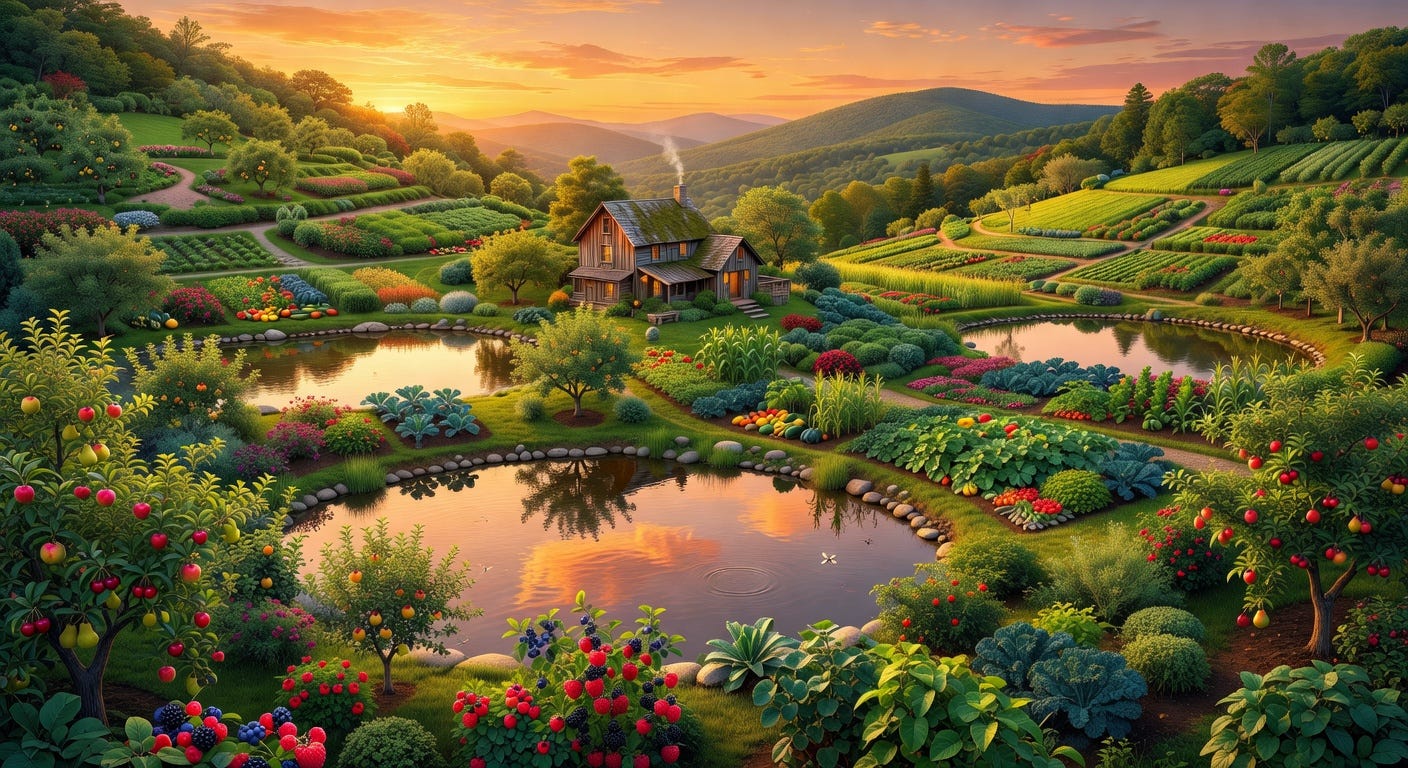
The property is a series of terraced ponds that trickle nutrients downhill through detention basins, building rich soil in the process. Every element does multiple jobs. Water collects, feeds plants, feeds animals, and prevents erosion simultaneously. It’s the opposite of monoculture farming, where you pour chemicals on one crop and hope for the best.
The Hurricane Test
In 2011, Hurricane Irene dumped up to 12 inches of rain on Vermont, causing $750 million in damage. Bridges washed out. Farms flooded. Towns were cut off.
Falk’s property absorbed it.
“Hurricane Irene showed us on our original home site that we could effectively prevent 25 acres of stormwater runoff from contributing to flooding by absorbing that precipitation on less than 10 acres of land,” Falk said in a 2024 interview.
Not only did the system prevent flooding, it captured those floodwaters and their nutrients, enriching the soil and feeding the plants. While neighboring properties dealt with destruction, his land literally got more productive. That’s not luck. That’s design.
The Business of Not Depending on Anyone
Falk isn’t a hermit philosophizing from a cabin. He runs an actual business. Whole Systems Design has conducted more than 750 site development consultations across the U.S. and abroad. He’s designed landscapes for the Island School in the Bahamas and the Hotchkiss School in Connecticut. His work has been profiled in Fast Company, the New York Times, Landscape Architecture Magazine, and CBC Radio.
His book, The Resilient Farm and Homestead (Chelsea Green, 2013), won the American Horticultural Society’s 2014 Book Award. Joel Salatin (who we profiled previously) called it one of the best things he’d read in the self-reliance genre. A revised and expanded edition came out in 2024, covering 20 years of lessons learned.
His income breaks down like this: roughly 50% from consulting and design services, 30% from education (workshops, his permaculture design course, the book), and the rest from lowered living expenses, his nursery, and farm tours.
Why This Matters
Here’s the thing about Falk that makes him different from your average “back to the land” influencer: he’s been doing this for two decades, and he’s honest about what doesn’t work.
His book is full of failures alongside the successes. Techniques that sounded great in theory but fell apart in Vermont’s brutal climate. Trees that died. Systems that needed redesigning. That honesty is worth more than any glossy Instagram feed of farm life, because it means the things that DID work have been tested in the harshest conditions North America can throw at them.
Falk also recommends 5-10 acres as the ideal size for most people seeking self-sufficiency. That’s attainable. You don’t need a sprawling ranch in Texas. You need a few acres, the right design, and time.
And his philosophy cuts deeper than gardening tips. “We need the opposite kind of culture,” he writes in his book. “A people that mean to stay.” In a country where the average American moves 11.7 times in a lifetime, Falk argues that rootlessness is the disease and commitment to a place is the cure. You can’t build a food forest if you’re leaving in three years. You can’t develop soil that feeds your grandchildren if you’re chasing the next opportunity in the next city.
The Bigger Picture
Falk founded Whole Systems Design “as a land-based response to biological and cultural extinction and the increasing separation between people and elemental things.”
He designs for “a future of climate instability, failing bureaucratic systems, and deepening economic insolvency.” Those aren’t hypotheticals. They’re the world we live in right now.
What Falk proved on his 10 acres in Vermont is that self-sufficiency doesn’t require warm weather, inherited wealth, or government subsidies. It requires learning to read the land, building systems that work with nature instead of against it, and staying put long enough to see the trees you planted actually bear fruit.
The industrial food system ships lettuce 2,000 miles in a refrigerated truck. Ben Falk walks out his door and picks dinner. Which one sounds more resilient to you?
Learn more:
- Whole Systems Design: Falk’s consultancy, courses, and farm tours
- The Resilient Farm and Homestead, Revised & Expanded Edition (Chelsea Green, 2024)
- TEDx Talk: Homestead Resiliency, Food Systems Regeneration
- CBC Radio: Rural Futures interview
- Permaculture Apprentice: 10-Acre Farmstead Profile
Sources:
1. Permaculture Apprentice, “Whole Systems Design, Ben Falk” (2020): https://permacultureapprentice.com/whole-systems-design-ben-falk-10-acre-farmstead-10-years-of-establishment/
2. Conway School Alumni, “Ben Falk ‘05”: https://csld.edu/alumni/ben-falk-05/
3. LandVest Blog, “Permaculture and Climate Resilience: Ben Falk’s Vision for Vermont’s Future” (2024): https://landvest.blog/2024/07/permaculture-and-climate-resilience-ben-falks-vision-for-vermonts-future/
4. Whole Systems Design, “About Us”: https://www.wholesystemsdesign.com/about-us
5. Chelsea Green Publishing, The Resilient Farm and Homestead, Revised & Expanded Edition: https://www.chelseagreen.com/product/the-resilient-farm-and-homestead-revised-and-expanded-edition/
6. Wikipedia, “Ben Falk (permaculturalist)”: https://en.wikipedia.org/wiki/Ben_Falk_%28permaculturalist%29
7. American Horticultural Society, Book Award Winners: https://ahsgardening.org/wp-content/uploads/2022/03/Chronological-list-of-award-winners.pdf
8. Institute of Natural Law, “The Radical Act of Staying” (2024):
