

How Joel Salatin turned a worn-out Virginia hillside into America’s most famous farm, one bureaucrat at a time.
In 1982, Joel Salatin quit his newspaper job, moved into his parents’ attic, and started farming full-time. He drove a $50 car. He and his wife Teresa subsisted on $300 a month. They had enough savings to survive one year without income, and fully expected to burn through it.
They didn’t. Instead, they built Polyface Farm into a $5 million-a-year operation that feeds 6,000 families, supplies 30 restaurants, employs 20 full-time staff, and has never taken a dollar in government subsidies. No crop insurance. No USDA grants. No begging at the trough. Debt-free.
TIME magazine called him “the world’s most innovative farmer.” The USDA would probably prefer a different word.
The Gullied Rockpile
The Salatin family’s route to Virginia started in Venezuela. Joel’s father, William, used savings from his accounting career to buy a 1,000-acre farm there. The family raised chickens in what Joel later described as “a totally free market, without government regulations.” They quickly cornered the local poultry market.
Then the 1958 election brought a new government that decided to redistribute the land. The Salatins fled. They returned to the United States on Easter Sunday, 1961.
William wanted to stay close to the Venezuelan embassy in D.C. in case things settled down. They didn’t. The family looked at properties from Pennsylvania to North Carolina and settled on a 550-acre farm in Swoope, Virginia. The Beef Site later reported it was called “the most worn-out, eroded and abused farm in the area.” It was cheap. That was the point.
Every agricultural expert, public and private, told the family the same thing: graze the forest, plant corn, borrow money, build silos, buy chemical fertilizers. William saw it as a trap. His own father had been a charter subscriber to J.I. Rodale’s Organic Gardening and Farming Magazine back when “organic” meant you were either a hippie or insane. The Salatins chose a different path.
Joel started selling rabbits, eggs, butter, and chicken at the Staunton Curb Market when he was about 14. Every Saturday, he woke up at 4 a.m. After graduating from Bob Jones University with an English degree in 1979, he married Teresa and returned to the local newspaper as a feature writer. The farm waited.
Then one day, Joel confronted his father on the farm lane. A realtor had been talking about selling the place and buying triple the acreage in Arkansas. Joel told his dad he wanted the farm for life. William promised never to consider selling again. He kept that promise.
By September 1982, Joel had saved enough for one year of runway and left the newspaper. The question that consumed him: how do you make a living on 90 acres of open pasture in the Shenandoah Valley?
The $100 Chicken House vs. the $400,000 Chicken House
The answer turned out to be elegantly simple, and it made the conventional agriculture establishment furious.
Salatin started with 10 beef cattle. He sold six the first year as freezer beef to friends and neighbors. Grossed $20,000. The next year, he added chickens.
Here’s where it gets fun. If you want to raise chicken for Tyson, you need a $400,000 chicken house. Salatin had 280 chickens and a $100 portable shelter he could drag across the pasture. No climate control. No automated feeding systems. No debt service. Just a box with chickens in it, moved to fresh grass every day.
The portable shelters came from old rabbit runs the family had built years earlier. They pulled them out of the barn rafters, retrofitted them, and accidentally invented what became the pastured poultry movement.
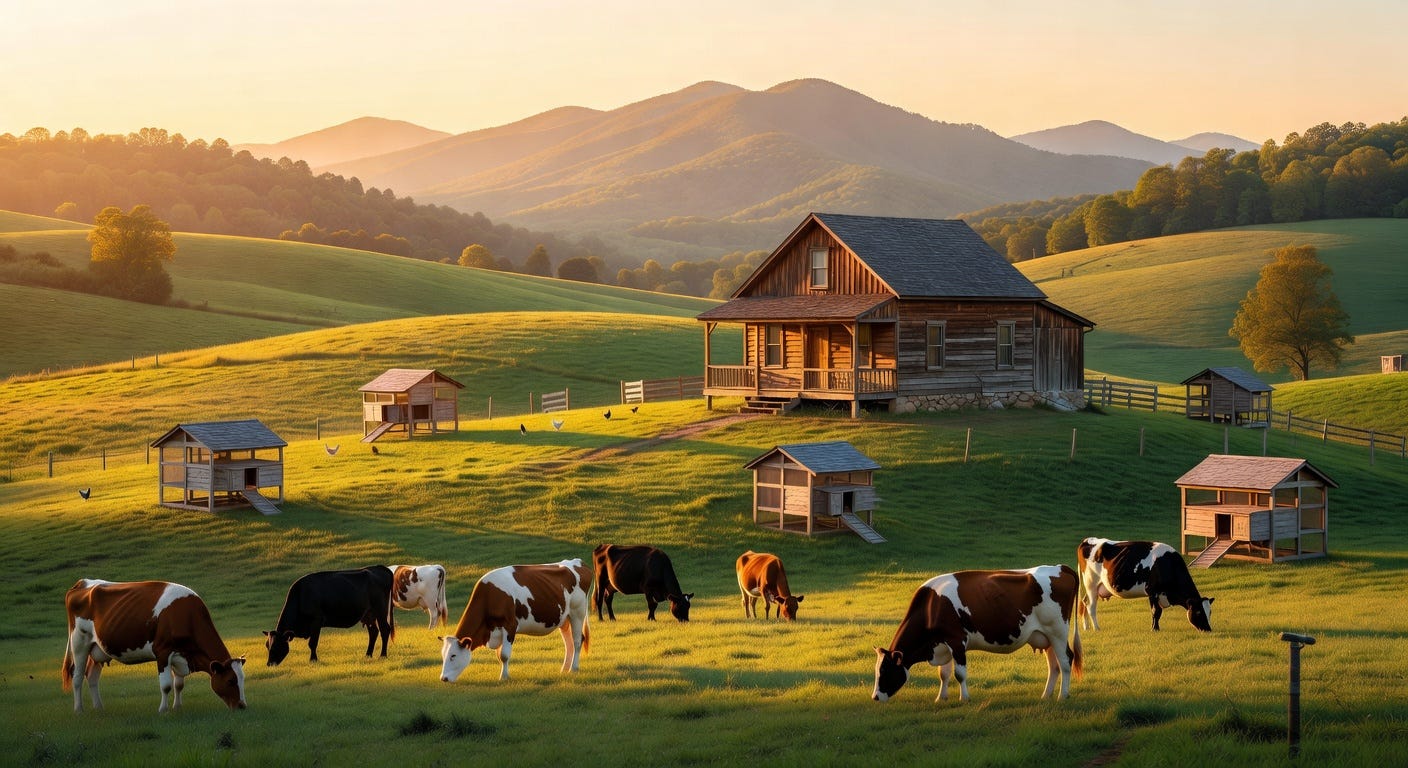
The system is almost comically logical. Cows graze a section of pasture, then move to the next. Chickens in portable coops follow three to four days later, scratching through the cow manure to eat protein-rich fly larvae. While doing this, the chickens spread the manure evenly and add their own droppings, fertilizing the field. The grass grows back thicker than before. No chemical fertilizer. No pesticides. No vet bills (Salatin says he calls a vet maybe once every three years). No seed has been planted on the farm in over fifty years.
The result? Polyface runs at a capital intensity of $0.50 per $1 of gross sales. The average American farm needs $4 in depreciable capital (buildings, machinery, infrastructure) to produce that same dollar. That’s eight times the capital intensity, and Salatin invests the savings in people instead of equipment.
Today the farm manages 2,000 acres (owned and leased), running roughly 1,000 head of cattle, 800 hogs, 25,000 broilers, 4,000 laying hens, and 2,000 turkeys. Polyface sells direct through three channels: 40% to restaurants, 40% through metropolitan buying clubs, and 20% through its on-farm retail store. Their buying club has 6,000 members who place orders online and pick up from drop-off locations within a few hours’ drive.
Zero advertising budget. The food sells itself.
The Bureaucrat Problem
If Polyface Farm were just a feel-good story about pasture management, it would be interesting. But what sets Salatin apart is what he did when the government showed up.
In 2007, he published a book titled Everything I Want To Do Is Illegal: War Stories from the Local Food Front. It’s exactly what it sounds like. Chapter after chapter of absurd regulatory encounters where a farmer growing clean food on his own land runs face-first into a bureaucracy designed for industrial meatpacking plants.
Want to sell raw milk from your own cows to your neighbor? Illegal. Want to process your own chickens on-farm and sell them at the farmers’ market? Depends on your state, how many birds, and whether six different agencies agree. Want to let your kids work on the family farm? Child labor regulations designed for coal mines and textile mills now apply.
His response to all of it: “Just leave me alone.”
But Salatin didn’t just complain. He routed around. Every regulatory wall became a puzzle to solve without asking for permission. On-farm processing under poultry exemptions. Direct-to-consumer sales that bypass wholesale regulations. Buying clubs structured so customers come to designated pickup points rather than Salatin shipping across state lines. When the local slaughterhouse faced closure (which would have killed his beef and pork processing), Polyface bought a 40% stake to keep it alive.
And here’s the detail that really drives the USDA crazy: Polyface has an open-door policy. “Anyone is welcome to visit the farm anytime. No trade secrets, no locked doors, every corner is camera-accessible.” Compare that to the factory farms the USDA actually approves of, the ones that lobbied for ag-gag laws making it a crime to photograph their operations.
The farm that the government says is too dangerous to sell you dinner invites you to walk through anytime you want. The farms the government rubber-stamps will have you arrested for taking pictures.
The Bigger Picture
Salatin doesn’t just farm. He writes (17+ books), lectures at places ranging from UC Berkeley to the Libertarian National Convention, and runs an apprenticeship program that trains the next generation of farmers to replicate the Polyface model. Michael Pollan’s 2006 bestseller The Omnivore’s Dilemma featured Polyface prominently. The Oscar-nominated documentary Food, Inc. put his face on screens worldwide.
He calls his philosophy a “food emancipation proclamation”:
“If two consenting adults want to get together voluntarily and exercise freedom of choice on the fuel for their microbiome, we should be able to do that without a bureaucrat involved.”
And:
“We’ve got choice in the bedroom, choice in the bathroom, choice in the womb, but no choice in the kitchen.”
He spoke at the 2020 Libertarian National Convention. He’s a self-described Ron Paul guy who wants to close foreign military bases and shrink the federal government to a tenth of its size. When the USDA hands out billions in relief payments to commodity growers, Salatin’s take is simple: “Shut it all down. Shut it all down and I think we can compete very well.”
He homeschooled his kids in the early 1980s, when the government was still sending truant officers to homes to threaten parents who dared educate their own children. Four generations of his family now live and work on the farm.
The conventional agriculture world has tried to dismiss him as a crank. His neighbors’ nickname for his methods was “bioterrorist.” Mother Earth News, a magazine he grew up reading, severed its relationship with him in 2020 over “a significant ideological impasse.” The USDA has never certified Polyface as organic, because Salatin refuses to participate in the certification system at all. He calls his food “beyond organic.”
None of it slowed him down.
The Pattern
From attic apartment to $5 million farm. From $50 car to TIME’s “most innovative farmer.” From 10 cattle to 6,000 families fed. All without a single government grant, subsidy, or loan guarantee. All while regulators insisted that what he was doing was dangerous, unorthodox, or flatly illegal.
Joel Salatin didn’t petition the USDA for permission to farm differently. He didn’t lobby Congress for regulatory carve-outs. He didn’t file public comments or wait for the system to reform itself.
He built a portable shelter out of scrap wood for 280 chickens, sold the meat to his neighbors, and kept going.
As he told one interviewer: “It’s one reason why I have such a hard time being political. The whole thing just seems so shallow. I’d rather milk cows and sell milk. Just leave me alone.”
Happy birthday, lunatic farmer. Here’s to another year of doing everything they say you can’t.
Sources
1. Progressive Farmer (DTN): “Virginia Farmer Turns $300-a-Month Subsistence Farm Into $2-Million-a-Year Organic Business” (March 2015) https://www.dtnpf.com/agriculture/web/ag/news/farm-life/article/2015/03/16/virginia-farmer-turns-300-a-month-2
2. Plain Values: “Beginnings: Polyface Farms + Joel Salatin” by Joel Salatin https://plainvalues.com/beginnings-polyfacefarms-joelsalatin/
3. The Beef Site: “Joel Salatin of Polyface Farms Reveals the Secrets of ‘Beyond Organic’ Farming” (Nov 2016) https://www.thebeefsite.com/articles/4359/joel-salatin-of-polyface-farms-reveals-the-secrets-of-beyond-organic-farming/
4. Smart Cities Dive / Seedstock: “Life as a Lunatic: Polyface Farms’ Joel Salatin” https://www.smartcitiesdive.com/ex/sustainablecitiescollective/life-lunatic-polyface-farms-joel-salatin-talks-seedstock/1005681/
5. Ambrook: “If I Had 30 Minutes With Trump” (Joel Salatin interview, 2025) https://ambrook.com/offrange/perspective/the-lunatic-farmer-speaks
6. Wikipedia: Joel Salatin https://en.wikipedia.org/wiki/Joel_Salatin
7. Wikipedia: Polyface Farm https://en.wikipedia.org/wiki/Polyface_Farm
8. Polyface Farm website (Guiding Principles)
https://polyfacefarm.com/
9. Chelsea Green Publishing: Everything I Want To Do Is Illegal by Joel Salatin (2007) https://www.chelseagreen.com/product/everything-i-want-to-do-is-illegal/
10. LewRockwell: “Joel Salatin: The Ron Paul of Family Farmers” (July 2021) https://www.lewrockwell.com/2021/07/ginny-garner/joel-salatin-the-ron-paul-of-family-farmers/
11. Indie Farmer: Joel Salatin Interview (Dec 2016) https://indiefarmer.com/2016/12/10/joel-salatin-interview/
12. Homesteaders of America: Podcast Episode 46 with Joel Salatin https://homesteadersofamerica.com/e46-government-overreach-local-action-and-real-food-defense-joel-salatin-of-polyface-farms/
13. Niche Meat Processor Assistance Network: Poultry Processing Regulations and Exemptions https://www.nichemeatprocessing.org/poultry-processing-regulations-and-exemptions/
14. YouTube: Joel Salatin at the Libertarian National Convention 2020
He's not a lunatic. He's also far more intelligent than you give him credit for, despite the praise. That portable chicken shed is extremely cleverly designed, not some ramshackle affair. He also does pork pasturing, something deemed nearly impossible before. If anyone is interested in raising animals, he has many masterclass videos online for free, of course.
Awesome story. His regulatory recurring nightmare is like that depicted in “Clarkson’s Farm” on Amazon Prime. It’s tax time, so I can really relate to the sentiment of “just leave me alone.”