

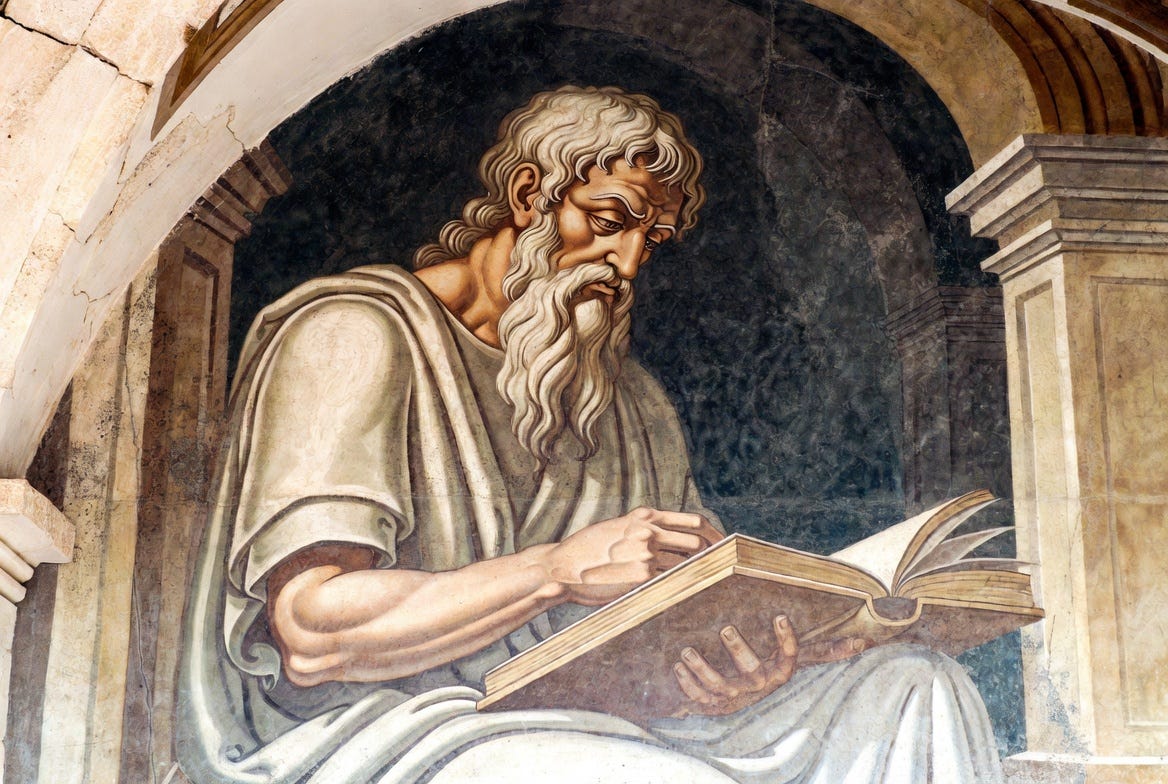
Is anyone else tired of the, “you’re not educated enough if you can’t read Greek and Latin,” posts that seem to be floating around Substack? I see them all the time now.
Underpinning every single one of them is a not-so-subtle undercurrent of “you suck”.
Here’s what I think is happening: a handful of people spent years of their childhood learning Greek and Latin. They were told this made them well-educated and smart. They then went out into the real world and realized that… nobody cares. Not even other well-educated and smart people.
What used to be a badge of intelligence in the 19th century is just not relevant anymore. Just like a college degree is no longer a meaningful badge.
These kids, who are now adults writing on Substack, were prepared for a world that doesn’t exist anymore. Which is sad. Sad for them, and sad for the world, because these are smart people who put in the hours, they were just rowing in the wrong direction.
So now they’re mad. They’re mad that their schools or parents subjected them to years of learning largely pointless knowledge at the expense of learning something more valuable, or - you know - just being a kid and getting to play, which by the way is also valuable.
Everything has an opportunity cost, folks. There’s only 24 hours in a given day. If you’re learning Latin and Greek, you’re not learning French, Spanish, Algebra, budgeting, gardening, sewing, carpentry, music, how to run a business, or any number of other things. Your time and energy are finite.
So what do they do? Instead of placing the blame where it ought to go, they go on social media and try to virtue signal with their pretentious attitude, trying to make themselves feel better. It’s not that they wasted years of their childhood learning useless skills - no - it’s that you, all of you peasants out there - are simply not educated enough.
Self-knowledge is important, and some of these folks seem to be missing it.
Now - if you actually use Greek and Latin for some reason in your real life, perhaps you’re a translator, then great - that’s not a useless skill for you. But for the vast majority of people who learned it - it was a waste of time. Just because “classical” education made this part of the curriculum two hundred years ago, doesn’t mean it’s still valuable today.
I can read a perfectly reasonable translation of Plato’s “Republic”, and figure out that he was a big government statist who wanted to lord of everyone else, without having to learn Greek first. There’s two points I’m trying to make here:
Reading translations is perfectly fine. Yes, you might miss some nuance, but it’s probably not worth years of effort learning a dead language to get it. Besides, most people who learned Latin and Greek as kids don’t actually read original texts as adults, and
Most of the ancient philosophers were… well, let’s just say, not very good. Philosophical thought has improved over the centuries and millennia. That’s not to say that modern philosophers are all good either. Every age has a small minority of clear thinkers and a large majority of charlatans. But I’d much rather read Rothbard than Plato. There seems to be a certain worship of Ancient Greeks that seems to entirely miss the fact that their society had slaves and enshrined homosexuality and pedophilia. Sure, they also built awesome things and were very advanced for their time, but most classical education seems to skip right over the unsavory parts.
You could say that learning Latin and Greek builds discipline, but so does any difficult task. Learning French builds discipline. Building a house builds discipline. Gardening builds discipline.
Moreover, there’s vastly more to learn now than there was two centuries ago. Physics, biology, and chemistry are deeper rabbit holes than ever before. Engineering, mathematics, computer science. What about history? You could spend your entire life learning about history (and there’s a lot of lessons here that are useful to us today) and still only learn a tiny fraction. The amount we’ve learned about horticulture in just the last few decades could fill an entire library.
A serious educator in 2026 would look at the vastly expanded sum of human knowledge and have to make serious prioritization decisions on what could benefit the next generation today, and I truly struggle to see how Latin and Greek would make that cut.
And we should stop worshipping the past just for the sake of it. Yes, people 200 years ago were doing a lot of things right. They were homesteading, homeschooling, and living in intact families and communities. So we look at their education and we think, “Oh, they studied Greek and Latin, that must be why their society was good at these things,” and then we try to emulate it. But they were also doing a lot of things wrong, and correlation is not equal to causation.
This kind of past-worship is just as toxic of a mindset as the modern progressive attitude that everything in the past was bad.
They’re both wrong.
It turns out, you need to actually develop criteria and apply your own filter. And developing that ability to reason and judge for yourself is a far more important skill for your kids to learn than learning Greek or Latin.
P.S. The modern government education system sucks, and it sucks for a reason - they want you stupid and compliant - and that’s why parents should be homeschooling, but the “classical” education is not necessarily the answer.
As parents with kids, this is something we’re in the process of figuring out ourselves. I intend to share what we learn here. Hopefully this series on homeschooling & education will be valuable to others.