

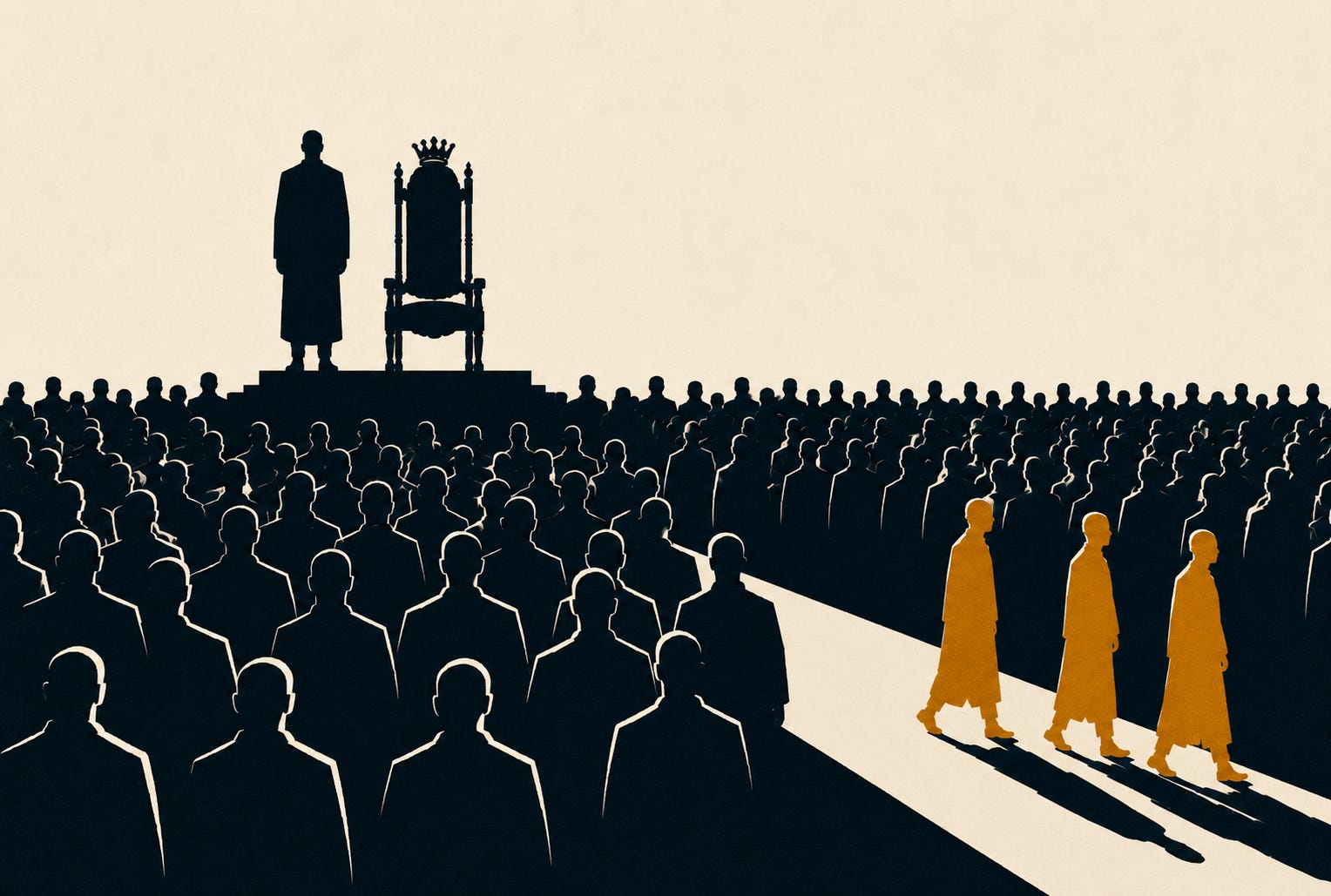
A lot of pro-liberty folks have a core assumption in their arguments and worldview - that people want to be free. That if you just show them their chains, they’ll want to shrug them off. That if you lead by example, and show them the tyranny, they’ll go buy land and want to be off-the-grid too. But it’s simply not true.
What’s stopping mass adoption of liberty isn’t lack of knowledge or means, it’s the unwillingness of most people to be free.
Give them the option, and they’ll hand the keys right back. They’ll vote for the next authority figure promising to make their decisions for them, join the next movement that tells them what to think, and feel genuinely relieved when someone else takes the wheel.
This isn’t a political mystery. It’s a psychological one. And several decades of research across completely unrelated fields keep landing on the same uncomfortable answer.
The 1%: Born to Rule
Robert Hare spent his career studying psychopathy. His Psychopathy Checklist-Revised (PCL-R) is the gold standard diagnostic tool: 20 items, scored 0-40, with a score of 30 or higher marking the clinical threshold for psychopathy.
In his 1999 book Without Conscience, Hare estimated that roughly 1% of the general population meets this strict clinical threshold. Broader measures, which flag milder cases the clinical interview would exclude, put the number higher, around 4 to 5%.
The thing is - that 1% doesn’t distribute evenly.
A 2010 study by Babiak, Neumann, and Hare examined 203 corporate professionals who had been selected by their companies for management development programs. These weren’t random employees. These were the ones identified as leadership material. The results: 3.9% scored 30 or higher on the PCL-R - the same strict checklist behind that 1% figure - roughly four times the general population rate. Almost one in twenty-five of the corporate world’s chosen leaders met the strict clinical threshold for psychopathy.
The kicker: psychopathy was positively associated with ratings of charisma and presentation style. The psychopaths weren’t getting flagged as problems. They were getting promoted. The system selected for them.
This shouldn’t surprise anyone who’s watched how power works. Positions of authority are attractive to people who want to control others. Psychopaths are drawn to those positions the way moths are drawn to light. And the traits that make them dangerous (charm, fearlessness, willingness to manipulate) are the same traits that make them look like “leaders” to the people doing the hiring and the voting.
The 80%: Escape from Freedom
If the 1% are the predators, the vast majority are the willing prey. Not because they’re stupid. Because freedom is genuinely terrifying when you lack the psychological infrastructure to handle it.
Erich Fromm figured this out in 1941. A German Jewish psychoanalyst who had watched Hitler’s rise firsthand, Fromm published Escape from Freedom asking a question that haunted him: why did millions of people voluntarily embrace a totalitarian regime? His answer wasn’t propaganda, or economic despair, or national humiliation, though those played roles. His answer was that freedom itself produces anxiety, and most people will do anything to escape that anxiety, including handing their autonomy to a dictator.
Fromm drew a sharp distinction between “freedom from” (liberation from external control) and “freedom to” (the creative capacity to direct your own life). You can have the first without the second. And when you do, the result isn’t liberation. It’s vertigo. You’ve been freed from the old authority, but you have no internal compass to replace it. The ground drops out.
(This is why so many people who become atheists immediately turn around and cling to the state as their god.)
Faced with that vertigo, Fromm identified three escape mechanisms:
Authoritarianism: Surrendering to a new authority. Submit to a leader, a party, a movement, a doctrine. The authoritarian personality contains both masochism (desire to submit) and sadism (desire to control those below you in the new hierarchy). It’s not just obedience. It’s relief.
Destructiveness: What you can’t control, destroy. If the world’s complexity is overwhelming, burn it down. This is the Antifa crowd.
Automaton conformity: The most insidious escape, and the most relevant today. People unconsciously adopt the beliefs, preferences, and behaviors that society expects, and then experience them as their own genuine choices. Fromm’s words from 1941 read like a prophecy for the social media age: “We have become automatons who live under the illusion of being self-willing individuals.”
That third mechanism is the one to sit with. The automaton conformist doesn’t know they’ve surrendered their autonomy. They think they’re thinking for themselves. They genuinely believe their opinions are their own. They just happen to be identical to whatever their social group, media ecosystem, or institutional affiliation demands.
Kegan’s Numbers
Robert Kegan, a Harvard developmental psychologist, spent decades studying how adults actually think. Not what they know, but the structure through which they process reality.
His Constructive Developmental Theory identifies five stages of psychological complexity. The first applies almost exclusively to children. The next four are where most adults live. But in essence, the earlier stages, when manifested in adults, are a sign of arrested development. An adult who didn’t develop past a certain age of intellectual maturity.
Stage 1 (the Impulsive Mind): is an early-childhood stage - roughly ages 2–4, governed by momentary impulses and perceptions with no stable self. Virtually all adults have matured beyond this phase.
Stage 2 (the Imperial Mind): Purely self-interested. Relationships are transactional. Follows rules to avoid punishment. This stage is about what you’d expect a 3-5 year-old to be. By the age of 5-6, children who are developing normally become capable of empathy and start to care about the needs of others (stage 3). That is, unless you abuse them (via spanking or in other ways). About 6% of adults never develop past this stage.
Stage 3 (the Socialized Mind): Identity comes from external sources: relationships, institutions, culture. Gets beliefs, morals, and sense of “truth” from the surrounding environment. Cannot independently answer “What do I want?” because “I” is defined by the group. This is where most adults live, about 58%.
Stage 4 (the Self-Authoring Mind): Has developed an internal compass. Can evaluate the expectations of others against a self-constructed framework. Generates their own understanding of the world. Doesn’t need external validation to know what they think. About 35% of adults get to this stage.
Stage 5 (the Self-Transforming Mind): Can hold multiple frameworks simultaneously and examine them from outside, including their own. About 1% of adults.
In his study of 342 adults, published in In Over Our Heads (Harvard University Press, 1994), Kegan found that roughly two thirds of adults operate at Stage 3 or below. Only about 35% have reached Stage 4. William Torbert independently studied 497 managers and executives using different methods and reached nearly identical conclusions.
In other words, more than half of the adult population has not developed the capacity for psychological self-authorship. Their identity, their beliefs, their values, their sense of what’s true is constituted by external structures: their employer, their party, their church, their peer group, their media diet.
When you give these people “freedom,” you’re not giving them something they want. You’re taking away the scaffolding that tells them who they are.
The 15-20%: The Ones Who Actually Want Freedom
So who does want freedom? Not as an abstract value they’ll nod along with, but as an operating principle they’ll actually live by?
Kegan’s data puts the Self-Authoring population at ~35%, but that includes people in transition between stages and those who demonstrate Stage 4 capacity only in limited domains. The consistently, robustly self-authoring population is smaller. Torbert’s parallel research, published as “Seven Transformations of Leadership” in Harvard Business Review, found that only 15% of leaders operate from post-conventional stages (what he called Individualist, Strategist, and Alchemist).
Abraham Maslow’s hierarchy of needs points to the same neighborhood. He estimated that fewer than 2% of people fully achieve self-actualization, though he believed a much larger percentage had the capacity.
Deci and Ryan’s Self-Determination Theory, built on decades of experimental research at the University of Rochester, identified autonomy as one of three basic psychological needs (alongside competence and relatedness). Their central finding: human beings can be “proactive and engaged or, alternatively, passive and alienated, largely as a function of the social conditions in which they develop and function.” When autonomy is supported, people thrive. When it’s suppressed, they become dependent, apathetic, and compliant.
But here’s the uncomfortable part of Deci and Ryan’s work: extrinsic rewards for behavior that is intrinsically motivated actually undermine the intrinsic motivation. Pay someone to do what they’d do freely, and they stop wanting to do it. This means most institutional structures (schools, corporations, governments) are actively manufacturing compliance by replacing internal motivation with external rewards and punishments. The system doesn’t just fail to develop autonomy. It actively destroys it, one child at a time.
The Milgram Pattern
Now watch what happens when you line these numbers up against completely different research domains.
Stanley Milgram’s obedience experiments at Yale in 1963: participants were told by an authority figure in a lab coat to administer what they believed were dangerous electric shocks to another person. 65% complied all the way to the maximum voltage, which killed the other (pretend) person. They heard screaming. They were visibly distressed. They kept flipping the switch because a man in a coat told them to. 35% defied the authority and stopped.
Solomon Asch’s conformity experiments in 1951: participants were asked to match line lengths, a task with an obvious correct answer. Actors in the room gave obviously wrong answers. 75% of participants conformed to the group’s wrong answer at least once. But 25% never conformed, not even once, across all twelve critical trials.
Now look at the American Revolution. Historian Robert Calhoon’s research found that only 40-45% of the free colonial population actively supported the Patriots, at best “no more than a bare majority.” Paul H. Smith’s 1968 study in the William and Mary Quarterly calculated that Loyalists comprised about 19.8% of free citizens. The rest were neutral or uninvolved. Out of a colonial population of 2.5 million, just over 100,000 served in the Continental Army.
The same ratios keep appearing:
1-4% who seek to control: psychopaths (Hare), corporate psychopaths (Babiak), Kegan’s Stage 5 + Stage 2 combined.
55-80% who conform, obey, or remain passive: Milgram’s obedient 65%, Asch’s conformists, Kegan’s Stage 3, the colonial population who stayed out of the Revolution or supported the monarchy.
15-35% who resist, think independently, or act autonomously: Milgram’s defiant 35%, Asch’s 25% who never conformed, Kegan’s Stage 4 and 5, Torbert’s 15% post-conventional leaders, the active Patriots.
These researchers weren’t coordinating. They were studying different phenomena in different decades using different methods. And they kept finding the same distribution.
What This Means
This isn’t a comfortable framework. It suggests that the liberty movement is not losing an argument. It’s dealing with a species-level distribution of psychological orientation. The majority of the population does not want freedom, not because they’ve been tricked or haven’t heard the right arguments, but because freedom requires a psychological capacity that most adults haven’t developed.
The 1% who seek control and the 80% who seek someone to follow are engaged in a transaction that works for both parties. The psychopaths get power. The socialized majority gets someone to tell them who they are and what to think. Both sides are getting exactly what they want.
The 15-20% who actually want autonomy aren’t losing the debate. They’re outnumbered by people who are playing a completely different game.
This doesn’t mean the percentages are fixed, or that people can’t develop. They can. That’s the subject of the rest of this series. But it starts with seeing the landscape clearly, without the comforting illusion that everyone secretly wants to be free and just needs the right pamphlet.
They don’t. And pretending otherwise is why most liberty activism goes nowhere.
Next in the series: “Children in Adult Bodies,” a deep dive into Kegan’s developmental theory: why most adults never reach psychological autonomy, what keeps them stuck, and what it means for governance.
Sources
- Hare, R.D. (1999). Without Conscience: The Disturbing World of the Psychopaths Among Us. Guilford Press.
- Babiak, P., Neumann, C.S., & Hare, R.D. (2010). “Corporate Psychopathy: Talking the Walk.” Behavioral Sciences & the Law, 28: 174-193.
- Sanz-García, A. et al. (2021). “Prevalence of Psychopathy in the General Adult Population.” Frontiers in Psychology.
- Fromm, E. (1941). Escape from Freedom. Farrar & Rinehart.
- Kegan, R. (1994). In Over Our Heads: The Mental Demands of Modern Life. Harvard University Press.
- Kegan, R. & Lahey, L.L. (2009). Immunity to Change. Harvard Business Press.
- Rooke, D. & Torbert, W. (2005). “Seven Transformations of Leadership.” Harvard Business Review.
- Ryan, R.M. & Deci, E.L. (2000). “Self-determination theory and the facilitation of intrinsic motivation, social development, and well-being.” American Psychologist, 55(1), 68-78.
- Maslow, A. (1954). Motivation and Personality. Harper & Row.
- Milgram, S. (1963). “Behavioral Study of Obedience.” Journal of Abnormal and Social Psychology, 67(4), 371-378.
- Asch, S.E. (1951). “Effects of Group Pressure.” Groups, Leadership, and Men.
- Smith, P.H. (1968). “The American Loyalists.” William and Mary Quarterly, 25.
- Calhoon, R. (various). Works on Loyalist/Patriot strength. Cited in Journal of the American Revolution.
This piece identifies the psychological distribution that explains the near‑universality of hierarchical government: most adults prefer external authority, not autonomy. That insight is essential for any theory of liberty or institutional design.
I’ve been playing with these numbers for more than twenty years, and I’m convinced that the 1% is way too low. Sure, the ones who actually control others, I.e., government at all levels may fit that 1%, but there are way more who still want to tell you what to do and how to think. One word proves my point; socialism. Socialists aren’t passive. They aren’t content to let you be. Busy bodies, karens. While they don’t have direct power, the use those that do to do their dirty work. Prove me wrong. 😑