

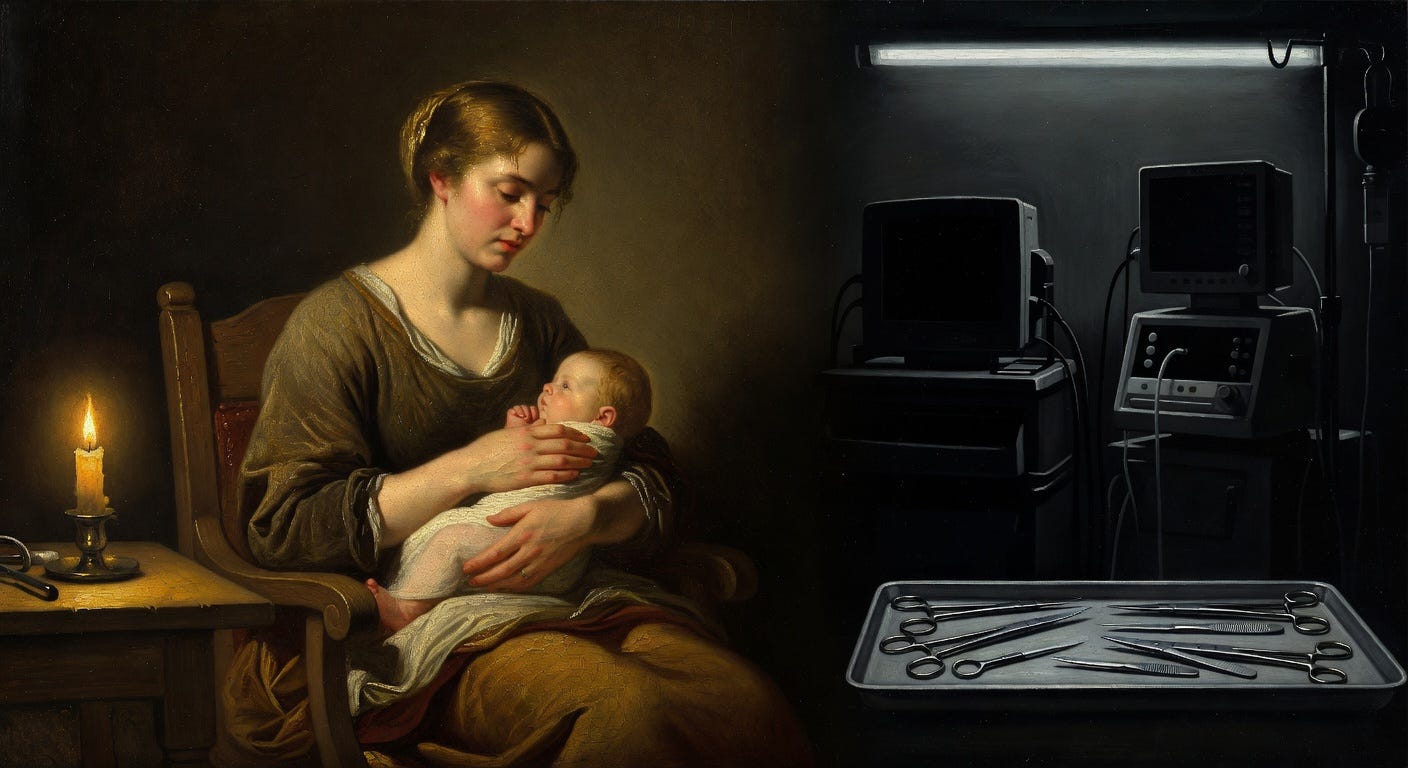
The United States spends more money on childbirth than any other nation on Earth. The average hospital vaginal delivery runs about $15,700. A C-section costs nearly $29,000, 85% more. American women deliver in the most expensive healthcare system ever built, surrounded by more technology per square foot than most countries have in an entire hospital wing.
And for all that spending, the system is killing more mothers than any comparable country. It’s killing more babies. And it’s doing it while performing surgery on one in three women who walk through the door.
That’s not a paradox. That’s a business model.
The Numbers Nobody Advertises
In 2023, 669 American women died of maternal causes, a rate of 18.6 deaths per 100,000 live births. That’s down from a horrifying 32.9 in 2021, but it still ranks the US dead last among comparable developed nations. Thirtieth out of 38 OECD countries. For Black women, the number is 50.3 per 100,000, roughly triple the rate for white women and five times Norway’s national average.
On infant mortality, the US posts 5.4 deaths per 1,000 live births, the highest rate among peer nations. Norway manages 1.6. Finland sits at 2.0. The US ranked 33rd of 38 OECD countries. Even when researchers control for birth weight, American babies still die at nearly double the rate of Finnish ones.
Meanwhile, the American C-section rate hovers around 32%: one in every three births ends in major abdominal surgery. Population-level data says that figure should be a fraction of what it is. A 2015 ecological study in the Lancet found that once C-section rates reach about 10% at the population level, further increases provide zero additional reduction in maternal or neonatal mortality. A 2014 analysis of 19 developed countries over three decades confirmed the same threshold. The WHO has maintained since 1985 that rates above 10-15% are “hardly justified from a medical perspective.”
But even that range overstates the case. The truly life-saving C-sections, the ones for placenta previa, cord prolapse, transverse lie, uterine rupture, genuine cephalopelvic disproportion, account for a far smaller slice, around 3%. The other 29% of American C-sections aren’t emergencies. They’re the downstream product of a system that profits from intervention.
Before Birth: The Ultrasound Pipeline
Most people assume ultrasound is perfectly safe. It’s just sound waves, right? The medical establishment has been extraordinarily careful to maintain that assumption while quietly expanding the technology’s power output without matching safety data.
The Output Increase Nobody Talks About
In 1985, when the FDA first set guideline limits for obstetrical ultrasound, the maximum allowable spatial-peak temporal-average (SPTA) intensity for obstetric ultrasound was 94 mW/cm². In 1992, the agency adopted a new approval pathway (Track 3) that raised the ceiling to 720 mW/cm², a roughly 7.7-fold increase in allowable output for fetal imaging. The reason? Manufacturers wanted sharper pictures. The mechanism? The “Output Display Standard,” which shifted responsibility from hard output caps to putting numbers on a screen that sonographers were supposed to monitor themselves.
Here’s the part that matters: no new fetal safety studies accompanied the increase. The American Institute of Ultrasound in Medicine acknowledges that epidemiological safety evidence is “based primarily on exposure conditions before 1992.” A 2008 review in Seminars in Ultrasound put it plainly: “There has been little or no subsequent research with the modern obstetrical ultrasound machines to systematically assess potential risks to the fetus.”
What the Mouse Study Found
In 2006, a team led by neuroscientist Pasko Rakic at Yale School of Medicine published a study in PNAS examining the effect of ultrasound on fetal brain development in mice. They labeled neurons destined for the brain’s superficial cortical layers, then exposed pregnant mice to ultrasound during the window when those neurons were migrating to their final positions.
The results from over 335 animals: when exposed to ultrasound for 30 minutes or more, a statistically significant number of neurons failed to reach their correct positions. They remained scattered in inappropriate cortical layers or in the white matter below. The effect was dose-dependent. The longer the exposure, the worse the dispersion.
In the cerebral cortex, a neuron’s position determines its connections and its function. Neurons in the wrong place wire up wrong. The authors called for “further investigation in larger and slower-developing brains of non-human primates and continued scrutiny of unnecessarily long prenatal ultrasound exposure.”
That larger investigation never happened.
The Handedness Signal
Separately, Norwegian researchers Kjell Salvesen and Sturla Eik-Nes published a 1999 meta-analysis of randomized trials that found a possible association between prenatal ultrasound exposure and non-right-handedness in children. A 2011 updated meta-analysis confirmed “a weak statistically significant association between ultrasound screening and being non-right handed.” For boys specifically, the odds ratio was 1.26 (95% CI 1.03-1.54). Three separate studies, two Norwegian RCTs and one Swedish trial, replicated the finding.
This isn’t about left-handedness being bad. It’s about what non-right-handedness signals. Handedness is established during fetal brain development through neuronal migration, the exact process the Yale mouse study showed ultrasound disrupts. An unexpected shift in handedness at the population level is a marker of disrupted brain lateralization. It suggests something is interfering with the precise sequencing of neural development.
The False Positive Pipeline
Beyond direct biological effects, ultrasound serves as the entry point to the intervention cascade. Which is exactly why doctors love it and recommend it so much. Here’s how it works:
A routine scan picks up a “soft marker,” maybe an echogenic bowel, a choroid plexus cyst, a marginal measurement. Individually, most soft markers are meaningless. But they get flagged. The next step: “Let’s do another scan to keep an eye on it.” That scan finds something else, or the same marker persists, and now you’re scheduled for stress tests, non-stress tests, more monitoring.
Estimated fetal weight triggers many unnecessary inductions. Ultrasound weight estimates can be off by 15-20%, sometimes a full pound in either direction. A baby estimated at 9 pounds might actually be 7.5. But the estimate is on the chart now, and “big baby” becomes a reason to induce early. Or a baby measuring slightly small becomes grounds for early delivery “just in case.”
Layer on “advanced maternal age” (35+), and any soft marker automatically bumps a woman into high-risk classification. More monitoring, more scans, more opportunities to find something “concerning” that wouldn’t matter if nobody had looked.
The cascade runs in one direction: scan finds concern → more scans → stress test → induction → failure to progress → C-section. Each step feels reasonable in isolation. Taken together, it’s a conveyor belt.
Women in the 1970s got zero routine ultrasounds. Today, multiple scans are standard: dating, anatomy, growth, late-term assessment. No evidence shows that more scans improve outcomes for low-risk pregnancies. But each scan is billable, and each scan is another chance to find something that triggers the next intervention.
The FDA has warned against “keepsake” ultrasounds done for entertainment and gender reveals: exposure with zero medical justification. That the warning exists tells you what they already know about the risks.
The Assembly Line
Once a woman checks into a modern American hospital in labor, she enters a system designed for throughput and liability management, not for the physiology of birth.
The Pitocin Cascade
Synthetic oxytocin (Pitocin) is administered to induce or augment labor in roughly 31% of US births. It creates contractions that are stronger, closer together, and more painful than the ones a woman’s body would produce on its own. But unlike the natural oxytocin a laboring body releases, Pitocin doesn’t cross the blood-brain barrier. There’s no corresponding endorphin surge. No natural pain modulation. No bonding cascade.
The result: Pitocin contractions hurt more, so women request epidurals at higher rates. Epidurals reduce mobility, which slows labor. You’re meant to move when you’re giving birth, not be strapped to a bed. (Yes, women literally used to be strapped to beds in the early 20th century). Slower labor gets diagnosed as “failure to progress.” And “failure to progress” is the number one indication for a first-time C-section.
This is the cascade that birth advocates have been describing for decades: Induction → Pitocin → Epidural → Immobility → Stalled labor → “Failure to progress” → C-section. Each intervention creates the conditions that “require” the next one. None of it was inevitable. All of it is presented as medical necessity after the fact.
And women who are in labor aren’t exactly thinking straight. Labor is painful, stressful, and scary, especially for first-time moms. So when a man in a lab coat tells them they need to do this or that, “for the baby’s safety,” they’ll do it. And then they leave with a $30,000 bill from the hospital.
The Machine That Cried Wolf
Continuous electronic fetal monitoring (EFM) was developed for high-risk pregnancies. It is now used in approximately 85% of all American labors. The assumption: if we watch the baby’s heart rate constantly, we’ll catch problems before they become disasters.
The evidence says otherwise. A 2017 Cochrane Review of randomized trials involving over 30,000 women found that compared to intermittent auscultation (listening with a handheld device at regular intervals):
Continuous EFM showed no reduction in perinatal death.
No reduction in cerebral palsy.
A 66% increase in C-section rate.
A 16% increase in operative vaginal delivery (forceps/vacuum).
Read that again. The technology increased surgery by 66% while providing zero measurable benefit in preventing the two outcomes it was supposed to prevent. As one review in the journal Medicine, Science and the Law noted, despite EFM being used in 85% of labors and C-section rates rising to 32%, there has been no attributable decrease in the rate of cerebral palsy.
The problem is false positives. Heart rate tracings are ambiguous. A dip that looks alarming on the monitor might mean nothing, or might mean something. But a physician staring at a tracing that looks concerning, knowing a malpractice attorney could use that tracing against them later, is going to err on the side of cutting. Every time. Of course, the more they cut, the more they earn, too.
And this is exactly what surgeons want. Remember, OB-GYNs are surgeons by training, they’re not there to watch you deliver naturally.
The 1955 Curve Running Modern Labor
In 1955, Dr. Emanuel Friedman studied labor progress in approximately 500 women and created what became known as “Friedman’s Curve”: the expected timeline of cervical dilation during labor, pegged at about 1 centimeter per hour once active labor began (defined as 4 cm dilation).
Women who don’t dilate on schedule get diagnosed with “failure to progress”, the single most common reason for first-time C-sections.
The problem? Friedman’s Curve is badly outdated. A landmark 2010 study by Zhang et al. (the Consortium on Safe Labor) tracked over 62,000 women and found that:
- Active labor doesn’t reliably begin until 6 cm, not 4 cm
- Normal labor can take significantly longer than 1 cm/hour
- Many women diagnosed as “failure to progress” under the old standard were simply progressing normally under a more accurate one
Despite this evidence, many hospitals still use the 1955 curve. The result: women who are laboring normally get labeled as failing and routed to surgery. The outdated standard persists because it just so happens to move patients through faster.
My wife’s first labor took 37 hours. We delivered naturally, at home, with zero interventions. Aside from the lack of sleep, everything went fine. If we had gone to a hospital we would have ended up with a c-section.
The Business Model
None of this happened by accident. The medicalization of American birth was a deliberate project, executed over decades by institutions that stood to profit from it.
How Physicians Replaced Midwives
In 1900, midwives attended roughly half of all American births. Physicians handled the other half, but fewer than 5% of births happened in hospitals. Birth was a household event, managed by women who had been doing it for millennia.
That changed fast. The 1910 Flexner Report, commissioned by the Carnegie Foundation and endorsed by the AMA, recommended hospital deliveries and called for the abolition of midwifery. The report has since been recognized for its “racist, sexist, and classist approach,” but its impact was permanent.
In 1915, Dr. Joseph B. DeLee, one of the most influential obstetricians of his era, declared childbirth “a destructive pathology” and called midwives “a drag upon the progress of science and art of obstetrics.” In 1920, he published “The Prophylactic Forceps Operation,” arguing that all births needed routine medical intervention: sedation, episiotomy, forceps delivery. His recommendations became standard practice.
The next push was to move birth into hospitals, where midwives were forbidden to practice. Licensing laws gave physicians a monopoly. By the 1920s, up to half of births occurred in hospitals. By 1955, it was 99%.
Here’s the part the profession doesn’t like to discuss: maternal mortality didn’t improve during this transition. It actually plateaued at 600-700 deaths per 100,000 births between 1900 and 1930, during the exact period when physicians were replacing midwives and moving birth to hospitals. The improvements came later, with antibiotics and blood transfusions, not from the shift to physician-led hospital birth itself.
Follow the Money
The financial incentives all point in one direction.
A 2021 study in JAMA Network Open analyzed 13.2 million deliveries across US hospitals and found that women delivering at hospitals with the highest profit margins on C-sections had 8% higher odds of receiving one compared to women at low-profit hospitals. C-section rates vary by more than 16-fold across US communities. If the surgery rate were driven purely by medical necessity, the variation would be minimal. It isn’t, because medical necessity isn’t driving it.
Brazil: The Endgame
If you want to see where pure financial incentive and zero cultural pushback leads, look at Brazil.
Brazil’s national C-section rate is roughly 56%, among the highest in the world. In private hospitals, the rate reaches 80-90%. C-sections in Brazil have become a status symbol: a marker of class, modernity, and access to elite care. Wealthy women schedule their deliveries around social calendars. “Too posh to push” is not a joke there; it’s the cultural default.
Public hospitals in Brazil run lower rates (around 40%), but still far above any medical justification. The country demonstrates what happens when a medical system fully captures birth as a consumer product: the intervention rate skyrockets, outcomes don’t improve, and the whole arrangement is normalized.
The First Hours After Birth: What Happens Before You Can Object
The interventions don’t stop at delivery. Within minutes of birth, a standard American hospital initiates a series of procedures on the newborn, most of them presented as non-negotiable, few of them actually justified for every baby.
Eye Antibiotics for Everyone
Erythromycin eye ointment is applied to virtually all newborns in the US, usually within the first hour of birth. It’s mandatory by law in most states. The rationale: preventing ophthalmia neonatorum, an eye infection caused by gonorrhea or chlamydia contracted during vaginal delivery.
Here’s what the policy actually does: it applies antibiotics to the eyes of every baby, regardless of the mother’s STD status, regardless of whether the baby was even born vaginally. A mother who tested negative for both infections during prenatal care, who delivered via C-section, will still have erythromycin smeared into her baby’s eyes.
The ointment blurs the baby’s vision during the most critical window for bonding and breastfeeding initiation. And erythromycin has failure rates as high as 20% against chlamydial conjunctivitis, so it’s not even reliably effective.
Multiple countries have figured out a better approach. The UK, Australia, and Scandinavian nations don’t do routine prophylaxis at all. They test mothers prenatally and treat only those at risk. It’s targeted, effective, and doesn’t blur every newborn’s first view of the world.
An STD Vaccine at Hours Old
The CDC recommends that all newborns receive the Hepatitis B vaccine within 24 hours of birth. Hepatitis B is transmitted through blood and sexual contact, a transmission profile similar to HIV. The birth dose exists to prevent vertical transmission from infected mothers.
Except that mothers are already screened for Hepatitis B during prenatal care. Their HBsAg status is known before delivery. For a baby born to a Hep B-negative mother, the newborn has essentially zero risk of Hep B exposure in the first hours, days, or weeks of life, assuming nobody is sharing needles with the infant.
The policy treats all babies identically, regardless of actual risk. Countries like Denmark, Sweden, Finland, Japan, and the UK don’t give universal Hep B at birth. They vaccinate infants of carrier mothers and wait for the rest.
Vaccinating a newborn, which is a serious shock to the system, against a blood-borne/sexually transmitted virus hours after birth, when the mother is confirmed negative, is a protocol driven by the desire to profit and poison. It has nothing to do with health.
Cutting the Lifeline Early
For decades, standard hospital practice has been to clamp and cut the umbilical cord within 15-30 seconds of birth. This is done for workflow efficiency: it speeds up delivery of the placenta and frees up the delivery team.
But the cord is still pulsating. Blood is still flowing. The baby has a significant portion of its blood supply still in the placenta.
Delayed cord clamping (waiting 1-3 minutes, or until the cord stops pulsating) allows transfer of up to 80-100 mL of additional blood, roughly one-third of the baby’s total blood volume. The evidence is overwhelming:
ACOG recommends delayed clamping for at least 30-60 seconds.
WHO recommends delayed clamping at 1-3 minutes.
Benefits include higher hemoglobin levels, improved iron stores for 3-6 months, reduced iron deficiency anemia, better brain myelination, and improved neurodevelopment at 4 years of age.
Immediate cord clamping means the baby starts life deprived of up to one-third of its blood supply. The iron from that blood supports brain development for months. The practice persists at many hospitals not because of evidence, but because it’s faster.
In other words, your “doctor”, if you can even call them that at this point, is so impatient they’re fine with your child having neurodevelopment knock-on effects years later - if they cut the cord and save themselves 2 minutes of waiting.
What They Don’t Tell You
The conversation about C-sections usually focuses on the immediate: recovery time, surgical risk, scarring. What gets far less attention is what C-sections do to the baby’s biology.
The Missing Microbiome
During vaginal birth, a baby passes through the birth canal and is colonized by the mother’s vaginal and intestinal microbiome. These bacteria are the foundation of the infant’s immune system. They colonize the gut, train immune cells, and establish the microbial ecosystem the child will carry for life.
C-section babies skip this process entirely. Instead, they’re colonized by whatever bacteria are in the operating room: skin microbes, hospital-associated organisms, and environmental bacteria that have nothing to do with the mother’s microbiome.
A 2021 review in Frontiers in Microbiology found that C-section birth is “closely related to an increased risk of food allergy, asthma, diabetes, obesity and other autoimmune and metabolic diseases in children.” A separate review in Frontiers in Immunology described a threefold risk of developing childhood asthma associated with C-section-disrupted immune development.
This isn’t fringe science. It’s published in mainstream medical journals. The gut microbiome’s role in immune system development is one of the most active areas of research in medicine. And the single biggest factor disrupting that microbiome at the population level is the rate at which we’re surgically delivering babies.
The Recovery Myth
C-sections are often presented as a reasonable alternative, almost equivalent to vaginal birth. They’re not. A C-section is major abdominal surgery: the surgeon cuts through skin, fascia, muscle, and the uterus itself. Recovery takes a minimum of 6-8 weeks, compared to days for a typical vaginal birth. Risks include infection, hemorrhage, blood clots, adhesions, and damage to surrounding organs.
Each subsequent C-section compounds the risk. Scar tissue from previous surgeries increases the likelihood of placenta accreta (where the placenta grows into the uterine wall), placenta previa (where the placenta covers the cervix), and uterine rupture. A first C-section often means every subsequent birth will also be a C-section, because most hospitals won’t allow vaginal birth after cesarean (VBAC) despite evidence that it’s safe for most women. Yet another way for them to make more money regardless of what the scientific evidence shows.
The Hormonal Cascade You Lose
Natural labor triggers a massive, coordinated hormonal response. Oxytocin surges for bonding, breastfeeding initiation, and uterine contraction. Endorphins modulate pain. Catecholamines prepare the baby for breathing air. Prolactin primes milk production.
A scheduled C-section bypasses the entire process. The mother goes from pregnant to post-surgical without the hormonal transition. Pitocin administered after surgery is a pale synthetic substitute that doesn’t replicate oxytocin’s effects on the brain, on bonding, on the full-body experience of meeting your child through the process your body was designed for.
Most Doctors Don’t Care About You, They Care About Dinner
The official “due date” is not the point at which a pregnancy becomes high-risk. It is simply the 50th percentile - the average day first-time mothers give birth. By definition, half of all women will naturally give birth after their due date. This statistical reality is routinely weaponized. Once a woman crosses 40 weeks (or even 39), many providers begin applying heavy pressure for induction, treating a normal pregnancy as if it has suddenly become dangerous. The cascade is predictable: induction with Pitocin, stronger contractions, epidural, reduced mobility, “failure to progress,” and ultimately a C-section.
The fact that due dates are weaponized is bad enough. But wait till you hear this statistic.
Multiple studies have shown that unscheduled C-sections and other interventions increase significantly during evening hours and shift change periods. When the clock approaches 5pm, suddenly doctors decide this labor needs to end now. A scheduled C-section that gets the team home for dinner is logistically preferable to staying late for an unpredictable vaginal birth. The fact that they’re literally cutting through your abdominal wall and hurting both maternal and fetal outcomes? They don’t care. They want to go eat dinner.
The Exit
All of this sounds bleak. It’s supposed to, because the system is bleak. But the good news is that you don’t have to accept the default. There are better options, and they have better outcomes.
Midwifery Works
Certified Nurse-Midwives (CNMs) and Certified Professional Midwives (CPMs) are trained birth professionals who approach labor as a physiological process, not a medical emergency. Research consistently shows that midwife-led care for low-risk pregnancies results in:
Lower C-section rates.
Fewer unnecessary interventions.
Higher patient satisfaction.
Comparable or better outcomes for mother and baby.
The countries with the best maternal and infant mortality numbers, Norway, Finland, Sweden, the Netherlands, all have robust midwifery systems where midwives are the primary attendant for most births and OB-GYNs handle only complications.
Legal status varies by state. Some states have full practice authority for midwives. Others restrict them severely. This might also be a good time for you to consider moving to a better state.
The midwifery laws tell you just as much about what the corrupt politicians and doctors think about you and your right to be free, as the homeschooling and homesteading laws.
Birth Centers
Freestanding birth centers offer a middle path: clinical support without the hospital assembly line. Birth centers are staffed by midwives, equipped for normal birth and basic emergencies, and have transfer agreements with nearby hospitals for complications that require higher-level care.
The cost is a fraction of a hospital birth. Intervention rates are dramatically lower. And for low-risk pregnancies, outcomes are excellent.
Home Birth
For low-risk pregnancies attended by qualified midwives, planned home birth is safe. A landmark Dutch study of 529,688 low-risk women found no increased risk of perinatal mortality for planned home births compared to planned hospital births. The key qualifier: “attended by qualified midwives” with access to hospital transfer when needed.
Home birth is not for everyone. High-risk pregnancies (multiples, breech, preeclampsia, prior C-section in some cases) belong in settings with surgical capability. But for the majority of healthy women (90%+) with straightforward pregnancies, home birth with a skilled attendant is a legitimate, evidence-supported option.
Doulas
A doula is a trained labor support person (not a medical provider) who provides continuous physical and emotional support during labor. The evidence on doulas is striking: continuous labor support is associated with shorter labors, fewer C-sections, less need for pain medication, and higher satisfaction. A doula can’t make medical decisions, but they can advocate, comfort, and help you navigate the system.
And they know ahead of time what kind of unnecessary pressure doctors will put you under to make an extra buck and get you out the door faster.
Questions to Ask Your OB
If you’re planning a hospital birth, informed consent is your primary defense against the intervention conveyor belt. Some questions that sort out providers quickly:
What is your C-section rate? (If they don’t know or won’t answer, that’s an answer.)
What is your induction rate?
At what point do you diagnose “failure to progress”? (Listen for whether they reference current evidence or Friedman’s 1955 curve.)
Do you support delayed cord clamping? (Should be at least 1-3 minutes. If they hesitate, that’s your answer.)
Can I decline routine newborn procedures? (Erythromycin, early Hep B for a negative mother.)
Do you support intermittent monitoring for low-risk labor? (If they insist on continuous EFM for every patient, they’re corrupt.)
Under what circumstances do you recommend induction? (Watch for “convenience” inductions dressed up as medical ones.)
How do you feel about birth plans? (Any provider who rolls their eyes at this question is telling you something important.)
The answers will tell you whether you have a provider who practices evidence-based medicine or one running an assembly line.
How to Find Better Care
American College of Nurse-Midwives: midwife.org for finding a CNM.
North American Registry of Midwives: narm.org for finding a CPM.
American Association of Birth Centers: birthcenters.org for finding a birth center.
DONA International: dona.org for finding a doula.
Evidence Based Birth: evidencebasedbirth.com for research-backed information on every birth intervention.
Ask other moms, on Facebook groups, etc. Often recommendations from mothers and reputation is more important than anything else.
The Bigger Picture
Birth in America has been captured by the same forces that captured the rest of healthcare: institutional inertia, liability culture, financial incentive, and the slow replacement of human judgment with protocol compliance. The result is a system that spends more, intervenes more, and loses more mothers and babies than peer nations that spend less and do less.
The documentary The Business of Being Born (2008) laid this out plainly. At the time of filming, the C-section rate was about 31%. It featured Ina May Gaskin’s Farm Midwifery Center, which had maintained a 1.4% C-section rate over 30 years with excellent outcomes. The numbers haven’t gotten better since.
The pattern is always the same: a tool designed for emergencies becomes routine, routine becomes mandatory, mandatory becomes profitable, and anyone who questions the cycle is dismissed as reckless.
You’re not reckless for asking questions. You’re not irresponsible for wanting evidence before someone puts a knife to your belly. The American medical system has a 32% surgery rate and the worst maternal mortality in the developed world. The burden of proof is on them, not on you.