

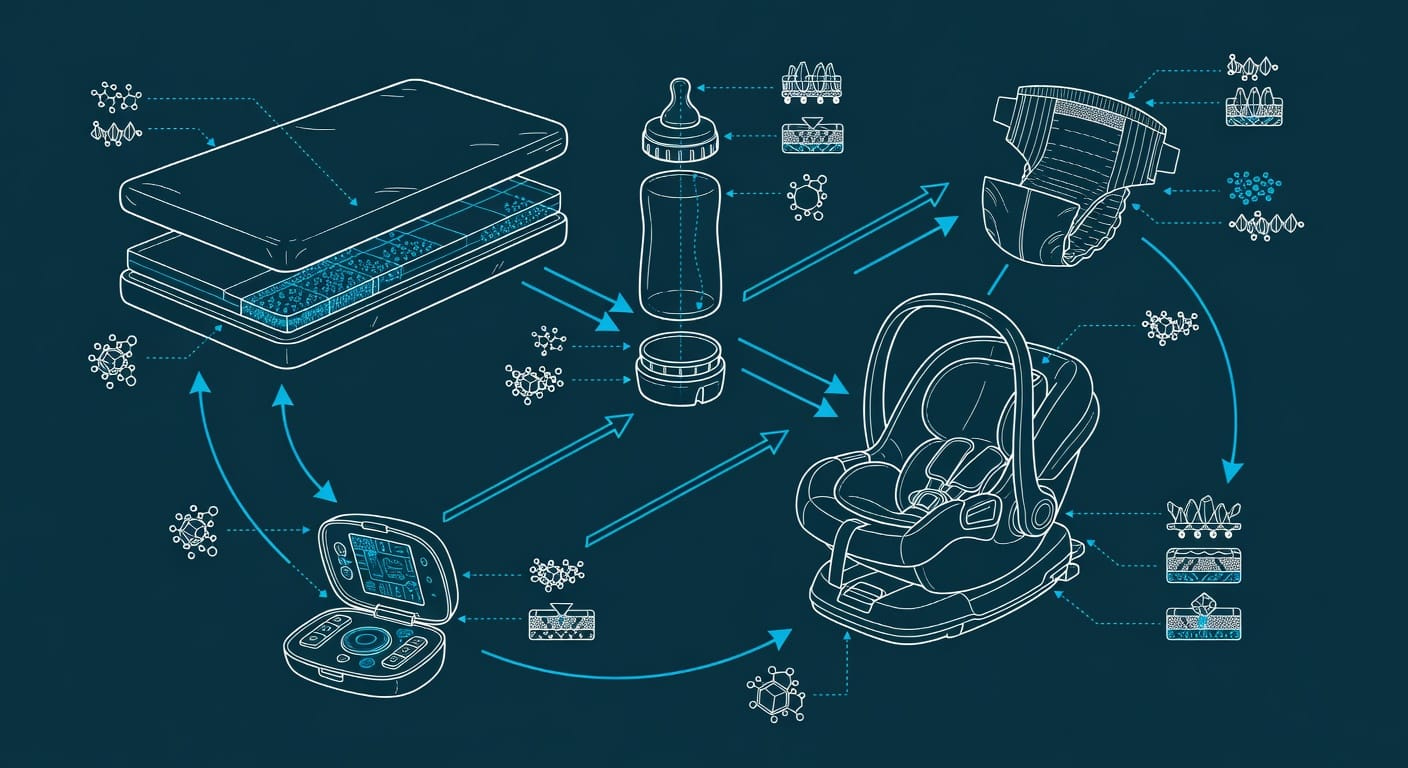
The most chemically exposed humans on Earth are not factory workers, miners, or lab technicians.
They’re infants.
A baby’s body processes toxins differently than yours. A 2024 review in Pediatric Research laid out why: relative to body weight, an infant’s respiration rate, food intake, and skin surface area are all higher than an adult’s. Their metabolism and renal clearance are lower in the first months, meaning toxicants that enter the body stay longer and accumulate faster. Their skin is more permeable, their blood-brain barrier is still forming, and their cells are dividing at a rate they never will again.
Everything hits harder, lasts longer, and arrives during the narrowest developmental windows in a human life.
In 2005, the Environmental Working Group tested umbilical cord blood from ten newborns. They found an average of 200 industrial chemicals per baby. A total of 287 chemicals across the group. Of those, 180 cause cancer in humans or animals, 217 are toxic to the brain and nervous system, and 208 cause birth defects in animal tests.
These weren’t crack babies. These were regular American newborns. And this was twenty years ago. Before WiFi baby monitors, before iPads in strollers, before microplastics were found in every human organ we’ve checked.
If you’re a parent and this makes you uneasy, that’s not guilt talking. That’s your instincts working correctly. Nobody told you any of this when you were picking out onesies.
The Flame Retardant Mandate
Federal law requires that children’s sleepwear in sizes 9 months through 14 years must either be flame-resistant or snug-fitting (16 CFR 1615/1616). Flame-resistant, in practice, means chemically treated with flame retardant compounds. Your baby’s loose-fitting footie pajamas almost certainly contain them.
Crib mattresses must meet a separate open-flame flammability standard (16 CFR 1633). Most manufacturers meet it by treating the mattress with chemical flame retardants. The baby sleeps on these chemicals for 10-14 hours a day, breathing the off-gassing vapors the entire time.
Car seats are loaded with the same class of chemicals in their foam padding. The Ecology Center has tested car seats periodically since 2006. In their 2016 study, flame retardant chemicals were detected in all 15 seats tested. Brominated flame retardants, which are typically persistent, bioaccumulative, and toxic, were found in 13 of 15 seats. In their 2014 study, three seats still contained chlorinated tris (TDCIPP), a known carcinogen.
Think about the exposure math. A child spends hours per week in a car seat, body pressed against treated foam, often in a hot car. Heat accelerates off-gassing. Their back is sweating. The child’s face is inches from the chemicals. Their skin absorbs them through contact. They breathe them continuously.
So who decided your baby needed to marinate in carcinogens?
The Tobacco Industry Did
The Chicago Tribune‘s Pulitzer-finalist “Playing With Fire” investigation (2012) documented how flame retardant mandates were the tobacco industry’s exit strategy. The logic was almost elegant in its cynicism: cigarettes cause house fires. Rather than make self-extinguishing cigarettes (which the technology for existed), the industry created a front group called Citizens for Fire Safety, funded by three chemical companies: Albemarle, Chemtura, and ICL. This group lobbied aggressively to mandate flame retardants in furniture, mattresses, and children’s products.
The result: instead of solving the cigarette problem, regulators slathered everything in your home with carcinogenic chemicals. Including every surface your baby touches. It’s hard to write about this because the evil of these people makes me so mad.
California’s original TB 117 standard was the epicenter. It required open-flame testing for furniture foam, which effectively mandated chemical treatment. This single California standard drove national practice because manufacturers didn’t make separate product lines for one state.
In 2013, after the Tribune investigation and years of advocacy, California revised TB 117 to replace the open-flame test with a smolder test for cover fabrics. This eliminated the need for chemical flame retardants in cushions. The new standard took effect in January 2014. But the Federal law didn’t change.
The CPSC itself, in a study of 475 child clothing-related burn injuries from 2003-2005, found “no evidence of increased risk of burn injury associated with the exemptions from the sleepwear standards”. Snug-fitting cotton pajamas without flame retardants were just as safe as chemically-treated ones. The chemical treatment wasn’t protecting children. It was protecting the tobacco industry’s liability exposure.
It was also poisoning the next generation of Americans. On purpose.
If you’ve read Part 2 of this series (”The Chemical Castration”), you already know what flame retardants do to the endocrine system. TDCIPP doesn’t just cause cancer. It disrupts thyroid hormones, which govern brain development. It’s linked to neurodevelopmental delays and childhood leukemia. And for decades, the government mandated it be pressed against your child’s sleeping body, and still does.
Even after the evidence showed it causes sickness and does nothing to protect babies. Maybe that’s exactly why the Federal government is waging war against your family’s health.
What’s in the Bottle
In 2020, researchers at Trinity College Dublin published a study in Nature Food that measured microplastic release from polypropylene baby bottles. The numbers were staggering.
Following the World Health Organization’s own recommended sterilization and formula preparation procedures, the bottles released up to 16.2 million microplastic particles per liter. The researchers estimated that bottle-fed infants up to 12 months old could ingest between 14,600 and 4.55 million microplastic particles per day.
For context, the WHO estimates adults consume about 300-600 microplastics per day. Some formula-fed babies are getting ten thousand times that.
“We were absolutely gobsmacked,” co-author John Boland told The Guardian.
Polypropylene makes up 82% of the global baby bottle market. Glass bottles are the primary alternative. This isn’t a complex trade-off. Glass doesn’t shed plastic into your baby’s food.
Heavy Metals in Baby Food
In 2019, Healthy Babies Bright Futures tested 168 baby food products. 95% contained at least one toxic heavy metal: arsenic, lead, mercury, or cadmium.
That triggered a Congressional investigation. The U.S. House Subcommittee on Economic and Consumer Policy subpoenaed internal testing data from seven major baby food companies. Three refused to cooperate: Walmart, Sprout Foods, and Campbell Soup (Plum Organics).
The four that did hand over data revealed the scope of the problem. Beech-Nut used ingredients testing as high as 913 parts per billion for arsenic. Earth’s Best Organics used ingredients testing as high as 309 ppb for arsenic. A follow-up report in September 2021 found that inorganic arsenic in finished products was 28-93% higher than the companies’ own estimates.
Rice-based products were the worst offenders. Infant rice cereal is responsible for more than half of all infant and toddler exposure to inorganic arsenic, per the Congressional report.
And in March 2025, Consumer Reports found heavy metals and PFAS (”forever chemicals”) in popular baby formula brands.
The FDA regulates infant formula as a “food” with less scrutiny than pharmaceuticals, despite it being the sole nutrition source for millions of infants. As Consumer Reports’ food safety director put it: “There is no safe level of heavy metals.”
The Diaper Problem
A baby wears a diaper for roughly 22-24 hours a day for the first 2-3 years of life. That’s a chemical delivery device pressed directly against their genitals during critical reproductive development.
What do you think that’s going to do to their ability to have children? To your ability to have grandkids?
In 2019, France’s national health agency (ANSES) tested disposable diapers and found over 60 toxic chemicals, including glyphosate (roundup), dioxins, formaldehyde, and fragrances. Health reference values were exceeded for PAHs, dioxins, and dioxin-like PCBs.
A 2024 review in Science of the Total Environment confirmed that disposable diapers frequently contain dioxins (PCDDs), phthalates, VOCs, PAHs, bisphenols, organotins, and heavy metals. The dioxins come from the chlorine bleaching process used to whiten diaper materials. Even with “elemental chlorine free” processing, trace dioxins persist.
We covered phthalates extensively in Part 2 of this series. They’re endocrine disruptors. They attack reproductive development. And here they are, pressed against a baby’s genitals around the clock.
Personal Care Products
A 2008 study from the University of Washington and Seattle Children’s Hospital found that babies recently treated with lotion, shampoo, and powder had more than four times the level of phthalates in their urine compared to unexposed babies. The association strengthened with the number of products used.
That’s because infants and toddlers have much higher phthalate intakes per unit of body mass because of their greater food, water, and product exposure relative to body weight. They’re getting hit harder by every source, and personal care products are a major one.
Johnson & Johnson’s Baby Powder
J&J marketed baby powder to mothers for generations. They put babies on their packaging. In September 2024, an Oregon jury awarded $260 million to a woman who developed mesothelioma at age 48 after decades of using J&J’s baby powder. She was first exposed as a baby when her mother used it on her.
In December 2025, a Maryland jury awarded $1.56 billion to another woman who developed asbestos cancer from J&J’s talc-based powder. Total verdicts: $320 million in 2024, over $2.5 billion in 2025 alone. J&J proposed an $8.2 billion settlement to end thousands of pending lawsuits.
That’s the company that put a baby on the bottle.
The Screen and Signal Problem
If you’ve read Part 6 of this series (”EMF and Its Effects on the Human Body”), you know the evidence on RF radiation and biological effects. The $25 million NTP study found “clear evidence” of carcinogenic activity from cell phone radiation in rats. The Ramazzini Institute replicated the findings at far lower exposure levels.
Now consider how this applies to babies.
A child’s skull is much thinner than an adult’s. Their brain tissue has higher water content. Research published in Environmental Research (2018) confirmed that children’s brains absorb substantially higher peak radiation doses than adults from identical exposure. Their bone marrow and eye lenses absorb significantly more due to thinner surrounding tissue.
Baby Monitors
WiFi baby monitors broadcast radio frequency radiation continuously, often placed within inches of a sleeping infant’s head. Most have fine print warnings that the device should be at least 20 centimeters (8 inches) away from the body. The Building Biology Institute notes that some monitors placed one meter from the crib produce readings equivalent to a cell phone tower 50-100 meters away. Wearable baby monitors, strapped directly to the infant, emit WiFi signals equivalent to operating a router next to the child.
Screen Time Reality
The AAP recommends no screen time for children under 18 months (aside from video chatting) and a maximum of one hour per day of high-quality content for ages 2-5.
In reality, a UCL study published in January 2026 found that two-year-olds average two hours of screen time per day, double the WHO recommendation. Kids ages 0-8 average about 2.5 hours per day.
Every one of those minutes represents a wireless device transmitting RF radiation into a developing brain that absorbs it more readily than an adult’s. And that’s before considering the developmental effects of the screens themselves.
The Magras & Xenos study (1997) found that mice exposed to RF radiation experienced a progressive decrease in offspring, ending in irreversible infertility within six generations. We covered this in Part 6. We’re raising the first generation of humans continuously irradiated from birth. No one knows what generation five looks like.
Soy Formula and Phytoestrogens
One more on the feeding front. A 1997 study in The Lancet found that infants fed soy-based formula receive a daily exposure to isoflavones (phytoestrogens) that is 6-11 times higher, on a body weight basis, than the dose shown to produce hormonal effects in adults eating soy foods.
Phytoestrogens bind to estrogen receptors. In a developing infant, that’s not a theoretical concern. Studies have found indicators of off-kilter developmental changes in soy-fed infants, ranging from unusually early menstruation to mammary gland effects. As Undark magazine put it in its investigation: “a baby on a soy formula diet is being repeatedly dosed every day.”
A 2021 review in Biochemical Pharmacology examined the latest findings on developmental exposure to phytoestrogens from soy and concluded the evidence warrants a “re-examination of soy infant formula recommendations.”
The Cumulative Load
Step back and look at a single day in the life of a conventionally-raised American infant:
They sleep 14 hours on a flame-retardant-treated crib mattress. They wear chemically-treated pajamas. A WiFi baby monitor broadcasts RF radiation next to their head all night. They’re changed with conventional diapers containing dioxins, phthalates, and fragrances pressed against their genitals. They’re bathed with fragranced shampoo and lotion that quadruples their phthalate load. They drink formula from a polypropylene bottle that sheds millions of microplastic particles. The formula itself may contain heavy metals and PFAS. They spend time in a car seat treated with brominated flame retardants. They chew on plastic toys containing phthalates. An iPad keeps them quiet, beaming RF radiation into a skull still forming, with fontanelle gaps where bone hasn’t closed.
This is a normal day. This is what the “safe” products on Target’s shelves deliver.
If you read Part 1 of this series (”The Countdown to Global Infertility and Human Extinction”), you know that sperm counts have dropped 59% since 1973 and the decline is accelerating. This is how it starts. Not with a sudden event, but with a lifetime of accumulation that begins before the child can speak.
What You Can Do
Every exposure above has a concrete alternative. None of them require moving off-grid or spending a fortune. Most cost the same or less.
Sleepwear & Clothing
The regulatory loophole in your favor: the CPSC’s snug-fit exemption means tight-fitting children’s sleepwear doesn’t need flame retardant treatment. Look for the hang tag that says “This garment is not flame resistant. Loose-fitting garment is more likely to catch fire.” That tag is your friend. It means no chemical treatment. You can also look up specific brands of baby clothes that have pledged to not use any flame retardants and only buy from them.
What to buy: 100% organic cotton snug-fit pajamas. Merino wool (naturally flame-resistant). Linen. Avoid polyester, which is a plastic fiber often treated with additional chemicals.
The hand-me-down advantage: Flame retardants and VOCs off-gas over time. Used clothing has already shed the worst of its chemical load. Hand-me-downs are genuinely safer than new garments from a chemical exposure standpoint. There is one big caveat though: laundry detergent. A lot of baby clothes are so contaminated with toxic laundry detergent that there’s no way to wash it out.
Car Seats
Several major brands now manufacture seats without added flame retardant chemicals:
Nuna: all car seats are flame-retardant-free
UPPAbaby: their MESA line was the first FR-free car seat on the market (2017). Uses inherently flame-resistant materials
Clek: publicly states they have eliminated brominated and chlorinated flame retardants
If you already have a car seat: Air it out outdoors in direct sunlight for several days before first use (heat accelerates off-gassing). Cover foam surfaces with an organic cotton cover. Keep car windows cracked when parked to prevent heat buildup that concentrates off-gassed chemicals inside the car.
Sleep Environment
Crib mattress: Wool is naturally flame-resistant and meets the federal 16 CFR 1633 flammability standard without any chemical treatment. Look for GOTS (Global Organic Textile Standard) and GOLS (Global Organic Latex Standard) certifications.
Naturepedic: organic cotton, no flame retardant chemicals, waterproof surface without vinyl/PVC
Avocado: GOLS organic latex, GOTS organic wool and cotton, no glues, formaldehyde, petroleum-based foams, chemical adhesives, or flame retardants. Oeko-Tex Standard 100 Class 1 certified (meaning annual lab testing for toxic substances)
MyGreenMattress is the one we use.
Sheets and blankets: Organic cotton or wool. Avoid anything marketed as “wrinkle-free” or “stain-resistant” (these treatments use formaldehyde and PFAS).
Baby monitor: Wired audio-only monitors eliminate RF exposure entirely. If using video, place the unit across the room, not next to the baby’s head. Avoid WiFi-connected monitors that broadcast continuously. Or just put the baby’s crib in your bedroom and skip the high-tech solutions.
Bottles & Feeding
Bottles: Glass with silicone sleeves (for grip and drop protection). Or stainless steel. Polypropylene bottles shed millions of microplastic particles. Glass ones shed zero.
Sippy cups, plates, utensils: Stainless steel or food-grade silicone. Bamboo plates and bowls (uncoated). No plastic.
The cardinal rule: Never heat plastic. Never microwave food or formula in plastic containers. Never pour hot water into a plastic bottle. Heat dramatically accelerates chemical leaching.
Breastfeeding, when possible, eliminates formula contamination entirely and provides immune factors, microbiome seeding, and developmental benefits no formula replicates.
If formula-feeding: Use glass bottles. Check the Clean Label Project’s infant formula testing for brands that test for heavy metals and phthalates. Certified brands include Bobbie, Else Nutrition, Cerebelly, Serenity Kids, Once Upon a Farm, Little Spoon, Fresh Bellies, and Yumi (source). Mix formula with filtered water (reverse osmosis), not tap.
Baby Food
Best option: Make your own from organic produce. A blender, a food mill, and glass storage containers. Freeze portions in glass or silicone ice cube trays. You control the sourcing, the preparation, and the storage. No intermediary.
If buying prepared food: Check the Healthy Babies Bright Futures database and Clean Label Project ratings for specific brand testing results.
High-risk foods to source carefully:
Rice: Accumulates arsenic from soil. I recommend you skip grains entirely. They’re empty calories and are essentially filler food. Your baby deserves better.
Root vegetables: Absorb heavy metals from soil. Organic sourcing matters here more than for most foods.
Fruit juices: Concentrated contaminants. The Congressional report found elevated metals in juice products. Whole fruit is safer; diluted or skipped is safer still. You could also just buy organic fruits and juice them yourself, but really you’re just feeding your baby a super-sugary drink with little benefit.
Diapers & Wipes
Cloth diapers are the cleanest option: organic cotton prefolds/flats with wool covers. They also cost a fraction of disposables over the diapering period. Modern cloth diaper systems are far easier than what your grandmother used.
If using disposables: Choose unbleached (no chlorine processing, no dioxins), fragrance-free, chlorine-free brands. Look for third-party certifications like Oeko-Tex or MADE SAFE.
Wipes: Cloth wipes with warm water are the zero-chemical option. For disposables, fragrance-free and chemical-free only.
Personal Care
The simple rule: If “fragrance” or “parfum” appears on the label, skip it. Fragrance = undisclosed mixture of potentially dozens of chemicals including phthalates. This applies to shampoo, lotion, soap, laundry detergent, and everything else.
Soap and shampoo: Unscented castile soap (Dr. Bronner’s makes an unscented baby version). Or check the EWG Skin Deep database for truly clean baby brands.
Lotion: Coconut oil. Shea butter. Olive oil. All work as moisturizers without synthetic chemical additives. Your great-grandmother used these. They still work.
Sunscreen: Mineral only, meaning zinc oxide or titanium dioxide as the active ingredient. Chemical sunscreens containing oxybenzone are documented endocrine disruptors. Better yet, put them in long-sleeves and a wide-brim hat.
Baby powder: Don’t use it. Talc carries asbestos contamination risk (see: $2.5 billion in J&J verdicts). Cornstarch feeds yeast infections. Just keep skin dry. A diaper change and some air time solves most of what powder was marketed to solve.
Toys (0-2 Years, Mouthing Age)
During the first two years, everything goes in the mouth. Choose materials accordingly.
What to buy: Solid untreated hardwood (maple, beech, walnut). Natural rubber teethers and pacifiers (not synthetic rubber/silicone). Organic cotton or wool stuffed animals. Silk or cotton play cloths. Wooden blocks, rings, and rattles.
What to avoid: Soft PVC/vinyl toys (phthalate reservoir). Painted imported toys (lead risk persists despite CPSIA). Foam toys. Anything with batteries and screens.
Where to source: European toy safety standards (EN 71) are stricter than U.S. standards on chemical content. Look for small-batch makers using certified organic and natural materials.
EMF and Screens
Under 18 months: No screens. This is the AAP’s own recommendation and the single easiest intervention on this entire list.
Baby monitor: Wired audio-only, or wireless placed maximum distance from the crib (across the room, not on the rail).
Home WiFi: Ethernet connections where possible. If not, put the WiFi router on a timer and turn it off at night. Keep the router out of the nursery and bedrooms.
The habit to never start: A phone or tablet used as a pacifier creates both RF exposure close to a developing brain and screen dependency simultaneously. If the habit never starts, it never needs to be broken.