

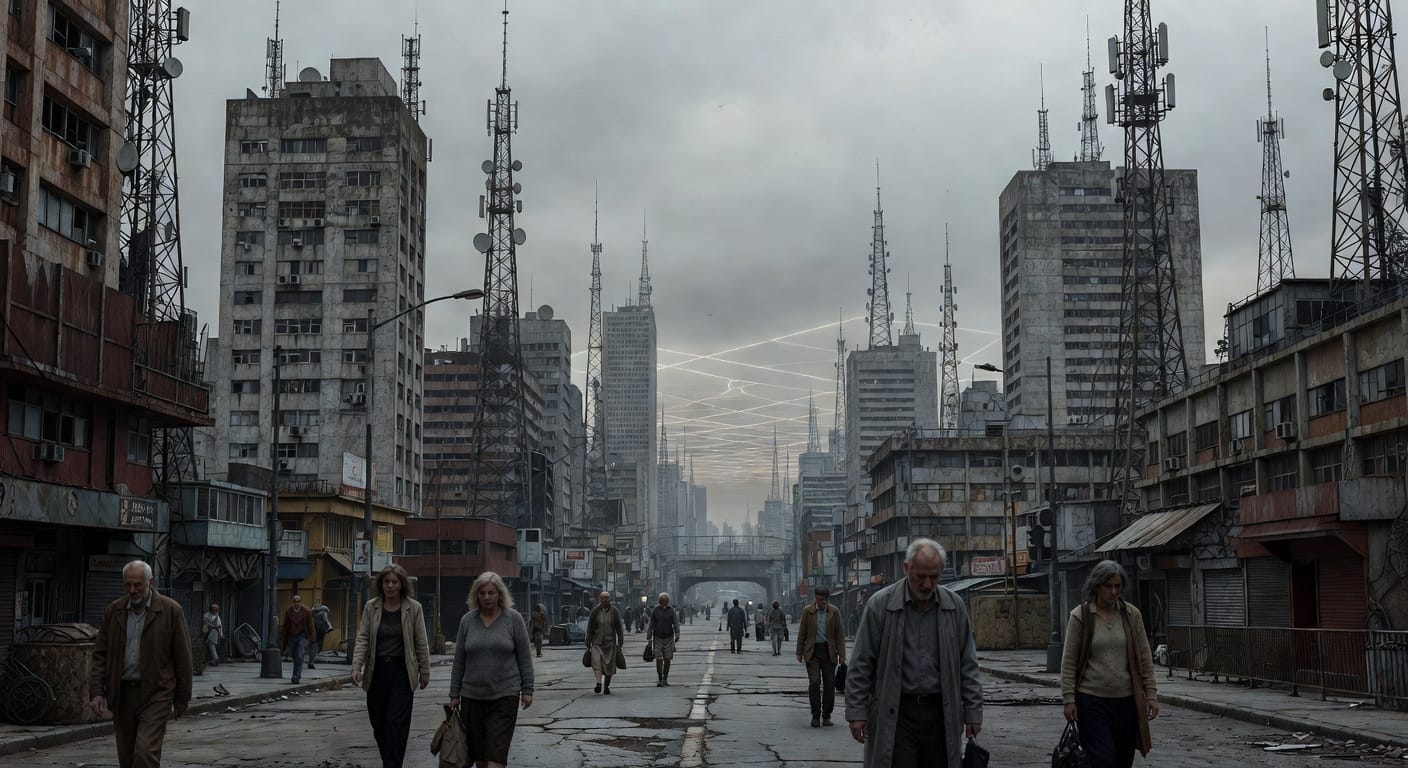
In the game Half-Life 2, the Combine does not wipe humanity out with bombs or camps. It flips a switch. A suppression field settles over the planet, and people stop reproducing. No spectacle. No grand finale. Just attrition.
It reminds me a lot of the cell towers our civilization seems to be building, almost compulsively, at ever-increasing densities. Escaping the reach of a cell tower is becoming harder and harder. We’re making our own biological suppression field, just so we can doom-scroll through an endless feed of depressing crap on social media.
In the movie Children of Men, the mechanism is never explained. The births simply stop. The future drains out of the room, and the world goes gray. People still go to work. They still buy coffee. They still watch the news. They just lose all hope and legacy. The movie is worth watching. It’s a preview of what’s in store for us and our children, and might just spur you into action, if the statistical trends aren’t cutting it for you.
Unfortunately, it seems as though our reality is heading for some combination of these fictional scenarios.
A convergence of chemical exposure, metabolic damage, medical overreach, economic pressure, and cultural incentives, all pushing in the same direction. Look at the parts separately and you get a stack of worrying trend pieces. Look at them together and you get a suppression field.
Something From Nothing
Modern regulation is built on a fantasy. It assumes exposures arrive one at a time.
This particular chemical is under the limit. That pesticide is under the limit. This plasticizer is with safe doses. This drug is approved. This building material passed inspection. This wireless standard is “safe” under rules written before smartphones existed.
But nobody lives one exposure at a time.
The best work in this field shows what happens when “harmless” inputs stack. In 2002, Silva’s team published a paper literally titled “Something From Nothing”: eight weak estrogenic chemicals, each below its no-effect threshold, still produced a measurable combined effect. Individually all of the exposures were considered safe. Put them all together and now there were serious health effects.
In 2009, Christiansen and colleagues found that four anti-androgenic chemicals at individually low doses could disrupt male development synergistically, not merely additively. In 2022, Andreas Kortenkamp’s team measured nine chemicals in 98 young Danish men and found a combined hazard index for semen quality at a median of 17 times the safe threshold.
Just nine.
Meanwhile, the CDC’s biomonitoring program tracks more than 400 environmental chemicals in real human bodies. Not hypothetical exposures. Measured ones. Then add the non-chemical layers: ultra-processed food, chronic stress, sleep debt, pharmaceutical burden, delayed childbearing, social atomization, EMF.
The real scandal is not that one product is dangerous. It is that almost nobody evaluates the whole stack together.
Three Layers, One Direction
The field works because every layer lands on the same target: family formation.
The first layer is biological. Hormones get disrupted, inflammation goes up, sperm quality falls, and bodies absorb an ever-increasing chemical load. We covered much of this in the previous parts of the series.
The second layer is economic. Child Care Aware reported that the average annual price of child care reached $13,128 in 2024. A study in Demographic Research found that, among female graduates, every $1,000 increase in student debt reduced the odds of first marriage by 2% per month.
The third layer is cultural. Pew found that the share of US adults under 50 without children who say they are unlikely ever to have them rose from 37% in 2018 to 47% in 2023. Among those unlikely to have children, 57% said a major reason was that they just did not want to, and 44% said they wanted to focus on other things.
This is also where feminism devalued motherhood. In professional work culture, motherhood is treated less like adulthood fulfilled and more like a career interruption to be delayed, outsourced, or apologized for. Economists have a name for part of the pattern: the child penalty. Review work from the National Bureau of Economic Research argues that child penalties now explain most of the remaining gender inequality in earnings, because women’s pay and career trajectories diverge sharply after the first child while men’s often do not.
The prestige ladder moved. Credentials, income, mobility, and uninterrupted self-construction get rewarded in public. Motherhood gets treated like a private detour that has to defend itself.
Children of Men Without the Drama
Children of Men understood something colder than panic.
A society does not need flames in the street to be dying. It can die in fluorescent light. It can die in daycare invoices, fertility clinic waiting rooms, antidepressant prescriptions, and apartment leases that punish anyone trying to raise more than one child. It can die in the shrugging assumption that parenthood is reckless, the world is too broken, and maybe a dog and a streaming subscription will do.
That mood is not coming from nowhere. It is what cultural resignation looks like after the biological and economic pressures have been grinding away for years.
This is the real horror. Not only infertility, but normalization. A society can accept civilizational collapse if it arrives dressed as responsible adulthood, lifestyle branding, and personal choice.
Our version is messier and more believable than anything fiction gave us. We have the invisible chemical and radio frequency fields, the economic choke points, the cultural deadening, and the surrogates waiting in the wings (porn, AI girlfriends, eventually robot companions).
And we can’t just recruit some action hero who’s going to turn off the suppression field and give us our fertility back. We’re going to have to make decisions, several per day, every day, for the rest of our lives, to put ourselves back on course.
And as we do that, we’re going to diverge into two societies, existing in parallel. More on that in the next part.