

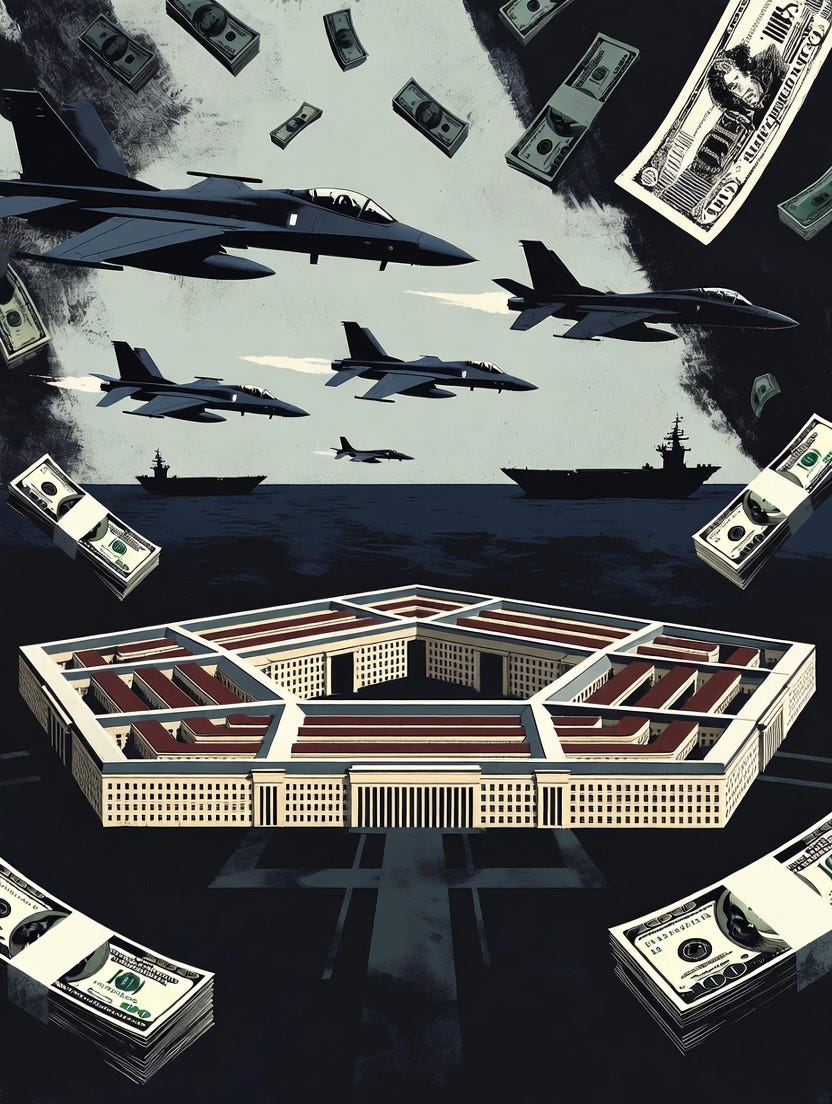
1. Pentagon Gaming Out a Sustained Military Campaign Against Iran
The Pentagon is preparing plans for a sustained, weeks-long military campaign against Iran if nuclear talks collapse, according to two U.S. officials who spoke to Reuters. This is a significant escalation from Friday’s confirmation that a second aircraft carrier, the USS Gerald R. Ford, is joining the USS Abraham Lincoln in the Persian Gulf.
Two carrier strike groups in one theater is an unusual concentration of American firepower. The Ford’s crew has been at sea for eight months and the Navy has flagged the ship as overdue for maintenance.
Trump has given Tehran roughly a month to agree to a deal on its nuclear program. Iran says its ballistic missile program is off the table.
Inside Iran, the regime is reeling from a crackdown on nationwide protests last month that reportedly killed nearly 7,000 people. Iranians are now holding 40-day mourning ceremonies, which historically reignite unrest.
“Weeks” could easily turn into years. Ask Iraq. Two carrier strike groups run roughly $12 million per day to operate. If this escalates, the bill lands on the American taxpayer, and the human cost lands on Iranian civilians who had nothing to do with their government’s nuclear ambitions.
Sources: Reuters, AP via Washington Times, The National
2. Border Patrol Shot Army Lasers at Party Balloons, Shut Down El Paso Airspace
When the FAA suddenly closed airspace over El Paso on Wednesday, Transportation Secretary Sean Duffy announced the move was prompted by a “cartel drone incursion” and assured the public that “the threat has been neutralized.”
That was not what happened.
A Border Patrol unit fired a U.S. Army LOCUST laser counter-drone weapon at what they assumed was a drone near Fort Bliss. It was a metallic party balloon. The weapon was deployed without FAA approval, which may have violated federal law. The FAA’s chief lawyer had warned the Department of War in a February 6 email that using the weapon near civilian airspace posed “a grave risk of fatalities or permanent injuries” to people flying overhead.
The FAA shut down airspace below 18,000 feet near El Paso, disrupting commercial flights and diverting medevac helicopters to Las Cruces, New Mexico, 45 miles away. The order was rescinded hours later.
The Department of War’s position: it doesn’t need FAA approval. Deputy Secretary Steve Feinberg reportedly said the department was “free to do what it wanted.” This comes after the fatal January 2025 collision between an American Airlines jet and a U.S. Army Black Hawk near Reagan National that killed 67 people. The administration has yet to walk back its “cartel drone” claim.
Sources: New York Times, NBC News, Zero Hedge
3. The U.S. Government Sold $701 Billion in Treasuries This Week. The Math Is Getting Ugly.
The Treasury Department held nine auctions this week, selling $701 billion in securities. That includes $54 billion in 10-year notes at 4.18%, replacing $25 billion in 10-year notes from 2016 that yielded 1.73%. That single swap added $29 billion to the total outstanding debt.
This is the mechanical reality of deficit spending. Every month, maturing low-rate debt from the easy-money era rolls over into higher-rate replacements, and total outstanding debt keeps growing because new issuance far exceeds what it replaces. The Treasury said it would shift toward more short-term bill issuance to ease pressure on long-term yields. Wolf Street’s analysis found that was jawboning: the ratio hasn’t actually shifted.
Meanwhile, services inflation spiked in January. Core services CPI jumped 0.39% month-over-month (4.8% annualized), the worst reading in a year. The BLS headline of 2.4% relies heavily on Owner’s Equivalent of Rent, a metric Wolf Street has documented as having been manipulated with doctored figures for September through November. Food prices are up 30% since January 2020.
The 13-week Treasury bill yield at 3.60% signals the market no longer expects a rate cut within three months. If you carry a mortgage, car note, or credit card balance, borrowing costs aren’t going anywhere.
Sources: Wolf Street, Wolf Street (CPI)
4. BLS Quietly Erased 1.03 Million Jobs
The Bureau of Labor Statistics released its annual benchmark revisions this week. Total nonfarm employment is 1.03 million jobs lower than previously reported for 2024 and 2025.
Every month, the BLS estimates payrolls from employer surveys and a model that guesses how many businesses opened or closed. Once a year, it checks those estimates against actual quarterly payroll tax data, which counts every employee in the country. The tax data is the gold standard. It showed the BLS had been overstating job growth by over a million positions across two years.
For two years, those inflated figures shaped Federal Reserve decisions, market expectations, and political narratives about the economy’s strength. They were wrong. Wolf Richter notes the obvious fix: benchmark quarterly instead of annually. The BLS has the data. It just doesn’t update.
Why it matters: If you’ve been skeptical every time a jobs report was touted as proof of a strong economy, this is your vindication. The government’s own data, once corrected against harder numbers, shows the labor market was significantly weaker than advertised.
Sources: Wolf Street
5. Jimmy Lai Sentenced to 20 Years in Hong Kong
Jimmy Lai, the 77-year-old founder of Hong Kong’s Apple Daily newspaper, was sentenced to 20 years in prison under China’s national security law. The charge: conspiracy to collude with foreign forces.
Lai’s actual crime was running an independent newspaper critical of Beijing and meeting with foreign officials to advocate for Hong Kong’s democratic movement. Apple Daily, which had a daily readership of over a million, was forced to close in 2021 after authorities froze its assets and arrested its editors.
Lai has been in custody since December 2020. He is a British citizen. The UK called the sentence “politically motivated” and demanded his release. Beijing’s response: the trial was “fair” and foreign governments should mind their own business.
Lai had every opportunity to leave Hong Kong before the crackdown. He chose to stay. He’s now spending what may be the rest of his life in prison for publishing a newspaper.
Sources: AP News, Epoch Times, Reuters