

I’ve been watching social media the past couple days, and something is eating at me.
A man named Edgar lived in the United States for over twenty years. He worked construction. He started a family with his wife Amavilia in South Florida. They had a baby. Within days of his son’s birth, Edgar was detained on a 2016 warrant for driving without a license, transferred to ICE custody, and deported to Guatemala. His wife now wakes at 3 AM to cook lunches she sells for ten dollars each, trying to feed two children alone.
The comment sections are predictable. “Tough. Shouldn’t have broken the law.”
In Wilder, Idaho, ICE conducted a mass raid at a family event. According to an ACLU lawsuit, people were shoved to the ground, zip-tied at gunpoint, denied food and water. Juana Rodriguez, a 30-year-old woman born in Idaho (that’s a US citizen, for those keeping score), begged officers to remove her zip-ties so she could console her sobbing 3-year-old son. They wouldn’t.
“Shouldn’t have been there.”
In April 2025, ICE deported three US citizen children, ages 2, 4, and 7, along with their mothers from New Orleans. American kids. Deported from their own country.
“Well, their parents shouldn’t have broken the law.”
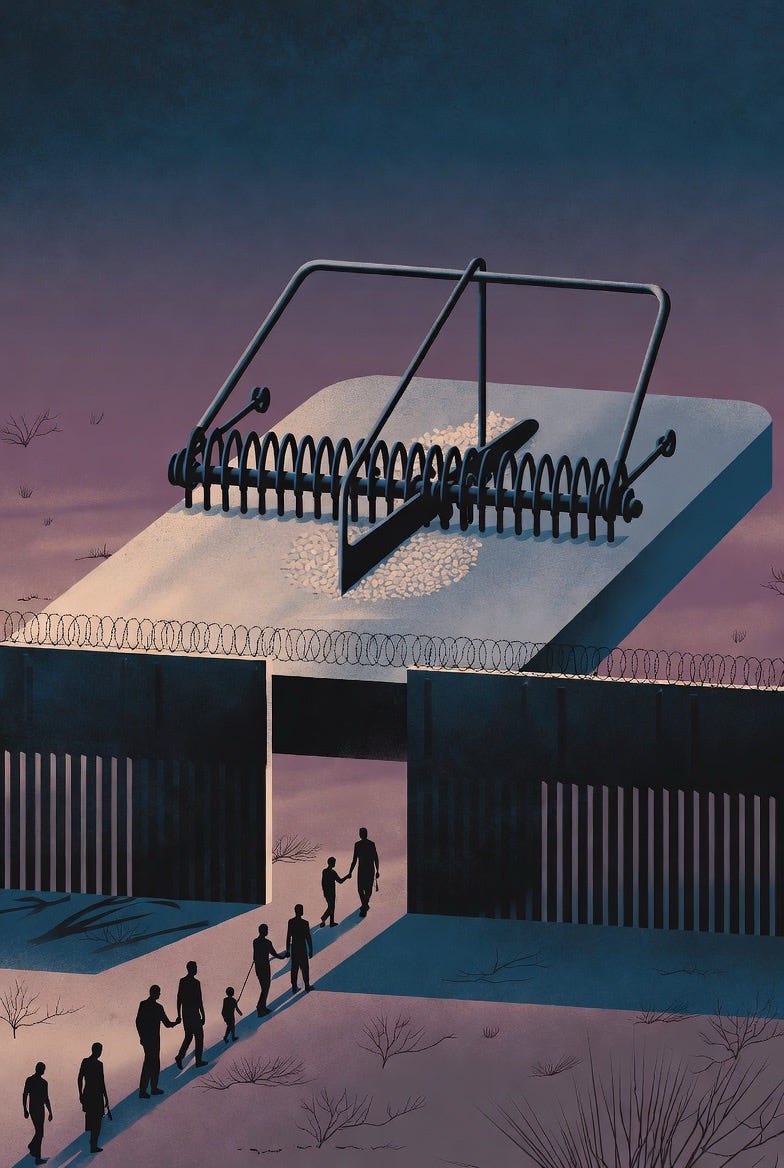
Let me be very clear about what I’m not doing here. I’m not writing a progressive “open borders” piece. I’m not writing a conservative “secure the border” piece. Both of those positions are part of a trap that’s been designed for you, and most of you are walking right into it with your eyes shut and your fists pumping.
This is a liberty piece. And if it doesn’t make you at least a little uncomfortable, regardless of your politics, I haven’t done my job.
The System Was Designed to Fail
Here’s a question the “just do it legally” crowd never asks: How, exactly?
The Cato Institute (not exactly a bleeding-heart outfit) published a comprehensive report called “Why Legal Immigration Is Nearly Impossible.” Their conclusion: employer sponsorship is buried under an “almost insurmountable barrier of bureaucratic red tape” that excludes nearly all workers without college degrees. Many applicants will literally die of old age before their number comes up.
This isn’t hyperbole. The USCIS backlog hit a record 11.3 million pending cases in 2025. Immigration courts have 3.7 million pending cases with average waits near four years. Family visa categories from Mexico, India, the Philippines, and China face waits measured in decades, not years. Mexico alone has 1.2 million people in the family-sponsored backlog. India has 291,000. Employment-based visas from India can mean 10 to 15 years of waiting.
Per-country caps limit each nation to 7% of annual allocation regardless of demand. A software engineer from India and one from Luxembourg get the same quota, despite India having 1,400 times more people.
Immigration law has been called “second only to the Internal Revenue Code in complexity” and a system where “a lawyer is often the only person who could thread the labyrinth.” An immigration attorney from Cornell confirmed it bluntly: “Immigration law has been called the second most complex area, second only to tax law, and there are often life-or-death consequences.”
Now compare this to how America actually processed immigrants when it was honest about what it was doing. At Ellis Island’s peak (1900-1914), an average of 1,900 people per day were processed. Most were through in three to five hours. Only 6% were rejected. Twelve million immigrants came through Ellis Island in total. They showed up, they were checked for disease and obvious disqualifiers, and they were in.
That was America when it actually wanted immigrants. Today’s system isn’t broken. It was designed this way. You create a labyrinth that virtually no low-skilled worker can navigate, you keep the backlogs measured in decades, and then you tell people who skipped the impossible line that they “should have done it legally.” It’s the bureaucratic equivalent of building a maze with no exit and then shooting anyone who climbs over the wall.
The Two-Step You Keep Falling For
Here’s the part that should make both sides angry.
Step One: Open the floodgates. Under the Biden administration, there were roughly 160,000 monthly border encounters on average. From FY2021 through early 2024, authorities encountered unauthorized migrants about 9.4 million times. The Department of Homeland Security documented 10.8 million total inadmissible encounters. Sanctuary jurisdictions (the DOJ has published an official list) explicitly limited cooperation with federal immigration enforcement. The message, whether stated or implied: come on in. Build a life. Put down roots. Enroll your kids in school. And then, when the political winds shift, all those roots you planted become handles for the next administration to grab. Sanctuary cities aren’t protection. They’re bait. They load the target population for the inevitable crackdown to harvest.
Step Two: Crack down with overwhelming force. The “One Big Beautiful Bill” allocated $170 billion for immigration enforcement. ICE’s budget went from $10 billion to $29 billion: nearly tripling. The stated goal: deport 1 million people per year. ICE plans to spend $38.3 billion converting warehouses into mega-detention centers, targeting 92,600 beds. For context, that $38.3 billion is more than the annual budgets of 22 US states. The Cato Institute estimates that at full capacity, ICE would be detaining 200,000+ people at any given time, with roughly 2 million cycling through annually.
Ten thousand new ICE officers are being hired. The sensitive locations policy that kept immigration agents away from schools, churches, and hospitals for decades was rescinded on Day One. The president invoked the Alien Enemies Act of 1798 to fast-track deportations. That same law provided the legal basis for the internment of 125,000 Japanese Americans during World War II, two-thirds of whom were US citizens.
See the pattern? One party opens the door. The other slams it shut with a battering ram. Both sides claim the other is the problem. And the ratchet only turns one direction: toward more state power.
The Brennan Center for Justice coined a chilling phrase for what’s being built: a “deportation-industrial complex.” Most of the new detention facilities will be run by for-profit private prison corporations, creating “strong economic and political constituencies that will make the new apparatus very difficult to dismantle.” Just like the military-industrial complex, once the contracts are signed and the lobbying dollars flow, this machine develops its own survival instincts.
Ask yourself: if they deport everyone they’re claiming to target, what happens to a $170 billion enforcement apparatus with 10,000 new agents and 92,600 detention beds? Does it quietly shut itself down? Has any government agency, ever, in the history of the world, voluntarily reduced its own budget and headcount because the job was done?
The TSA was supposed to be temporary. The Patriot Act was sold as an emergency measure with sunset provisions; its core powers were made permanent. Yale Law professor Oona Hathaway warned that the Authorization for Use of Military Force “massively expanded beyond what Congress initially envisioned,” setting “a dangerous precedent... that Congress might pass an authorization that it means to be very narrow or limited, and presidents can interpret those authorities in increasingly broad and creative ways.”
That’s not a bug. That’s the feature.
The Constitution-Free Zone You’re Already Living In
The Founding Fathers fought a revolution over warrantless searches. Two hundred and fifty years later, the government just drew a line on a map and gave itself permission to do them again. Federal regulations give Customs and Border Protection authority to operate within 100 miles of any US “external boundary”, including all land borders and coastlines. Within this zone, CBP claims authority to stop, frisk, detain, interrogate, and arrest people without a warrant.
Two-thirds of the US population, roughly 200 million people, lives in this zone. Entire states fall within it: Connecticut, Delaware, Florida, Hawaii, Maine, Massachusetts, New Hampshire, New Jersey, New York, Rhode Island, and Vermont. Nine of the ten largest US metro areas are inside it.
The regulation was adopted in 1953 by the Department of Justice without any public comment or debate. At the time, there were fewer than 1,100 Border Patrol agents. Today there are over 21,000, with thousands more on the way.
A Penn State Law Review article called this “constitutional erosion” affecting two-thirds of the American population. The Fourth Amendment is not fully suspended in this zone (the ACLU notes that agents still need “reasonable suspicion” for stops), but in practice, Border Patrol routinely exceeds its legal authority. And when they do? The ACLU documents “inadequate training for Border Patrol agents, a lack of oversight by CBP and the Department of Homeland Security, and the consistent failure of CBP to hold agents accountable for abuse.”
If you live anywhere near a coast or border (that’s most of you), you are already inside a zone where your Fourth Amendment protections exist more on paper than in practice. And the immigration enforcement buildup is supercharging it.
The Milgram Problem (Or: Why You Lost Your Empathy)
In 1961, psychologist Stanley Milgram set up an experiment at Yale to understand how ordinary people participated in the Holocaust. He expected to prove that Germans were uniquely susceptible to authoritarian compliance. What he found instead is that 65% of American participants administered what they believed were lethal electric shocks to another person, simply because an authority figure in a lab coat told them to continue.
They weren’t sadists. They expressed extreme distress. They sweated, they trembled, they begged to stop. But when the man in the lab coat said “the experiment requires that you continue,” most of them kept turning the dial.
Milgram never needed to go to Germany. He found authoritarianism in Connecticut.
As a Psychology Today analysis put it: “We watch in real time as millions of our fellow citizens demonstrate their willingness to follow authoritarian leaders who demand loyalty above truth, who attack democratic institutions, and who dehumanize those they define as ‘others.’”
Hannah Arendt watched Adolf Eichmann’s trial and concluded he was “neither perverted nor sadistic” but “terrifyingly normal.” He was a bureaucrat who followed orders. She wrote that “the essence of totalitarian government, and perhaps the nature of every bureaucracy, is to make functionaries and mere cogs in the administrative machinery out of men, and thus to dehumanize them.”
That’s the psychological machinery running right now. The state declares a category of person “illegal.” Authority figures repeat it. Media amplifies it. Research confirms that the term “illegal alien” measurably increases prejudice through “heightened perceptions of threat.” A 2011 legal study found that when the Supreme Court used dehumanizing metaphors like “invasion of illegal aliens,” cases were more likely to result in unfavorable outcomes for immigrants. The language isn’t an accident. It’s a technology.
And once the empathy switch is flipped, the Milgram 65% take over. Normal people who consider themselves moral look at a man who lived here 20 years, had a baby, and got deported over a decade-old traffic ticket, and their response is: “Shouldn’t have broken the law.”
That sentence is the modern equivalent of “I was just following orders.” It’s a moral off-switch wrapped in legalism.
The Real Beneficiaries (Hint: Not You)
Let’s follow the money and power, because that’s what this is actually about.
Corporations get a workforce they can exploit without consequence. Undocumented workers can’t complain about safety violations, can’t sue for wage theft, can’t organize. As one expert told the Loyolan: “Big companies love undocumented labor because it’s cheap, and it’s easy to exploit.” If they actually wanted to stop illegal immigration, they’d go after employers. They don’t, because the exploitation is the point.
The government gets expanded power. Every “crisis” justifies more authority, more funding, more surveillance. The $170 billion deportation apparatus being built right now will not be dismantled when the “crisis” ends, because crises never end when there’s money in perpetuating them.
The media gets engagement. Immigration is the perfect rage-fuel: emotional, visual, tribal. Left-leaning outlets run crying children at the border. Right-leaning outlets run crime stories involving immigrants. Both get clicks. Neither solves anything.
Working-class Americans and immigrant workers both lose. They’re pitted against each other by the same people who profit from both their labor. As the Atlantic documented, immigration has historically been viewed as “great for corporations (cheap labor) and consumers (lower prices) but bad for native-born workers.” Meanwhile the Maine AFL-CIO traced this pattern back to the 1880s: Irish workers pitted against Chinese workers, French Canadians described as “the Chinese of the eastern states.” Same playbook, different century.
This playbook is older than the republic itself. Every ruling class in history has used ethnic and immigrant scapegoating to keep the working class fighting each other instead of looking up.
Today It’s “Illegals.” Tomorrow It’s You.
Here’s where I lose whatever readers I haven’t already lost.
The infrastructure being built for immigration enforcement will be turned on American citizens. It always is. This isn’t speculation. It’s the most predictable pattern in the history of state power.
The Alien Enemies Act of 1798, originally targeting French nationals during a war scare, was used to intern 125,000 Japanese Americans in 1942. Two-thirds of them were born here.
The Patriot Act, sold as a tool against foreign terrorists, has been used for domestic surveillance of American citizens on a massive scale.
Tom Homan, Trump’s border czar, has already confirmed that ICE made “collateral arrests” of “many” American citizens during immigration operations, detained based on “location, occupation, physical appearance.” American citizens. Detained based on how they look.
The Brookings Institution warned that immigration surveillance databases and AI tools are “particularly concerning... given the nation’s history of using antiterrorism and national security measures to disproportionately surveil and infringe upon the civil liberties of minority groups.” And because data is stored indefinitely, “the expansion of immigration surveillance without robust privacy and free expression protections could have far-reaching effects on all Americans.”
When you cheer for a deportation machine with a $170 billion budget, 92,600 detention beds, 10,000 new officers, authority to raid churches and schools, and operations in a zone covering two-thirds of the country, you are not cheering for something that will only be used against “illegals.” You are cheering for infrastructure.
Today the target is someone who overstayed a visa twenty years ago. Tomorrow it’s gun owners who didn’t register under a new law. Or homeschoolers who didn’t comply with a curriculum mandate. Or crypto users who violated a financial regulation they’ve never heard of. Or someone who posted the wrong thing online.
Once you let the state define an entire category of human beings as fundamentally outside the protection of rights, you’ve handed it a template. All it needs to do next time is change the label.
The Ponerology of Immigration Policy (Or: The Architects Can’t Feel Pain)
If you’ve been following our series on ponerology, you already know the core insight: power structures attract people who are clinically incapable of empathy. Psychopathy is 3-4 times more prevalent among CEOs and people in positions of institutional authority than in the general population. The trait is 60-81% heritable based on twin studies.
These aren’t people who make cruel policy because they’re misguided. They make cruel policy because cruelty is invisible to them. They don’t experience the suffering they create. A system designed by people without empathy will inevitably produce outcomes that lack empathy. That’s not a moral failing. It’s a diagnostic criterion.
The immigration system isn’t broken by accident. The impossible backlogs, the decades-long waits, the Byzantine complexity, the deliberate under-funding of immigration courts while tripling the enforcement budget: these aren’t bugs. They’re design choices. You make legal immigration functionally impossible. You let millions come through the back door. Then you build a massive enforcement apparatus to go after them. At every stage, someone in power benefits. At no stage does the underlying problem get solved, because solving it would eliminate the leverage.
The people typing “shouldn’t have broken the law” on social media are playing the same role as Milgram’s subjects. They’re the 65%. Not evil. Not psychopathic. Just responding to authority signals with compliance instead of thought. The authority said these people are “illegal.” The law says they shouldn’t be here. Therefore their suffering is justified. QED.
Hannah Arendt would recognize this instantly. The banality of evil isn’t about monsters. It’s about normal people who stop thinking.
There Is No Political Solution
If you’ve read this far hoping I’ll tell you which party to vote for, or which immigration policy would fix this, I’m going to disappoint you.
The Democrats created the conditions for a crisis. The Republicans are using the crisis to build a police state. Both are funded by the same corporate donors who profit from exploitable labor. Both benefit from the wedge issue that keeps you arguing with your neighbor instead of questioning why you’re paying $170 billion so that private prison corporations can warehouse human beings.
Voting for “better immigration policy” is like asking the fox to redesign the henhouse. The people who designed this system are constitutionally incapable of designing one that serves human beings, because they don’t experience other human beings as fully real.
The answer, as always, is exit and build.
Stop debating immigration policy on social media. Stop letting the state define who counts as a person and who doesn’t. Stop giving your emotional energy to a system designed to harvest it.
Build communities that don’t need the state’s permission to exist. Build economic systems outside government control. Build human connections that cross the artificial lines drawn by people who see all of us (citizens and immigrants alike) as resources to be managed, not people to be respected.
The man in Idaho who zip-tied a US citizen mother and ignored her toddler’s screams didn’t do it because he hates Latinos. He did it because he was wearing a uniform, following orders, in a system designed by people who don’t feel what other humans feel. The person typing “shouldn’t have broken the law” isn’t evil. They’re just doing what Milgram predicted: following the authority, turning the dial, and not looking too hard at what’s on the other end.
The monsters were never supernatural. They just run the system. And until enough people see that clearly, the system will keep producing exactly what it was designed to produce: division, compliance, and power.
The dial goes higher. The question is whether you’ll keep turning it.
Sources
PBS/AP, “Trump administration separates thousands of migrant families in the U.S.” (Dec 2025)
ACLU, “Lawsuit: Mass Immigration Raid at Family Event in Wilder, Idaho” (Feb 2026)
Mother Jones, “ACLU’s lawsuit over ICE raid at an Idaho racetrack” (Feb 2026)
NBC News, “Idaho families sue over immigration raid” (Feb 2026)
Cato Institute, “Why Legal Immigration Is Nearly Impossible” (Jun 2023)
VisaVerge, “US Immigration Backlog Reaches New High” (Jul 2025)
History.com, “At Peak, Most Immigrants at Ellis Island Were Processed in a Few Hours”
Migration Policy Institute, “Comparing Biden and Trump Deportation Records” (Feb 2025)
House Committee on Homeland Security, “FY2024 Startling Stats” (Oct 2024)
Brennan Center, “Big Budget Act Creates a ‘Deportation-Industrial Complex’”
NPR, “How ICE became the highest-funded US law enforcement agency” (Jan 2026)
AP News, “ICE plans $38.3 billion detention expansion” (Feb 2026)
Reuters, “ICE to spend $38.3 billion on detention centers” (Feb 2026)
Cato Institute, “5% of ICE Detainees Have Violent Convictions, 73% No Convictions” (Nov 2025)
CBS News, “Less than 14% of ICE arrests had violent criminal records” (Feb 2026)
The Guardian, “2025 was ICE’s deadliest year in two decades” (Jan 2026)
Southern Border Communities Coalition, “100-Mile Border Enforcement Zone”
Penn State Law Review, “The U.S. Border Patrol’s Constitutional Erosion”
BBC, “Alien Enemies Act: The 1798 law Trump used to deport migrants” (Sep 2025)
Densho, “The Alien Enemies Act Paved the Way for Japanese American Incarceration”
Brennan Center, “Rolling Back the Post-9/11 Surveillance State”
TIME, “How 9/11 Radically Expanded the Power of the U.S. Government” (Sep 2021)
Psychology Today, “Milgram’s Obedience to Authority Experiment Comes Home” (Feb 2025)
Aeon, “What did Hannah Arendt really mean by the banality of evil?”
PMC, “Effects of dehumanization and disgust-eliciting language on attitudes toward immigration”
AILA, “From ‘Alien’ to ‘Noncitizen’: The Subtle Power of Language in U.S. Courts”
The Atlantic, “The Truth About Immigration and the American Worker” (Oct 2024)
Loyola Marymount/Loyolan, “Cheap labor: An unexpected adversary to immigration reform”
Maine AFL-CIO, “How Corporations Use Anti-Immigrant Politics to Divide the Working Class”
Wikipedia, “Detention and deportation of American citizens in the second Trump administration”
Brookings Institution, “How tech powers immigration enforcement” (Oct 2025)
Cato Institute, “Deportations to Add Almost $1 Trillion in Costs” (Jun 2025)
Smarthistory, “Nativism, immigration, and the Know-Nothing Party”
National Immigrant Justice Center, “22 People Challenge Unlawful Warrantless ICE Arrests” (Oct 2025)
Foster Global, “The Dehumanizing History of Words We’ve Used to Describe Immigrants”