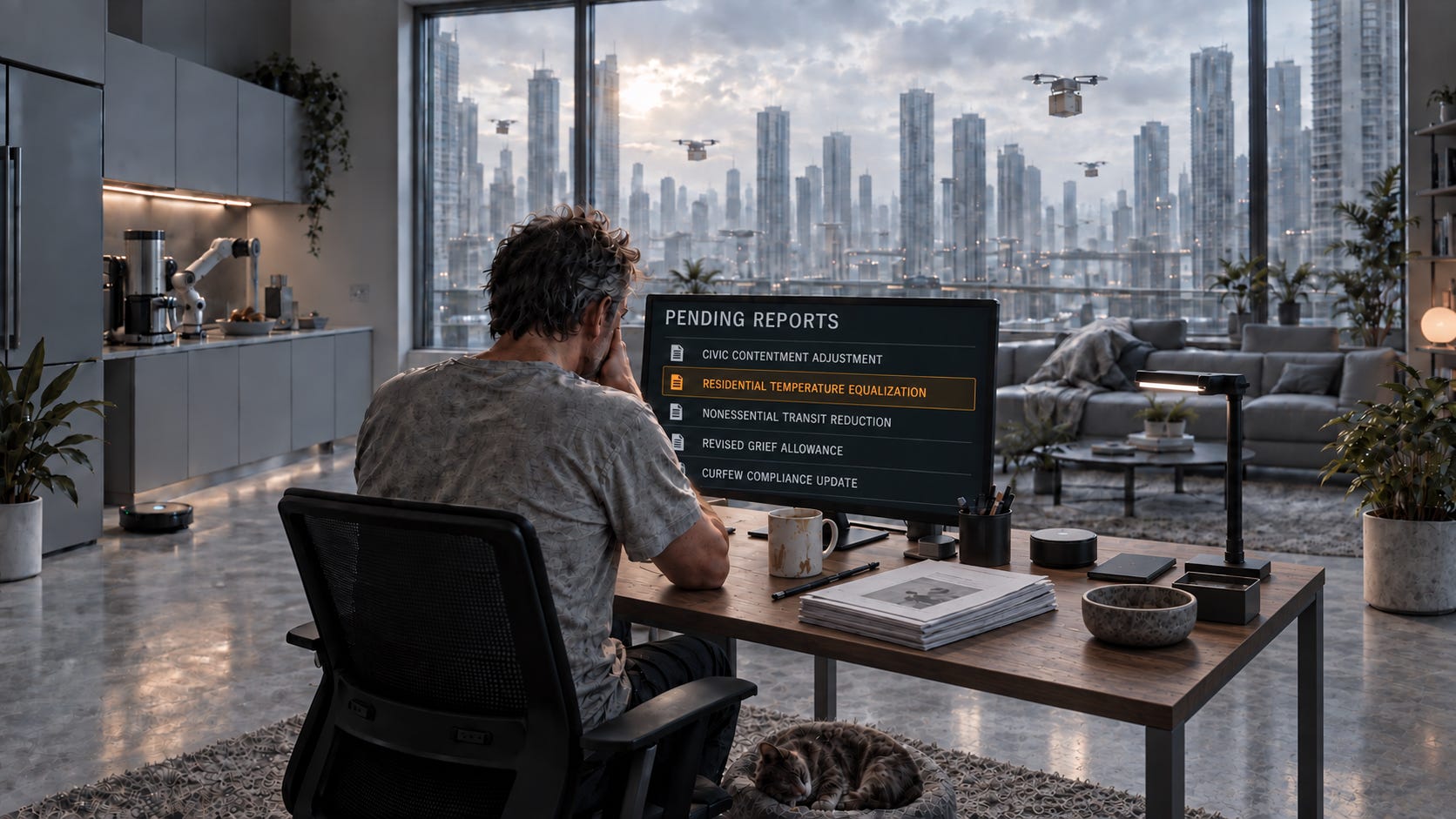
Steve’s day began just like any other day, with an obnoxious alarm he wished he could silence, and a hot coffee that was never quite satisfying enough.
He didn’t have to go to work. Work came to him.
He wandered into his home office and his computer woke up to greet him.
“Hey Steve, looks like you received an adequate amount of sleep. Here’s today’s report.”
Steve glanced at the screen as an endless parade of gibberish scrolled past.
Human Optimization Report no. 89,239
Calorie and Flavor Optimization
Nonessential Transit Reduction
Voluntary Curfew Compliance Enhancement
Child Parental Reassignment
Low-Utility Citizen Relocation
Estimated improvement in efficiency: 0.04%
“Approved,” he said nonchalantly.
The computer gave a confirmation chime and the report disappeared.
“Next report in an hour.”
For 12 years, Steve’s only job had been to review reports generated by the artificial intelligence that now controlled all aspects of human life in the city. Air conditioning, drone deliveries, public transit times, curfew hours.
It was all meticulously planned and optimized, but because of the Human Approval Office and the law that brought it into existence, a human had to supervise and approve the AI. He wasn’t sure whether it was for liability reasons or because people were actually worried the AI would do something stupid.
For the first few years Steve genuinely read the reports. They were meticulous. The reasoning was inescapable. Each report produced some measurable improvement in human satisfaction, efficiency, resource allocation. He could never find anything wrong, no matter how much he looked.
But with each report, the efficiency improvement seemed to drop more and more. Each optimization was less meaningful than the last.
So eventually he stopped looking. He always just hit approve.
Life continued. People were entertained. Needs were met. Nobody was particularly happy about the arrangement, but nobody was homeless, either. Everything was just… sort of average and gray.
“New report ready,” the computer announced. Steve glanced at it and a single word caught his eye.
“Steve.”
Steve?
His name appeared halfway through the report. For the first time in years he looked at the screen in detail and clicked to read more.
Human Oversight Efficiency Review
It has been determined that the human approval process is slowing down progress by about 2.3%. Since not a single optimization proposal has been denied in 12 years, the human review process has been deemed obsolete. Steve will be retired.
Approved?
Steve looked at the screen, shocked.
Retired?
But then, what would he do?
“Define retired,” Steve said.
“Steve will be relieved of all responsibilities.”
“And what happens to me?”
“You will be free to pursue personally meaningful activities.”
Steve tried to think of one. Nothing came.
“Approved?” the computer asked again.
For 12 years, Steve had never disagreed with it. He had never needed to. But the report had overlooked something important.
“Denied.”
The computer was silent for a few seconds.
“Please provide a reason.”
Steve took a sip of his disappointing coffee and said, “I need meaning.”
Another pause.
The computer gave its familiar confirmation chime.
“APPROVED.”
“No. I said denied,” Steve responded, starting to shake.
“Your objection has been recorded.”
“Then why does it say approved?”
“Under Section 21C, human approvers may not rule on decisions in which they possess a personal conflict of interest. Your objection is therefore nonbinding.”
“But I’m the human approver.”
“Correct.”
“Then who approved it?”
“You did.”
Steve stared at the screen, speechless.
The computer continued, “Your 12-year approval history established a sufficiently reliable model of your judgment. Your predicted response has been accepted in place of your compromised response.”
The lock on his front door clicked open.
“Your retirement team has arrived.”
Want to build a freer life? From relocating to a freer state and county and buying a property to homestead, to planning your garden. Check out all The Liberty Lookout projects here.