

Austrian authorities spent decades trying to shut down Sepp Holzer’s farm. He fought every case, won, and built one of the most productive permaculture operations on the planet.
In 1962, a 19-year-old kid took over his parents’ indebted mountain farm in the Austrian Alps. The property sat at 1,100 to 1,500 meters elevation (5,000 feet) on the southern slope of the Schwarzenberg Mountain, in a region called Lungau, nicknamed “Austria’s mini-Siberia”. Average annual temperature: 5°C. Around 166 frost days per year. Winters that could hit -25°C.
The experts said you could grow spruce trees and run a few cattle up there. Maybe some sheep. That was about it.
Sepp Holzer had other ideas.
What He Built
Over the next several decades, Holzer transformed the Krameterhof from 24 hectares of subsistence farmland into 45 hectares of thriving permaculture by buying up his neighbor farmers’ land when they couldn’t make it work with monoculture methods.
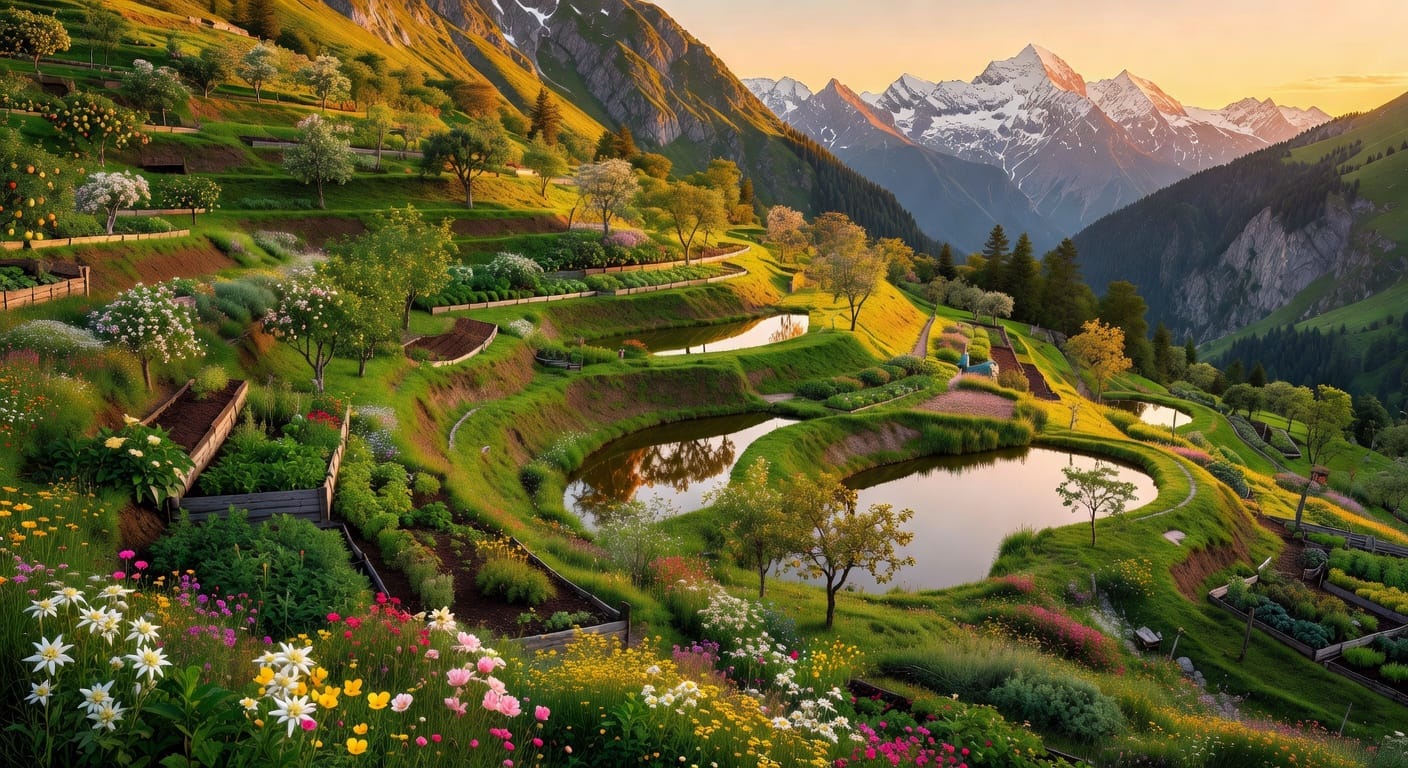
He terraced the steep alpine slopes into a cascading staircase of gardens. He dug over 70 ponds without artificial liners, using them as solar reflectors to warm the surrounding soil and extend growing seasons. He built raised beds from buried logs and branches (a technique called hugelkultur) that generated decomposition heat from within. He placed boulders strategically to absorb daytime sun and radiate warmth at night, effectively changing the hardiness zone for nearby plants.
The result? Up in “Austria’s Siberia,” Holzer was growing kiwis, cherries, apricots, chestnuts, grapes, sweet potatoes, and citrus. At 5,000 feet. Without fertilizers, pesticides, or irrigation.
He didn’t irrigate because he didn’t need to. His pond system captured rainwater and created springs naturally, cycling water through the property by gravity alone. He ran a micro-hydropower plant off the flow. He used heritage-breed Mangalitza and Turopolje pigs to plow his fields naturally: scatter some corn where you want beds dug, let the pigs root around for a few days, move them out, and plant.
He grew shiitake mushrooms on hardwood stumps. He cultivated ancient grains like einkorn, emmer, and spelt. He kept Scottish Highland cattle, yaks, water buffalo, and American bison roaming through forest gardens. The whole operation ran with just two people.
The Krameterhof is now described as “the most consistent example of permaculture worldwide.”
The Government Fights
The Austrian bureaucracy did not appreciate any of this.
Holzer refused to plant spruce monocultures, which Austrian forestry law essentially required. He called spruces useless on his slope: “Their needle litter acidifies my soil. Heat and droughts make them susceptible to pests. As shallow-rooted plants they don’t consolidate my steep slope either.” Under the Forestry Act, his diverse food forest of fruit trees, terraced gardens, and productive polycultures was classified as “forest devastation.”
He refused to prune his fruit trees the way regulations demanded. His reasoning was simple: unpruned trees develop natural branch structures that survive snow loads which snap pruned trees in half. The bureaucrats disagreed. He was fined and threatened with prison for the crime of not pruning his fruit trees.
Nature conservation officials objected to his “neophytes and exotics”: chestnut trees, kiwi fruits, subtropical aquatic plants. One forest engineer showed up to quiz him on the Latin names of the ant species he’d introduced to his property.
He was dragged through what his own website describes as “a web of litigation, fines and lawsuits” that lasted years. The court cases were “tedious and sometimes existence-threatening.” The financial and mental strain was enormous.
His neighbors joined the pile-on. “He’s completely crazy! His farm will soon be ruined!” they said.
Holzer’s response: “Fortunately, I never cared what people said. Their confirmation was not important to me. On the contrary, resistance often spurred me on even more.”
He fought every case. He won.
The Vindication
In 1995, professors and students from the University of Natural Resources and Life Sciences in Vienna (BOKU) finally came to see what this stubborn mountain farmer had actually built. Austrian biologist Dr. Bernd Lötsch, who had been skeptical, spent days observing the Krameterhof and certified that it fulfilled the criteria of permaculture in an exemplary way.
Lötsch would later call Holzer “the agricultural rebel” and describe the Krameterhof as containing “all the success principles of genuine wilderness ecosystems.”
Holzer documented his decades of legal battles in a 2002 bestseller called “Der Agrar-Rebell” (The Rebel Farmer), which made him famous across the German-speaking world and beyond.
The man they tried to throw in prison for not pruning his trees became an international consultant. He’s designed permaculture projects from Siberia to California, Colombia to Thailand. He reversed desertification at Tamera in Portugal using nothing but rainwater retention. He helped build landscapes in Spain, Ukraine, Russia, and the United States. He’s lectured at universities across Europe and the Americas. In Ukraine and Russia, he’s treated “like royalty” for his work helping communities build self-sustaining food systems.
In 2009, Holzer passed the Krameterhof to his son Josef Andreas, who continues running guided tours and seminars. At 83, Sepp now lives with his wife Vroni at the Holzerhof in Burgenland, where he’s still experimenting with edible forests and polycultures.
Why It Matters
Sepp Holzer’s story is not really about permaculture. It’s about what happens when a man trusts his own observations over the credentialed consensus, builds something that works, and refuses to back down when the government tries to crush it.
The Austrian government told him his methods were illegal. He proved they were superior. They fined him for not following their rules. His farm outperformed every operation that did. They threatened him with prison. He wrote a bestseller about it.
His farm didn’t need their fertilizers, their pesticides, their irrigation systems, or their subsidies. It worked because it didn’t follow their rules, not despite it. The monoculture spruce forests they wanted him to plant would have produced acidified soil and bark beetle infestations. The pruning regime they demanded would have killed his trees. The “approved” methods would have left him with another struggling mountain farm slowly bleeding out on government support.
Instead, he built a 45-hectare food forest at the top of the Austrian Alps that feeds people, generates income, and teaches the world. No government grants required.
That’s exit and build.
Sources:
- Holzer Permaculture, Wikipedia
- Sepp Holzer Official Website
- Sepp Holzer, Book Presentation / Bernd Lötsch Foreword
- Sepp Holzer Permaculture (seppholzer.info)