

Mark Shepard was designing body armor for the government when he decided he’d had enough of concrete walls and fluorescent lights. “My engineering career was incredibly short-lived,” he told EthicalFoods. “I didn’t like working out of a cubicle inside a concrete building with no windows. I wanted to live outdoors.”
So he left. Not for a nicer office or a corner with a view. He went back to school to study ecology, then hitchhiked to Alaska to homestead on land 300 miles from town, 5 miles off the road, and 3,500 feet up the side of a mountain. He and his wife Jen lived there for eight years.
When their first son was born, they wanted something a little less extreme. They bought a piece of beaten-down, abandoned cropland in southwest Wisconsin and started building something nobody around them had seen before.
That was 1994. Three decades later, New Forest Farm is 106 acres of edible forest in Viola, Wisconsin, and it’s considered one of the most ambitious perennial agriculture projects in the country.
What Corn Country Looked Like Before Corn
The land Shepard bought was typical Midwest wreckage: overgrazed pasture, depleted soil, the kind of exhausted ground left behind after decades of corn and soybean monoculture. It sits in the Driftless Area of southwestern Wisconsin, a region the glaciers skipped, leaving behind rolling hills and river valleys instead of the flat prairie most people picture when they think of the heartland.
Shepard looked at the landscape and asked a question most farmers never consider: what grew here before we started plowing?
The answer was oak savanna, a lightly forested grassland where oaks, hickories, chestnuts, and hazelnuts thrived alongside grasses and grazing animals. So that’s what he rebuilt.
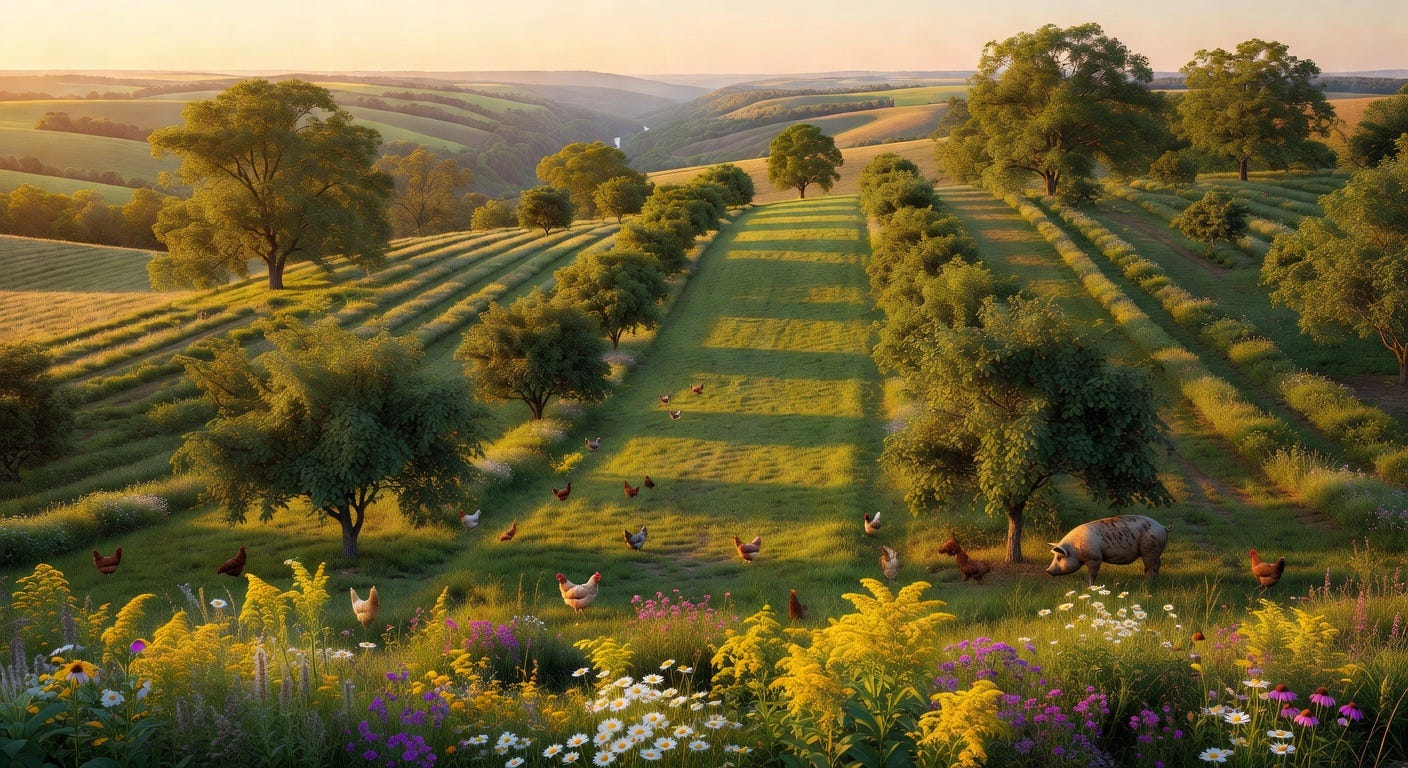
New Forest Farm is a planned conversion of that worn-out cropland into a commercial-scale perennial ecosystem modeled on the native oak savanna. Chestnuts, hazelnuts, walnuts, and apples are the primary tree crops. Between the rows: asparagus, winter squash, grapes, elderberries, currants, and raspberries. In the grassy alleys between the trees, cows, pigs, turkeys, sheep, and chickens rotate through on managed grazing cycles.
Over three decades, Shepard has planted an estimated 250,000 trees on the property. The farm is entirely solar and wind powered, and the equipment can run on locally produced biofuels.
“I Don’t Want My Plants to Be Sissies”
Shepard’s management philosophy is hilariously blunt. He calls it the STUN method: Sheer Total Utter Neglect. (His wife suggested renaming it “Strategic Total Utter Neglect,” since nothing about the setup is actually thoughtless.)
The idea is simple. Plant massively, then let natural selection do the sorting. Trees that can’t handle the local soil, rainfall, frost, and pests? They die. “If it dies, ‘good riddance,’” Shepard says. The survivors are naturally adapted to the specific microclimate, bred over generations for disease resistance, vigorous growth, and heavy fruiting without irrigation, spraying, or coddling.
It’s the opposite of industrial agriculture, where plants are kept alive with an IV drip of synthetic fertilizer, pesticides, and fossil fuel inputs. Shepard’s plants don’t need any of that. They’re not sissies.
The Numbers That Matter
The U.S. government spends roughly $16 billion per year subsidizing American farmers, with corn and soybeans eating the lion’s share. That money props up a monoculture system that degrades soil, poisons waterways, and leaves farmers dependent on government checks to stay afloat.
Shepard doesn’t play that game.
He’s been a member of the Organic Valley cooperative (the world’s largest organic farmer’s co-op) since 1995. He sells hazelnuts through the American Hazelnut Company. He runs Shepard’s Hard Cyder, turning his apples into hard cider. He operates a nursery business, Forest Agriculture Enterprises, selling perennial rootstock to other farmers. He teaches workshops worldwide, leads farm tours, and consults on restoration agriculture design. His book Restoration Agriculture (Acres U.S.A., 2013) laid out the blueprint for anyone who wants to replicate what he’s done.
According to Shepard, a section of New Forest Farm that used to grow corn now produces more than ten different perennial crops and 30% more calories per acre than corn. And nutritional density? “Corn can’t even come close.”
The key insight: the farm has year-round cash flow. Nursery stock sells in late winter. Asparagus comes in spring. Produce fills the summer. Hazelnuts and apples arrive in late summer and fall. Livestock sells periodically. Cider ferments year-round. There’s always something coming in, because the system is diverse by design, not dependent on a single commodity controlled by international markets and government price floors.
The Bigger Picture
Shepard didn’t set out to make a political statement. He set out to grow food in a way that doesn’t destroy the ground it grows in. But the implications are hard to ignore.
The standard American farm is a ward of the state. It grows what the USDA subsidizes, buys seeds from a handful of corporations, sprays chemicals on schedule, and prays the commodity price holds up. When it doesn’t, the government writes a check. The farmer is nominally independent, but functionally a contractor for an agricultural-industrial complex that couldn’t survive without taxpayer money.
Shepard walked away from all of it. He proved that you can feed people, make a living, build soil, shelter wildlife, and power your equipment on a 106-acre farm in Wisconsin without a dime of government subsidy. The system gets more productive over time, not less. It doesn’t require annual replanting, annual tillage, or annual inputs. The trees just keep growing.
“Annual agriculture, whenever it has been used to provide the staple diet of any culture, has always led to ecosystem collapse and eventually societal collapse,” Shepard told EthicalFoods.
His farm is the counterargument, growing quietly in the Wisconsin hills for 30 years now.
That’s exiting and building.
Sources:
- New Forest Farm (official site)
- Forest Agriculture Enterprises: About Mark Shepard
- EthicalFoods: Interview with Mark Shepard
- Cultivating Resilience: New Forest Farm Profile
- Action Ecology: Restoration Agriculture, Ecology & Mark Shepard
- Permaculture Apprentice: New Forest Farm
- The Permaculture Podcast: Mark Shepard Part II (STUN method)
- Regenerative Rising: Mark Shepard Bio
- USAFacts: Federal Farm Subsidies
- Farmer to Farmer Podcast: Mark Shepard
This is very cool. Thanks for sharing.