

In 1979, Paul Gautschi dug a well on his new property in Sequim, Washington. It went 213 feet down and produced half a gallon of water per minute. That’s barely enough to run a kitchen sink, let alone irrigate a garden large enough to feed his wife Carol and their seven kids.
He’d moved his family from Los Angeles to the Olympic Peninsula specifically to homestead. An arborist by trade, a Vietnam veteran by circumstance, and a gardener since childhood, Gautschi had spent his whole life doing things the hard way: tilling, composting, hauling, weeding, watering. The desert clay of his boyhood backyard in 1950s L.A. had taught him that gardening meant breaking your back.
Now he had no water. And a family to feed.
The Forest Floor
Gautschi looked around his property and noticed something obvious that he’d never really thought about. His lawn was parched and yellow. The surrounding cedar trees were bright green.
Nobody was watering those trees. Nobody was fertilizing them. Nobody was weeding around them. They just grew.
He walked into the woods and scraped at the ground. Beneath the fallen leaves and needles, he found years of decomposed organic matter that had formed rich, moist, living soil. The forest was building its own topsoil, retaining its own water, and feeding itself. It had been doing this for millennia without a single bag of fertilizer or a single irrigation line.
“That poor well,” Gautschi later said, “was one of the greatest gifts I ever got, because it opened me up to how nature works.”
He started shoveling wood chips around his fruit trees. Then, for reasons even he found frustrating in hindsight, he kept tilling his vegetable garden the old way for another 17 years.
The Realization
The orchard thrived on nothing but annual wood chips and pruning. The garden, despite all his tilling and hauling and weeding, stayed mediocre. One day Gautschi knelt beside one of his fruit trees and pushed the wood chips aside with his hand. He was soon up to his elbow in beautifully moist, weed-free soil.
He threw away his rototiller. He covered the entire garden in wood chips. And he never looked back.
The Method
Back to Eden gardening is almost absurdly simple. Cover bare ground with a deep layer of wood chips. Let them decompose. Don’t till. Don’t fertilize. Don’t spray. Water minimally, if at all. When you plant, push the chips aside, plant into the soil beneath, then mulch with chips around plants once they’re established.
That’s it.
The wood chips act as the earth’s skin. They prevent evaporation. They suppress weeds. They regulate temperature. They feed billions of microorganisms that break the organic matter down into rich, living soil. Over time, the system becomes self-sustaining. Gautschi claims he uses nothing but a rake in his garden. No spade, no fork, no hoe.
The Results
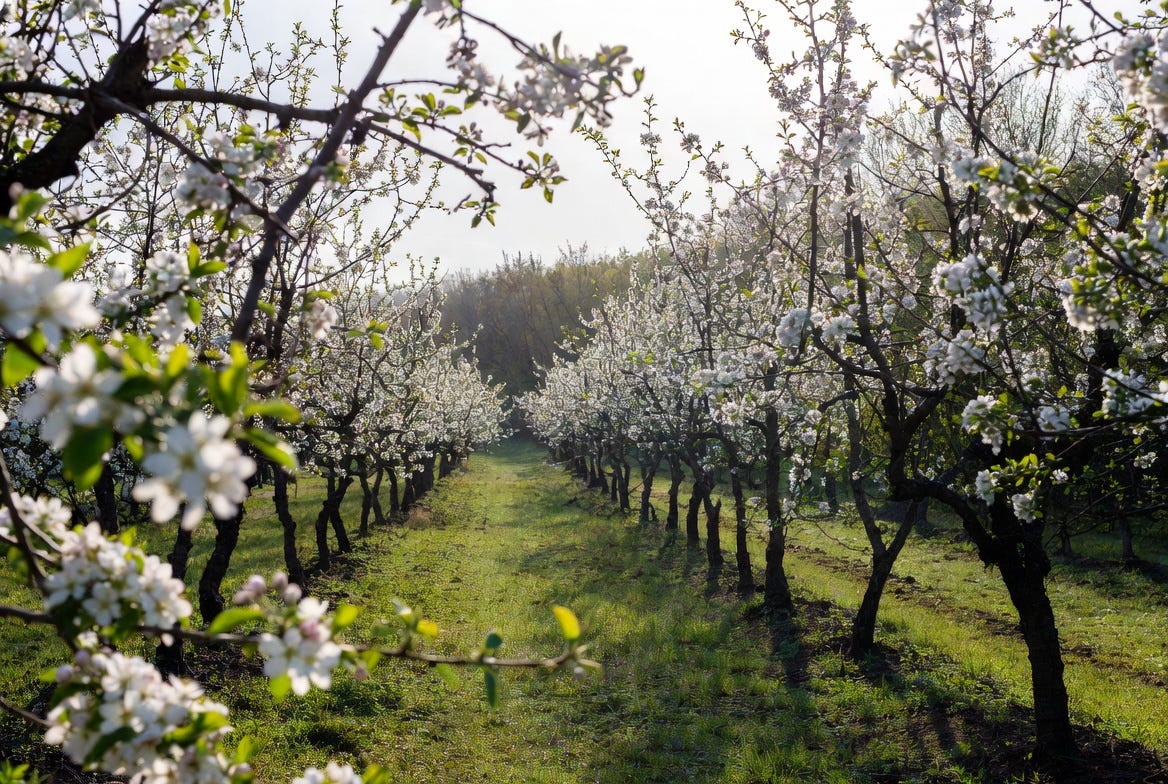
Gautschi’s orchard hasn’t been watered in over 44 years. His soil tests at a perfect pH of 7: dead neutral. Plants that supposedly can’t grow together thrive side by side in his garden: lavender (which loves alkaline soil) next to blueberries (which demand acid), sage next to wasabi. His apple tree branches bow to the ground from the weight of the fruit. Dwarf trees send roots out in a 35-foot radius from the trunk, which arborists call unheard of.
Store-bought apples, Gautschi says, are “featherweight.” His are so dense with water and minerals that “your hand drops.”
Visitors to his garden describe it as a pilgrimage. Rory Groves of The Grovestead wrote that eating a single pear from Gautschi’s orchard was literally a meal, because the nutrient density of fruit picked live from that soil is so far beyond what grocery stores carry. Gautschi’s only complaint: “My biggest problem is abundance.”
He has never sold a single piece of produce. Everything goes to his family and anyone who shows up.
50 Million Views, Zero Marketing Budget
In 2011, a friend named Michael Barrett who’d met Gautschi at a Bible study hired two young filmmakers, Dana Richardson and Sarah Zentz, to document what was happening on this half-acre in Sequim. After 11 months of filming, they released Back to Eden online for free.
The film has now been viewed over 50 million times in 228 countries. It sparked a global movement. Thousands of gardeners around the world adopted the wood chip method, and the phrase “Back to Eden gardening” became its own search category.
For years, Gautschi gave free tours of his garden every Sunday from April through September, hosting groups as large as 450 people. Visitors flew in from Europe and Asia. He never charged a dime.
As of 2022, the tours are closed indefinitely. Gautschi was exposed to Agent Orange during Vietnam, and the long-term effects on his body have made it difficult for him to walk the property. The garden, of course, keeps producing without him.
Why It Matters
Paul Gautschi didn’t patent anything. He didn’t start a company. He didn’t create a subscription service or a certification program. He grew food for his family using materials he got for free, then gave away the knowledge to anyone willing to listen.
The entire documentary is still free to watch. The wood chips are free if you call your local tree service. The method requires no special tools, no purchased inputs, no expert consultation. Just observation, patience, and a willingness to stop fighting the dirt and start copying the forest.
In a world that wants to sell you expensive raised bed kits, proprietary soil blends, smart irrigation controllers, and an app to tell you when to water your tomatoes, a crippled Vietnam veteran in rural Washington has been quietly proving for 45 years that the answer was on the forest floor the whole time. You just have to look down.
Imagine if more farmers stopped spending fortunes every year on GMO seeds, glyphosate spray, expensive fertilizer; and instead started to treat their soil as their savings account, and not something to be strip-mined. Would Monsanto still be able to poison our food supply if farmers woke up and stopped buying the products that doom their own farms?
On a personal note, I’m starting a garden this year, and I’m going to be trying out the wood chip method! If you’re waiting for other people to change, you’re going to be waiting a long time. Change starts at home.
Sources:
- American Essence: “A Garden as Nature Intended” (Oct 2024)
- Back to Eden Film Official Site
- Back to Eden Gardening Courses
- The Grovestead: “Gautschi’s Gardens”
- Epic Gardening: “Back to Eden Gardening”
- Planet Natural: Back to Eden Film Review
- Northern Homestead: “Challenges with the BTE Method”
You really can't go wrong with mulch.