

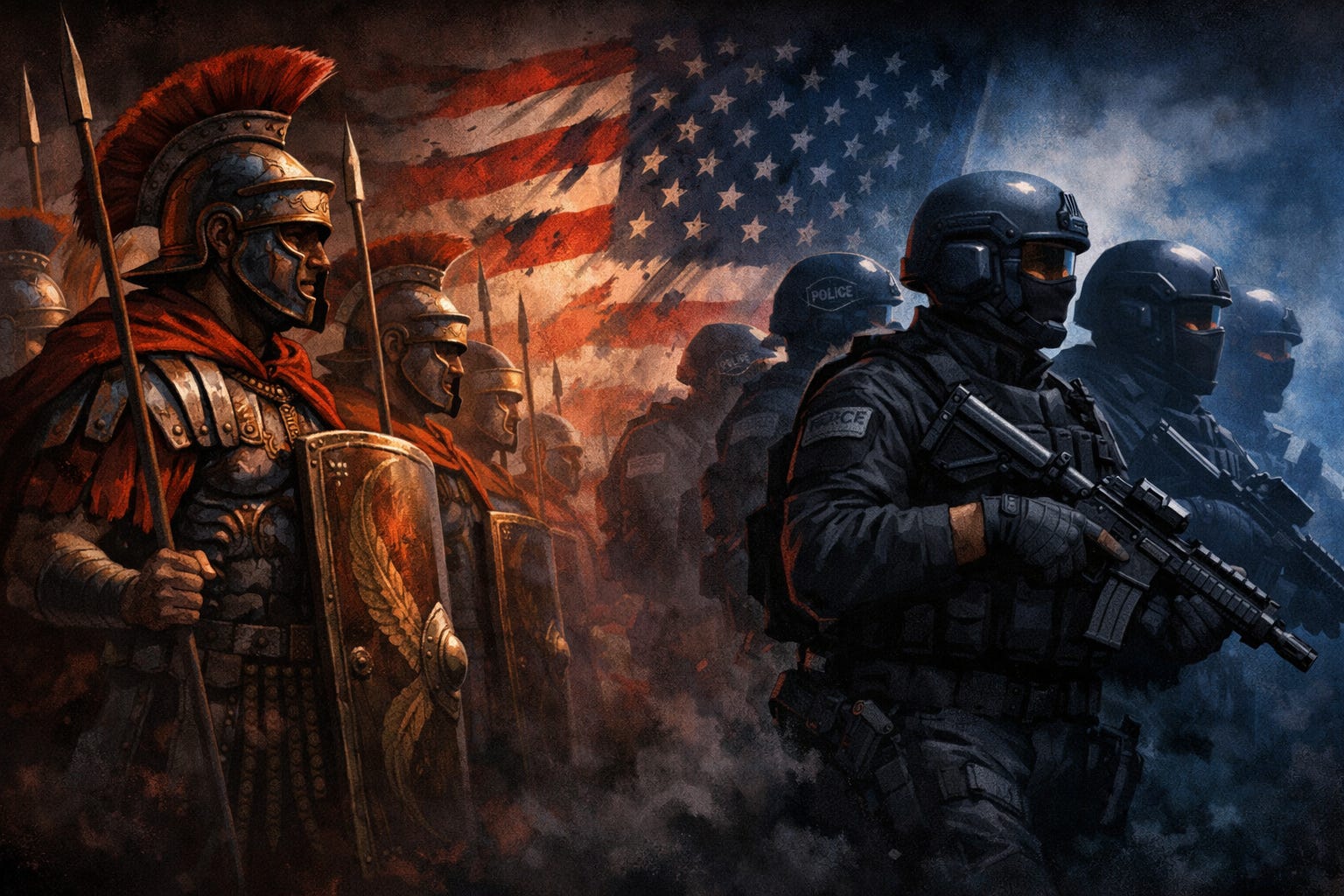
1. Building the Praetorian Guard
ICE more than doubled its officer count last year, luring recruits with $50,000 signing bonuses in a months-long taxpayer-funded blitz. DHS called it a “historic 120% manpower increase.” The federal prison system lost over 1,800 workers in a single year (its worst since 2017) as guards followed the money. The scale tells the story: this isn’t staffing an agency. It’s constructing a domestic enforcement army.
These 12,000 new officers and agents get abbreviated training (a whistleblower told Congress the program is “deficient, defective, and broken”), lavish bonuses, and careers that exist only because this administration created them. Their loyalty is structural.
History rhymes. Late-era Roman emperors paid the Praetorian Guard ever-increasing sums to secure their loyalty. The Guard became kingmakers: when Emperor Pertinax tried to impose discipline and cut their bonuses, they murdered him and auctioned the throne to the highest bidder. The pattern never changed: buy loyalty with public money, create a force beholden to the ruler rather than the republic, watch the institution consume itself.
Sources: ProPublica
2. The President’s Media Shopping List
Netflix co-CEO Ted Sarandos is visiting the White House Thursday to discuss the streamer’s bid for Warner Bros. Discovery’s studio and streaming assets. Top of the agenda, per Politico: Trump’s demand that Netflix fire board member Susan Rice, former Biden domestic policy chief and Obama national security advisor.
Rice’s offense? She said on a podcast that corporations that “bent the knee” to Trump would be “held accountable” when Democrats return to power. Trump called her “purely a political hack” on Truth Social. Political activist Laura Loomer urged him to “kill the Netflix-Warner Bros. merger now.” The DOJ has since opened a formal antitrust probe.
Meanwhile, Paramount CEO David Ellison sat as a guest of Sen. Lindsey Graham at Trump’s State of the Union, while running a competing $108 billion hostile bid for all of WBD. A Heritage Foundation offshoot launched “Project Netflix” to scuttle the deal. The president of the United States is personally conditioning regulatory approval of a corporate merger on political loyalty tests for board members. That’s not antitrust enforcement. That’s a shakedown.
Sources: Politico, CNBC, Deadline
3. Strange Bedfellows at the Supreme Court
The ACLU, an organization that spent decades insisting the Second Amendment doesn’t protect individual gun ownership, just filed its first-ever brief defending someone’s gun rights. The case: United States v. Hemani, oral arguments Monday.
Ali Hemani, a Texas man, was charged under federal law for possessing a Glock 19 while being a marijuana user. Section 922(g)(3) makes it a felony punishable by up to 15 years for an “unlawful user” of any controlled substance to own a firearm. The 5th Circuit struck it down as unconstitutional. The Trump administration, despite its executive order on “protecting Second Amendment rights,” is asking SCOTUS to reinstate the charge.
Siding with Hemani: the ACLU, the NRA, NORML, the Drug Policy Alliance, Gun Owners of America, and the Firearms Policy Coalition. The ACLU’s Brandon Buskey: “This is the first time that we have entered a case affirmatively on behalf of an individual making a Second Amendment claim.” The vagueness argument alone is devastating: nobody can define “unlawful user” with enough precision to justify 15 years in a cage.
When the gun lobby and the civil liberties lobby agree the government went too far, pay attention.
Sources: Reason
4. The Epstein Files That Disappeared
The DOJ removed more than 50 pages of FBI interviews from the public Epstein files database, specifically documents where a woman accused Trump of sexual abuse when she was a minor. The accuser came forward in 2019, alleging Epstein introduced her to Trump around 1983 when she was 13 years old.
An FBI slide deck listed Trump as a “prominent name” in the sex-trafficking investigations. One summary describes the allegation in graphic detail. Yet only the first of four FBI interviews with the accuser made it into the public release, despite the Epstein Files Transparency Act requiring full disclosure.
Rep. Robert Garcia reviewed unredacted evidence logs at the DOJ and confirmed the department “appears to have illegally withheld FBI interviews with this survivor.” Democrats are opening a parallel investigation. The DOJ claims files were “temporarily pulled” for “victim redactions” and will be “promptly restored.” The White House says Trump has been “totally exonerated.”
Three million pages released. Fifty-three conveniently missing. All pointing the same direction.
Sources: The Guardian, The Daily Beast, Common Dreams
5. Patel’s Revenge Tour Continues
FBI Director Kash Patel fired at least 10 FBI employees this week, all connected to the classified documents investigation into Trump’s retention of top-secret records at Mar-a-Lago. The firings came the same day Patel told Reuters the Biden-era FBI had subpoenaed his phone records and those of White House Chief of Staff Susie Wiles during that very investigation.
The arithmetic is simple. Patel was subpoenaed by a federal grand jury in 2022, given immunity to testify. The investigators pulled his phone records as part of standard procedure. Now he runs the FBI and he’s firing the people who did the investigating. The FBI Agents Association called it “unlawful,” warning it “weakens the Bureau by stripping away critical expertise and destabilizing the workforce.”
This is part of a broader purge: dozens pushed out over the past year, prosecutors swept from the DOJ, three former senior officials (each with decades of service) suing Patel for wrongful termination since September. The message to anyone in federal law enforcement is clear: investigate the boss, lose your career.
Sources: AP, The Guardian
6. The Wall Comes Down
The Trump administration is tearing down the post-Watergate wall between law enforcement and intelligence agencies. Per ProPublica, the CIA is getting access to a database of hundreds of millions of documents: FBI case files, banking records, criminal investigations of labor unions, all touching on law-abiding Americans.
These restrictions exist because Presidents Johnson and Nixon used the CIA to spy on anti-war and civil rights activists. Intelligence agencies operate with far more secrecy and far less oversight than the FBI, which is precisely why they were kept separate. The administration blew past that by labeling drug gangs “terrorists” and using the designation to justify sharing domestic data without the usual legal hurdles. One intelligence official called it “shocking” that nobody “wants to deal with” the privacy implications.
The whole thing happened with almost no public acknowledgment and almost no notification to Congress. Sen. Ron Wyden called the abuse potential “staggering.” The DNI’s spokesperson offered a canned quote about “seamless two-way push communications.” The spigot is open, and nobody asked permission.
Sources: ProPublica