

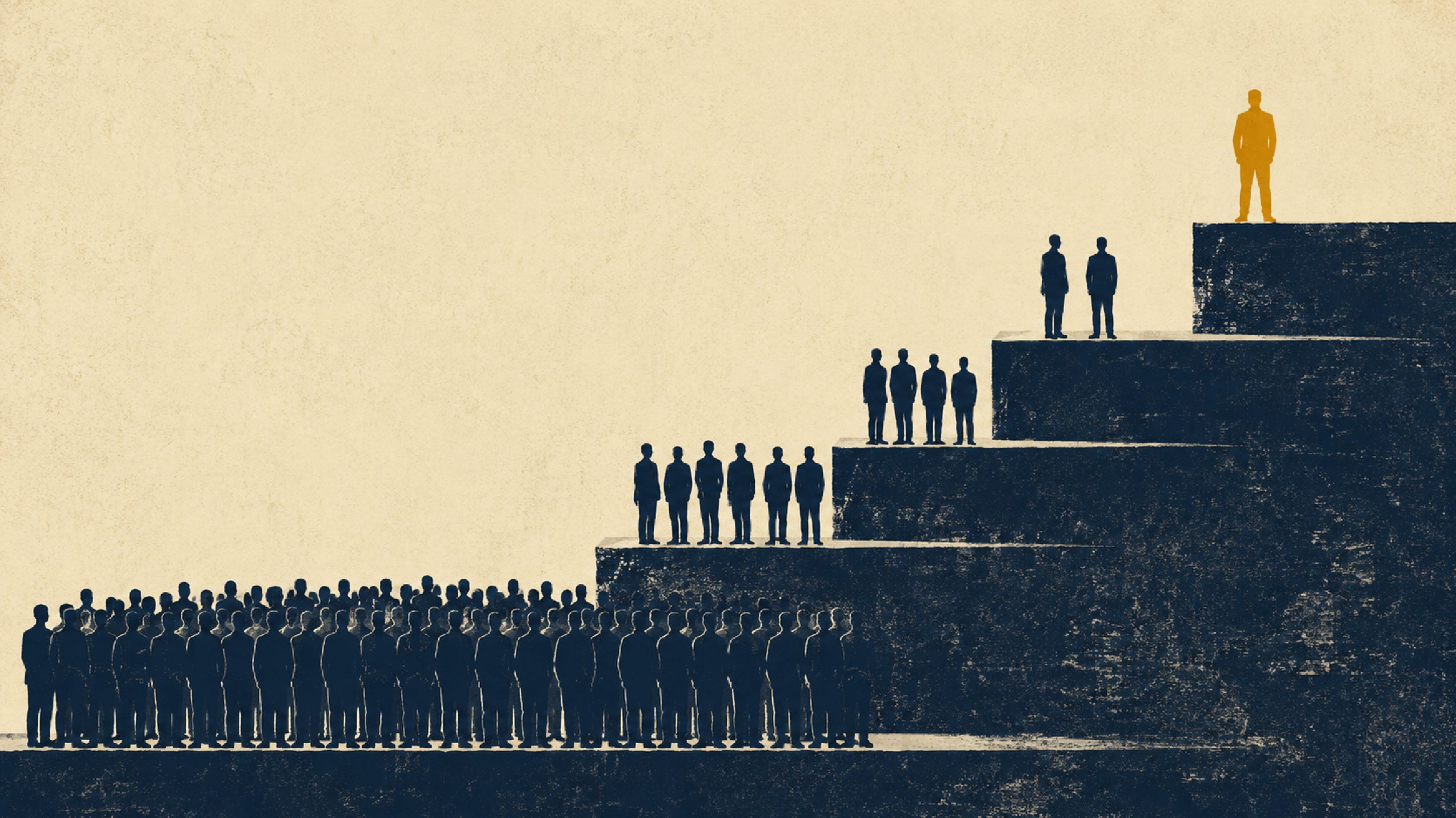
Have you ever tried to talk to a family member about liberty and run into a wall? No matter how good the arguments you make, they just don’t get it. Take the non-aggression principle: it’s so simple! It elevates consent to the primary determination of whether an action is moral or not. It’s probably the simplest, most self-evident moral framework in existence, far simpler to understand than the endless inconsistencies and contradictions found in government or religious law.
And yet - to this day I’ve only ever convinced one person, my wife. Everyone else stubbornly refuses to change their minds. From people who don’t even understand the basics, to the ones who seem to understand and even agree on some surface level, but the next time you talk to them, it’s like the past conversation never happened. They didn’t get enlightened, they just nodded to placate you and then went right back to their regular lives.
For years I assumed I was just not good enough at putting my point across. If only I was a better orator, more charismatic, had better arguments, I could finally “convert” my friends and family to my viewpoint.
It turns out, my approach had been wrong. My entire worldview was a projection of my own desire for freedom unto others. Most people don’t care about freedom. We discussed that in part 1. Those people are essentially immune to arguments.
These people simply haven’t developed the ability to reason for themselves, to form their own opinions. Key & Peele have a fantastic sketch about this here, it’s both funny and true.
When you’re trying to convince them to change their mind and stop supporting another war, more taxes, or some specific regulation that infringes on your liberty, you’re not just asking them to think for themselves and make up their own mind - something they haven’t developed the psychological ability to do - you’re also asking them to go against the grain of the social group they’re in - an unthinkable proposition to the majority, for whom conformism has become a way of life (just look at most people’s reaction to COVID mandates).
Arrested Development
As parents we often worry whether our kids are talking at the right level, if the fact that they repeatedly skip from twelve to fourteen when counting is okay, and so on. Yet we almost never wonder about the development stage an adult is at.
Kegan makes the point that the human mind can stall, in fact, most minds have. In part 1 we went over the different developmental stages. Two thirds of adults never make it past the first three stages. The last two stages, the ones where people can actually form their own opinions and do something independent with their lives? Only about one third make it here.
That’s not to say that people stuck in stage 3 are stupid. I’ve met a staggering number of smart people who cannot think for themselves. They can excel at their jobs, at mathematics, at science, at any number of things, all while not holding a single original thought in their brain.
I had a friend in high school who was academically the smartest kid in our year. He had good grades, excelled at mathematics, and always knew the answer to anything the teacher would ask. But he was deeply Catholic, and I had just started thinking critically about religion at this time. I tried to talk to him, to ask questions, to make arguments, and he would just shut down. I was watching this very smart young man’s brain stall and sputter. He would become so uncomfortable he had to physically excuse himself and leave the room because his brain couldn’t handle the cognitive dissonance created by my questions (which would highlight simple contradictions in the bible) and his beliefs.
I’m not here to pick on Catholics. It’s the same with anyone who holds strongly to any dogma and can’t defend it with reasoning - because they didn’t arrive at it with reasoning. You can’t reason someone out of religion because they were never reasoned into it.
The “trust the science” scientists who don’t want you looking at the studies too closely, they’re the same. The liberals who push the LGBT agenda, the conservatives who push “back the blue”. None of these people realize their thoughts are not their own.
The Exploitable Masses
Because modern life places an ever-increasing number of demands upon us that require independent thought:
Taking our kids out of school and homeschooling them so they don’t become brainwashed, illiterate automatons,
Homesteading and growing our own food so we can eat healthy instead of depleted, pesticide-ridden produce,
Going off-grid to become resilient as the grid continues to degrade,
Saving for retirement independently without relying on government benefits or dollar-pegged investment funds,
Finding a partner who will have the willpower to stand up for your kids when the government wants to vaccinate them with yet another cocktail of drugs,
etc.
But people stuck in stage 3 cannot accomplish these tasks, and so they have mounting anxiety. This inability to self-actualize combined with anxiety stemming from an ever-increasing number of demands placed by modern life creates the perfect citizen.
Think about this from the government’s perspective. If you’re a psychopath (1-4% of the population) and you want to control others, people stuck in stage 3 are perfect. They’re often agreeable and psychologically cannot fathom challenging authority or straying from their social programming.
This isn’t a political failure. We don’t need a change of government - that won’t solve anything at all.
We need to fundamentally change the way children are raised so that they become self-actualizing adults and not conformist automatons. Everything else is political theater meant to distract us from the fundamental problem. The solution is inter-generational and will take decades. There is no other way to achieve lasting liberty. As long as a large majority of the population want government because they fear freedom and responsibility, we will continue to get government no matter what political “safeguards” are put in place.
No constitution can protect us from this inevitability.
And this goes beyond politics. In one study, the vast majority of managers and executives, 85%, were in stage 3 or lower - above even the average across the population.
You know that manager who wants to delegate but can’t help micromanage everyone because they don’t want to make themselves disposable? I’ve had my share of those.
The Inevitable Failure of Democracy
If you read about democracy in a textbook you’ll get the idealized version: people get a choice. They can research the topics, reason about issues, and vote for who will most likely achieve the promised goals (never mind that politicians have no moral right to do anything whatsoever).
Yet according to Kegan’s research, two thirds of the population aren’t even psychologically capable of doing this - and the third that is are probably the third that doesn’t vote because they know it’s pointless.
In reality, adults stuck in stage 3 or below blindly follow whatever group they’re in. Whenever their group’s position changes, their views change, and they don’t even notice. That’s how you’ll find liberals defending a war that they would have opposed 3 years ago. The hypocrisy is endemic.
This is why the culture war ends up dictating politics, and not reasoned arguments, every time.
In part 3 we’ll cover how childhood manufactures compliance. And why you want your kids to be defiant. As parents all too often we want our kids to just obey us, and then we’re surprised when they go along with the group and government edicts. What did you think would happen if you spent years dictating compliance to authority as a virtue?
Sources:
- Kegan, R. (1994). In Over Our Heads: The Mental Demands of Modern Life. Harvard University Press.
- Kegan, R. (1982). The Evolving Self. Harvard University Press.
- Kegan, R. & Lahey, L.L. (2009). Immunity to Change. Harvard Business Press.
- Rooke, D. & Torbert, W. (2005). “Seven Transformations of Leadership.” Harvard Business Review.
- Fromm, E. (1941). Escape from Freedom. Farrar & Rinehart.
- DiMaggio, P.J. & Powell, W.W. (1983). “The Iron Cage Revisited: Institutional Isomorphism.” American Sociological Review, 48(2), 147-160.
- Piaget, J. (1972). “Intellectual Evolution from Adolescence to Adulthood.” Human Development, 15, 1-12.
- Ryan, R.M. & Deci, E.L. (2000). “Self-determination theory.” American Psychologist, 55(1), 68-78.
Great articles!
The Greeks all warned us that an uneducated electorate leads any type of democracy to tyranny, and Tytler’s cycle of democracy shows the last stage before bondage being dependence on the government (UBI nails that coffin shut).
Maybe there is a way of out of this mess that would be relatively simple in theory?
In practice, it might not be as simple, but why not at least have a discussion about it?
We could require that every voter must pass a civics test, or at least mirror the citizenship test, in order to vote. I’ll bet that alone could weed out at least 50% of the conformist types who don’t care to ask why 2 + 2 does not make 5. It might be hard at first, but maybe there will be relief from much of the public who feels like they should vote to be a good person and now, they simply can’t vote…unless they study for the test!
Although all states have jurisdiction in their elections, and I could never advocate a national law out of the first principles of federalism, and it would not happen in this dysfunctional congress anyway, but we could try for a petition for the redress of grievances that we need an educated electorate in order to restore the constitutional republic back to our founders’ vision of federalism.
Yes, cries of discrimination will be made and the test could be hacked or cheated, but at least the voter is looking for an answer to the question in order to answer the test.
Tears will be shed by the “victims” unable to vote and the answer is easy. Study. If you can’t pass after studying, then no voto. But you can always try, try again. That’s the American way!