

This article has a companion website. Check out the Oldest Fear.
Politicians, pundits, priests, and provocateurs would have you fight over your religion, race, gender, sexual preferences, whether you’re an immigrant or not, which way you vote in the fake elections – pretty much anything to keep you distracted from the real war. The battle that we’ve been barely aware of in our subconscious. The battle we’re constantly distracted from by both ourselves and our enemies.
We distract ourselves from it because the truth is almost too hard to acknowledge.
Our enemies distract us from it because if we woke up and acted on the realization, it would spell their doom.
Because this truth sits below our conscious understanding most of the time, it ends up manifesting in myths and children’s stories. We can’t quite muster the courage to look at it directly, so it exists somewhere in the psychological substrate connecting us all.
What truth?
That there is only one real enemy we should be aware of - and it’s probably not who you direct your anger and disdain towards.
It’s the psychopath. I originally wrote about this a few years ago here.
Psychopaths are everywhere. Depending on how you count, they are roughly 1% to 6% of the population, but they disproportionately cluster in positions of power. Whether that’s politicians, bureaucrats, or corporate CEOs and managers, where we find them at a rate about 4x the average population.
The existence of psychopathy is something some are aware of, but only briefly; before they banish the thought from their conscious mind.
The fact that there are those among us who lack the basic fabric of humanity: empathy, remorse, love – in essence, a soul – is so terrifying that even the ones who know about this fact often forget.
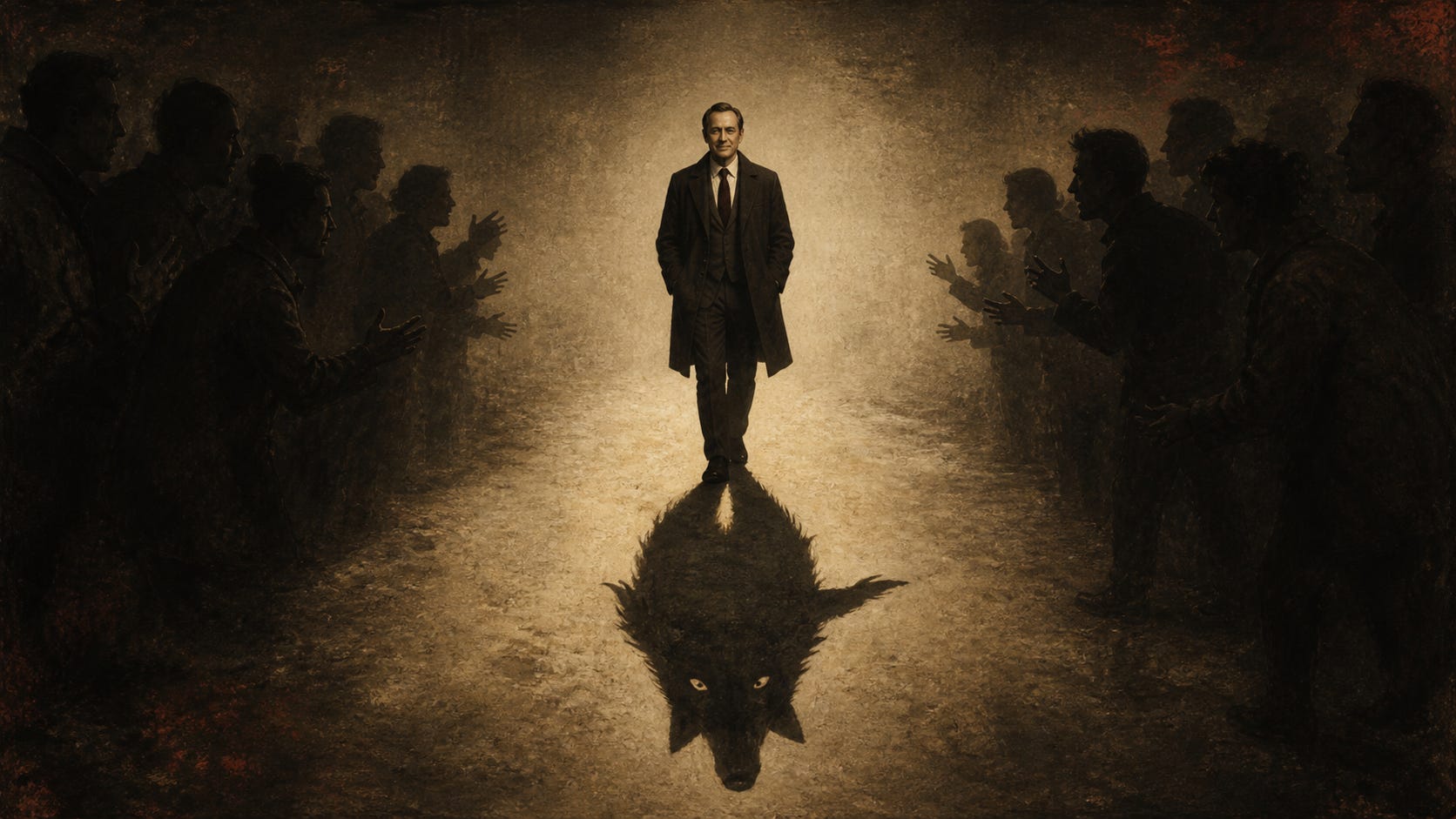
We bury it during our daily life - the same way a sheep must bury their knowledge of wolves to venture out into a new field and eat grass.
Hiding in Plain Sight
The truth is that psychopaths are the greatest threat to you and your family, far and above anyone else, and you can find them anywhere.
They’re dangerous precisely because they do not look like enemies. They learn what the people around them respect, then wear it as camouflage.
A uniform can do it. So can a lab coat, a clerical collar, an expensive suit, revolutionary rhetoric, or a long list of credentials. They parasite off of existing reputations and authorities.
But the pattern of behavior remains consistent even as the costume changes.
They deploy charm when charm gets them access.
They lie easily and repeatedly, then act offended when questioned.
They show cruelty when they believe there will be no consequences.
They impose rules on everyone else while treating themselves as exempt.
They pursue control long after money, comfort, or any rational objective has been satisfied.
They never accept responsibility because every failure must belong to someone else.
Most importantly, they treat other human beings as tools.
This can appear anywhere. A soldier can use “following orders” to excuse cruelty he enjoys. A police officer can use public safety to justify domination. A politician can speak movingly about peace, then bomb children. A scientist or doctor can hide abuse behind expertise and procedure. A revolutionary can promise liberation while positioning himself to become the next ruler.
It’s worth saying that not all of these people are always psychopaths. Normal people can do terrible things (as the Milgram experiments demonstrated) when controlled by other psychopaths, or because they’re afraid, confused, ambitious, or moral cowards.
The way you can tell is by following the pattern. Psychopaths consistently choose deception, domination, and harm; and feel no remorse afterward. Evil is not a one-off with these people, and they don’t apologize (at least, not sincerely).
The Empathy Switch
Psychopaths don’t simply lack empathy, they actually have the ability to turn it on and off at will. It’s a switch.
Is the appearance of having empathy useful to them? Watch them make a rousing speech about something you care about so you vote for them. Once they disappear off the stage, the pretense goes with them.
Transcending the Tribe
Psychopathy is hard to deal with for most normal people not just because it’s terrifying, but also because it crosses the tribal boundaries we’re so used to using to define “our people” and “others”.
There are just as many psychopaths in your Church as there are in the Mosque down the street. And just as many good people in both places, too. And that’s hard to hear, because it means there are people you considered “on your team” who really aren’t on any team but their own – and, even harder to accept – it means you can’t use some obvious visual identifier to distinguish between friend and foe.
The psychopath doesn’t dress in a particular way. They don’t have a certain color of skin, or gender, or religious belief. They could literally be anyone.
It’s much easier to fool yourself into thinking the enemy is going to wear a specific identifier than accept the truth that they hide among us.
The Fallacy of Free Societies
The difficult truth is that we will never be free as long as we allow psychopaths to walk in our midst.
We could build the most elaborate constitution to protect our rights; the most well-balanced system of checks; decentralized organizations. It won’t matter. As long as psychopaths are allowed to walk among us, they will find a way to exploit and control any system for their benefit. They corrupt everything they touch; and many things they build are corrupt from the get go (including your government).
Advocates for self-government and free markets will often talk about aligning incentives so that strangers benefit each other – but these systems only work on normal human beings. Psychopaths work by a different ruleset. They’re not just after money, and they don’t want to live a peaceful life.
They want power, control, authority. Not for any ulterior purpose, but for the sake of power itself. They’ll work outside the free market system. They’ll conspire. They’ll arrogate power to themselves, little by little, until there’s nothing left of your free society.
And they have no moral qualms. You can’t teach the non-aggression principle to someone who sees you as an ant to be stomped on. That’s one of the likely reasons why every decentralized and free society that has ever existed (and there have been many) has been taken over by a government.
It’s not that they couldn’t figure out the perfect institutional arrangement and rules to maintain their society. It’s because they didn’t see the wolves in sheep’s clothing among them.
The only solution is identification and ostracism – but this will not even begin to start if we can’t look at the situation clearly and recognize who the real enemies are.
Psychopaths in Myths
Many cultures on earth have independently realized the same thing, and encoded elements of psychopathy into their myths and stories.
The vampire who hides at night and drinks your blood, and cares so much about keeping their bloodline pure. That’s a metaphor for the parasitical royal class who for thousands of years have valued inbreeding above the health of their children. Why? Because psychopathic traits are heavily heritable.
The Japanese had Kitsunes, foxes who would put on a beautiful human face so they could get close enough to you before you could react.
The Navajo have skin-walkers. Indians have the Rakshasa. Changelings. Reptilians. Werewolves. The list goes on.
It’s always evil wearing the mask of something familiar.
Psychopaths in Children’s Stories
Teaching our children about psychopaths is so important to us, on some level, that we’ve been telling the same stories to them for centuries. A warning passed down from generation to generation.
In the Little Red Riding Hood, the wolf learns to speak like a human, copies the grandmother’s voice, and wears her clothes.
Aesop wrote about the wolf in sheep’s clothing.
Hansel and Gretel. Snow White.
We’ve been warning our children about psychopaths through stories and metaphors. Never directly. What are we so afraid of?
Solutions
Decentralization and exit & build are all important, but none of them can substitute for identifying the personality type that will patiently exploit every safeguard you build into your intentional community or fledgling nation.
Today that means watching patterns of conduct and refusing to hand trust or authority to people who repeatedly lie, manipulate, and harm without remorse. In the future, it may also mean using physiological and neurological screening tools built from research we already have (more on that later).
Voluntary communities should be free to use those tools, weigh the evidence, and ostracize people they reasonably conclude pose a threat. I’m not advocating for coercion or any kind of government action. I’m saying free people should show more discretion about who they associate with.
The alternative is to keep pretending every human mind follows the same moral rules, then act surprised when the wolves capture the sheepfold again. We have spent thousands of years warning our children about predators wearing familiar faces. It is time adults stopped treating the warning as a fairy tale.
To trace the myths and stories told about psychopaths, I’ve created a new site called the Oldest Fear. Click on the various cards to learn more about each myth.

Want to support my work? Becoming a supporter unlocks more features on Lookout Map and helps fund free projects like The Collapse Index.
Interested in solutions to the problem of identifying psychopaths? We’ll address that more in future installments of this series on Psychopathy, Ponerology & Power.
A brilliant article actually. I myself only recently learned psychopaths are completely devoid of empathy and remorse which is indeed scary. So in some ways those people are indeed inhuman monsters or heartless machines, but they look totally like everyone else and learn to imitate normal human behavior (in a way like AI does lol, remembering other our discussion). Hence it's also pretty hard to spot those people on early, do you have any advice here - how to spot psychopaths before they harmed you?
Another issue here is indeed that we used to treat others exactly like ourselves. So even when we think of villains, we usually imagine a deeply traumatized person who turned to evil out of immense suffer and whom mere kindness could sometimes help. But in case of psychopaths, this approach is just disastrous - they will only use our kindness against us to manipulate and abuse us.
But it's hard for ordinary people to even imagine that someone might be evil by default, from birth, without any trauma or bad circumstances making him such. It's hard even for me to imagine despite I'm no ordinary person and don't lack imagination. But still.
A good point. I have a bit of a quibble though, with everyone is calling those people "psychopaths". Actual psychopaths and sociopaths (in medical terms) are usually... well, not successful, it's a pretty noticeable mental disorder with bad side effects. My pet theory is that humans as a species have several different sets of social behavioral instincts that can be either inborn or triggered to become the dominating behavior at some point, and, well, what you'd call a "psychopath" I'd call simply a mentally healthy adult baboon with a human intellect. Which also makes it less scary and mysterious (not less harmful to the society though).