

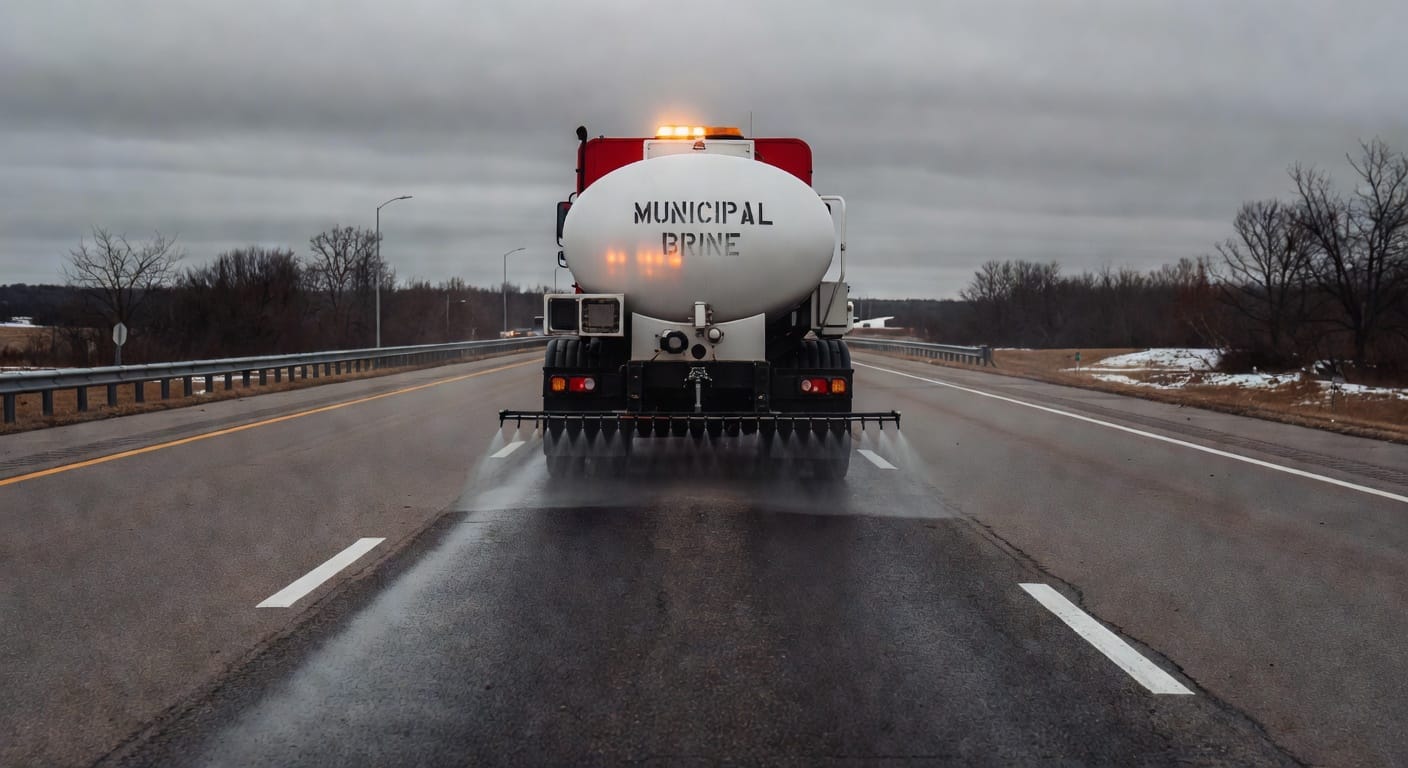
In 2020, investigative journalist Justin Nobel published a piece in Rolling Stone called “America’s Radioactive Secret.” It documented something that sounds like it belongs in a dystopian novel: the US oil and gas industry generates billions of gallons of radioactive wastewater brine every year, and because they don’t know what to do with it, a significant portion of it gets spread directly on public roads.
Not buried in lined containment cells. Not processed through licensed radioactive waste facilities. Sprayed on the roads you drive on, the roads your kids walk along, the roads that run past farms and through small towns in at least 13 states across the country.
If you read Part 3 of this series (about “Biosludge”), the pattern is going to look very familiar. Toxic industrial waste, rebranded as something harmless, approved by regulators, and dumped into the environment under the banner of “beneficial use.” Different industry. Same playbook.
What Comes Up with the Oil
Every oil and gas well drills through ancient geological formations that contain brine, a highly concentrated saltwater that has been in contact with radioactive rock for millions of years. When oil and gas are pumped to the surface, this brine comes up too. The industry calls it “produced water.”
Produced water is the largest waste stream in the American oil and gas industry. According to the American Petroleum Institute, more than 18 billion barrels of waste fluids from oil and gas production are generated annually in the United States. To put that in perspective, that’s roughly 756 billion gallons per year, dwarfing the volume of oil actually extracted.
This isn’t clean saltwater. Produced water contains naturally occurring radioactive materials (NORM) that become concentrated during the extraction process, which the EPA classifies as Technologically Enhanced Naturally Occurring Radioactive Material (TENORM). The key contaminants are radium-226 and radium-228, both carcinogenic isotopes, along with barium, strontium, lead, arsenic, benzene, and other heavy metals.
The radioactivity levels are not subtle. The EPA’s safe drinking water standard for combined radium-226 and radium-228 is 5 picocuries per liter (pCi/L). Brine from the Marcellus Shale formation, which underlies Ohio, Pennsylvania, West Virginia, and New York, averages around 9,300 pCi/L. Some samples exceed 10,000 pCi/L. That’s roughly 2,000 times the federal safe drinking water limit for radium.
And what does the industry do with hundreds of billions of gallons of this radioactive brine every year? Some goes into deep injection wells. Some gets treated at wastewater facilities. And some gets loaded onto trucks and sprayed on roads.
How Radioactive Waste Becomes “Road Treatment”
The practice works like this: oil and gas companies need to dispose of produced water. Proper disposal (deep well injection, licensed treatment) costs money. Spreading it on roads costs nothing, or even generates a small fee. Rural townships and counties, meanwhile, need cheap ways to suppress dust on unpaved roads in summer and de-ice paved roads in winter. The brine is high in salt, so it serves both purposes.
The result is a convenient arrangement where the oil and gas industry gets free waste disposal, and cash-strapped municipalities get free road treatment. Everyone wins, except for the people living next to those roads, drinking the water downstream, eating the food grown in adjacent fields, and breathing the dust.
At least 13 states allow the practice, including Ohio, Pennsylvania (until 2018), West Virginia, New York, and Michigan. Ohio legalized brine spreading in 1985, though the practice likely dates back to the 1930s in the state. Commercial dust suppressants cost up to a dollar per gallon. Oil and gas brine is free.
Any product that’s “free” should automatically raise eyebrows. Why is it free? Why are they just getting rid of it?
In most cases, no testing for radioactivity is required before the brine is applied. William Burgos, a professor of civil and environmental engineering at Penn State who co-authored a major study on brine road spreading, told Environmental Health News: “The number of analytes is really limited, and radium isn’t on the list at all.” He noted that none of the states allowing road spreading required any radium analysis.
You can spread radioactive waste on public roads, and nobody is required to check whether it’s radioactive.
The Loophole That Makes It Legal
How is this possible? The answer is a single piece of legislation from 1980 and a follow-up regulatory decision from 1988.
In 1980, Congress amended the Resource Conservation and Recovery Act (RCRA) with what’s known as the Bentsen Amendment. This provision exempted “drilling fluids, produced waters, and other wastes associated with the exploration, development, or production of crude oil or natural gas” from Subtitle C hazardous waste regulations. Subtitle C is the section of RCRA that governs the handling, treatment, and disposal of hazardous waste. The exemption meant that oil and gas waste, no matter how toxic or radioactive, would not be subject to the same rules as equivalent waste from any other industry. With enough money and influence corporate America can basically exempt itself from any laws that apply to everyone else.
In 1988, the EPA issued a Regulatory Determination confirming the exemption. Despite acknowledging that oil and gas exploration and production wastes could be hazardous, the EPA concluded that “regulation of oil and gas E&P wastes under RCRA Subtitle C was not needed.”
The consequence: radioactive brine that would trigger a Superfund cleanup response if it came from any other industry is legally classified as “non-hazardous” when it comes from an oil or gas well. States were left to create their own rules, resulting in a patchwork of regulations where some states ban road spreading, most don’t test for radioactivity, and several have no meaningful oversight at all.
If you read Part 3 on biosludge, you already know this trick. Different waste stream, different industry, same regulatory architecture: create an exemption, call the waste something benign, let the industry “self-regulate”, and walk away.
AquaSalina: The Product You Could Buy at Lowe’s
If you want a concrete example of how casually this is handled, consider AquaSalina.
AquaSalina is a commercial de-icing product made from oil and gas produced water, manufactured by Duck Creek Energy out of Cleveland and Mogadore, Ohio. The Ohio Department of Transportation approved it in 2004. It was sold at Lowe’s hardware stores and used by ODOT on state highways. In the winter of 2017-2018, Ohio sprayed over 500,000 gallons of AquaSalina on its highways. By 2018-2019, that volume had grown to nearly 800,000 gallons.
Then someone tested it for radioactivity.
In 2017, the Ohio Department of Natural Resources (ODNR) tested AquaSalina samples and found radium levels on average 300 times higher than the federal safe drinking water standard. One sample clocked in at 9,602 picocuries per liter of combined radium-226 and radium-228. For reference, Ohio’s own legal limit for radium in landfill waste disposal is 0.005 picocuries per liter. The product on Ohio’s highways contained radium concentrations roughly 1.9 million times the state’s landfill disposal limit.
But here’s the catch: Ohio has no radium limit for road spreading. The same state that regulates landfill disposal at 0.005 pCi/L has no standard at all for brine applied to public roads. So AquaSalina was legal. Not because it was safe. Because no one had written a rule that said it wasn’t.
A Duquesne University scientist who reviewed the test results called it “a nightmare.” The Ohio legislature’s response? Multiple bills (SB171, HB282) were introduced that would have reclassified brine as a “commodity” rather than toxic waste, exempted it from ODNR testing, and authorized brine with up to 20,000 pCi/L of radium-226 to be sold in stores without any radioactive warning label.
The solution to the radioactive road problem, according to some Ohio legislators, was to make it easier to put more radioactive brine on more roads with less testing. You can imagine who they’re being bribed by.
Ohio eventually planned to discontinue AquaSalina use around 2021, largely due to years of pressure from activist groups like the Ohio Community Rights Network and the Ohio Brine Task Force. But the broader practice of spreading conventional brine on roads continues across the state and the country.
The Contamination Chain
Brine doesn’t stay on the road. That’s not how physics works.
Roads to Soil
When radioactive brine is sprayed on a road surface, it doesn’t form a permanent seal. It soaks in, runs off, and spreads. Radium, heavy metals, and salts concentrate in the roadside soil. A 2018 Penn State study published in Environmental Science & Technology found that nearly all of the metals from brine leach out from roadways when it rains. Some radium and lead also settle into the road surface itself, creating a long-term contamination reservoir that continues to release pollutants with every rainstorm.
In Pennsylvania alone, from 2008 to 2014, the study found that road spreading released four times more radium to the environment (320 millicuries) than oil and gas wastewater treatment facilities, and 200 times more radium than accidental spills. The single largest pathway for radium contamination from the oil and gas industry in Pennsylvania wasn’t spills. It wasn’t treatment plant failures. It was the stuff they were putting on their roads on purpose.
Soil to Crops
Brine contamination doesn’t respect property lines. When salts, heavy metals, and radionuclides wash off treated roads into adjacent agricultural land, they accumulate in the soil and get taken up by crops. Crops that you eat.
North Dakota State University documents the mechanism clearly: brine salt ions “negatively affect the site’s soil and vegetation, impairing its ability to produce crops and forage.” The salts create an osmotic effect that prevents plants from absorbing water even when the soil is moist, effectively causing drought conditions in plants surrounded by water. Most common crops show salt stress when sodium exceeds 70 milligrams per liter in soil water. Corn production is affected at relatively low salinity levels; soybeans and edible beans are even more sensitive.
In times past, there used to be a scorched earth strategy in which retreating armies would literally salt the earth to make it impossible to grow anything there. Now, corporations and the government are doing this to our own soil.
In North Dakota, the damage from brine contamination is visible from satellite imagery. Thousands of acres of farmland have been dormant for 50 years or longer due to historical brine exposure, according to environmental remediation firm Terracon. An unprotected one-acre brine pond can ruin 10-20 acres of surrounding land. The Peterson family farm near Antler, North Dakota, has dealt with multiple saltwater spills totaling tens of thousands of gallons since the 1990s, losing productivity on at least 30 acres of land that once grew peas, soybeans, and grain.
The radionuclide pathway is more insidious. Radium behaves chemically like calcium, which means plants absorb it through the same uptake pathways they use for nutrients. The Agency for Toxic Substances and Disease Registry (ATSDR) confirms that cattle grazing on forage grown in radium-contaminated soils pass the radionuclide into their milk. This is not a theoretical concern. This is a documented transfer chain: brine on roads, runoff to fields, uptake into crops and livestock, and into the human food supply.
Maybe we should start putting radioactive warning stickers on milk. And this makes me wonder - does USDA organic certification still cover farms that have radioactive brine run-off contaminate their soil from nearby roads? I suspect the USDA doesn’t test for this.
Runoff to Waterways: Where the Fish Die
This is where the contamination chain becomes most visible, because dead fish are hard to ignore.
When rain washes brine off treated roads and into ditches, streams, and ponds, it dramatically elevates the salinity of freshwater ecosystems. The EPA’s chronic criterion for chloride in freshwater (the threshold for long-term aquatic life protection) is 230 mg/L. The acute criterion is 860 mg/L. Oil and gas brine contains chloride concentrations that dwarf both numbers. When this hypersaline waste enters a freshwater stream or pond, it creates conditions in which freshwater organisms simply cannot survive.
Dunkard Creek, 2009. This stream along the Pennsylvania-West Virginia border was one of the most ecologically diverse waterways in the region, supporting freshwater mussels, mudpuppy salamanders, and fish species ranging from minnows to three-foot muskies. Then a combination of energy industry discharges, primarily acid mine drainage from Consol Energy’s Blacksville No. 2 coal mine, spiked salinity levels and triggered a bloom of golden algae, an organism that thrives in salty water and produces toxins lethal to aquatic life. The result: a massive die-off across an estimated 43 miles of the creek. Virtually everything in it died. Consol eventually paid $5.5 million in penalties. The case illustrates how multiple energy industry waste streams (coal, oil, gas) converge in the same watersheds, and how radioactive brine from oil and gas operations, which can be seven times saltier than the ocean, compounds the damage.
Taylor Fork, Ohio, 2021. An unused gas well owned by Genesis Resources LLC began spewing suspected frack waste into this small tributary. Before the state could contain the leak, brine killed fish across more than two miles of the stream. The emergency management director on scene said it bluntly: “The chloride counts are really high, that’s why the fish kill happened, they believe.”
These are dramatic examples, but the quieter damage is arguably worse. Chronic low-level brine runoff from treated roads accumulates in stream sediments over years. A 2018 Duke University study led by geochemist Avner Vengosh found that radioactivity in stream sediments at oil and gas wastewater disposal sites in Western Pennsylvania was 650 times higher than at unaffected upstream sites. Seven years after Pennsylvania had restricted some of its wastewater disposal practices, the radioactivity persisted. “It’s not only fracking fluids that pose a risk,” Vengosh said. “Produced water from conventional, or non-fracked, oil and gas wells also contains high levels of radium.”
The ATSDR confirms that aquatic organisms, including fish, snails, clams, and algae, bioaccumulate radium from water. A small rural pond downstream from a brine-treated road isn’t just getting saltier. It’s accumulating radioactive material in its sediment and in the bodies of every organism living in it. If you fish in it, eat from it, or water livestock from it, the radium enters your food chain.
Radium-228 has a half-life of about 6 years. It can take decades to decompose.
Radium-226 has a half life of 1,600 years. Read that again. 1,600 years. Whatever’s been contaminated with it will remain contaminated for thousands of years, long after the U.S. government and Western civilization have disappeared from history.
Groundwater Infiltration
Brine percolates. Gravity and rain push it through the soil column into the aquifer below. If your drinking water comes from a well, and roads in your area are treated with radioactive wastewater, the contamination pathway to your kitchen faucet is as simple as gravity and time.
William Burgos of Penn State noted that most brine spreading in northwestern Pennsylvania occurs within the Allegheny River watershed, which is the drinking water source for the city of Pittsburgh. Nobody was tracking whether the radium and metals washing off those roads were making their way into the city’s water supply.
The Dust You Breathe
Here’s a pathway most people don’t think about: airborne contamination.
About 34% of US roads are unpaved, and dust from those roads contributes to nearly half of the nation’s annual airborne particulate matter emissions, which are already linked to cardiovascular and respiratory disease. When brine is applied to these roads and dries, the radium, heavy metals, and salts it contains become part of that dust. Every car that drives by kicks it up. Wind carries it to adjacent properties, gardens, play areas, and livestock pastures.
You don’t need to drink the water or eat the crops to be exposed. You just need to breathe.
And here’s the kicker: the Penn State researchers could only find one published study investigating whether brine actually works as a dust suppressant. That study, conducted in North Dakota, found no statistical difference in the amount of dust blown off treated roads versus untreated roads. The researchers speculated that brine doesn’t contain enough calcium and magnesium to bind dust effectively. Nathaniel Warner, one of the Penn State study’s co-authors, said it plainly: “If it doesn’t work any better than water at suppressing dust, maybe we just don’t need to be doing this.”
So to recap: the radioactive brine may not even work for its stated purpose. But it’s still being spread because oil and gas companies don’t want to spend the money to dispose of it properly, and the U.S. government is so utterly corrupt that it writes laws to protect them from liability.
Rusting Bridges and Cars
The damage isn’t just biological. Road brine is one of the most corrosive substances routinely applied to public infrastructure. Chloride ions penetrate concrete and attack the steel rebar inside, accelerating structural failure of bridges that were designed to last decades. A Federal study backed by the FHWA estimated the annual direct cost of corrosion for highway bridges alone at $8.3 billion, consisting of $3.8 billion to replace structurally deficient bridges and $4.5 billion in maintenance. The EPA has estimated that salt-based de-icers cause roughly $5 billion per year in combined damage to cars, trucks, roads, and bridges.
Your car is taking the same hit. AAA ran an Automotive Engineering study and found that U.S. drivers spent about $3 billion per year on rust repairs caused by road salt and de-icing chemicals. Brake lines, fuel lines, suspension components, and exhaust systems corrode from underneath while body panels rot from road spray. The industry that generates the brine gets free waste disposal. Taxpayers pay billions to replace the bridges. Drivers pay billions to replace the cars. The costs are real and enormous - they’re just not on the oil company’s balance sheet.
What Radium Does to Your Body
Radium deserves special attention because of how it behaves biologically. Unlike many toxins that pass through the body relatively quickly, radium has a nasty trick: it mimics calcium.
Your body can’t tell the difference between radium and calcium at the molecular level. When you ingest or inhale radium, your body treats it like a nutrient and deposits it in your bones and teeth, the same places it stores calcium. Once there, it stays. Radium-226 has a half-life of 1,600 years. It will be emitting ionizing radiation inside your skeleton long after every other cell in your body has been replaced many times over.
This is not speculative science. We have a century of evidence for what chronic radium exposure does to the human body, and the story begins with the Radium Girls.
In the 1910s and 1920s, young women in factories across the northeastern United States painted watch dials with radium-based luminous paint. They were told it was harmless. They were instructed to lick their brushes to form a fine point for detail work. The United States Radium Corporation (USRC) knew the paint was dangerous and actively suppressed data showing worker illness. Doctors and dentists were pressured not to release findings.
The women developed “radium jaw”, a condition where the jawbone literally disintegrated from internal radiation. They suffered bone fractures, anemia, and cancers of the bone, bone marrow, and other tissues. Many died in their twenties and thirties. Their suffering eventually led to landmark workplace safety reforms and established the foundational understanding that radium is a bone-seeking carcinogen.
That understanding hasn’t changed. What has changed is the scale at which radium is being released into the environment.
The health effects of chronic, low-level radium exposure include:
- Bone cancer (osteosarcoma) from radium deposited in bone tissue
- Leukemia from radiation damage to bone marrow
- Liver and breast cancer from radium exposure at even low levels
- Lung cancer from inhaling radon gas, which is a decay product of radium and the second leading cause of lung cancer in the United States
The standard radiation protection model (the “linear no-threshold” model) holds that there is no safe level of ionizing radiation exposure. Every dose carries some incremental cancer risk. Children and pregnant women are the most vulnerable, because rapidly dividing cells are more susceptible to radiation damage. And unlike acute exposure, chronic low-level exposure is insidious: the effects accumulate over decades, making it nearly impossible to trace a specific cancer back to a specific source. Which is, of course, very convenient for the industries doing the contaminating.
What You Can Do
The point of this series has never been to leave you feeling helpless. Understanding the problem is step one. Taking practical action is step two.
Test your water. If you live near oil and gas operations, or in any of the states that allow or have historically allowed brine road spreading, test your well water or municipal supply for radium-226, radium-228, barium, total dissolved solids (TDS), and chloride. Standard water quality tests don’t include radionuclides. You need to specifically request a radiological panel. Labs like Tap Score offer mail-in kits that include radium analysis.
Install reverse osmosis filtration. Standard carbon filters do not remove radium. Reverse osmosis (RO) systems do. If your water test reveals any detectable radium, an RO system on your drinking water line is one of the most effective protective measures you can take. Ion exchange and water softeners can also reduce radium levels. This is a high-priority upgrade for anyone on well water in oil and gas country.
Know what’s on your roads. Contact your county or township road department and ask what de-icing and dust suppression products are being used. Ask specifically whether oil and gas brine or “produced water” is applied. If they won’t answer, file a FOIA request (or your state’s equivalent public records request). Many municipalities don’t advertise the practice, but they are required to keep records of road treatments.
Grow under cover and in raised beds. If you’re growing food near roads that may be treated with brine, or in areas with significant dust from unpaved roads, greenhouse or high tunnel growing provides a physical barrier against contaminated dust and runoff. Raised beds with imported clean soil and defined drainage add another layer of protection.
Rainwater collection with first-flush diverters. If you collect rainwater for irrigation or household use, a first-flush diverter discards the initial volume of rainfall that washes contaminants off your roof and collection surface. This is especially important in areas where airborne brine dust may settle on collection surfaces.
Choose your land carefully. If you’re in the process of buying rural property (and if you’re reading this series, you may well be), add this to your due diligence checklist: check whether the county or state allows wastewater road spreading. Look at proximity to oil and gas operations. Check ODNR, DEP, or equivalent state databases for well locations, brine hauler routes, and historical spreading records. A beautiful parcel downhill from a brine-treated road is a liability disguised as a homestead.
Support the people fighting this. Groups like the Ohio Community Rights Network, the Ohio Brine Task Force, and Fair Shake Environmental Legal Services have been on the front lines of this issue for years, fighting for testing, transparency, and bans on brine spreading. Justin Nobel’s book Petroleum-238 is the definitive deep dive into the oil and gas industry’s radioactive waste problem. Informed communities are harder to dump on.
Move. As much as it sucks to say this, if you live in a state that’s spreading radioactive wastewater on the roads, you should probably move. It’s going to be on your vehicle in the winter (and possibly in the summer), you’re going to touch it every time you touch the door handles. Your pets and kids will get contaminated every time they walk outside by a road that’s been sprayed. We used to live in a state that did this and moved. Waiting for the government to ban something that makes corporations money and has been going on for decades is probably futile. Moving might be the best thing you can do.
The Economics of Externalizing Costs
The oil and gas companies have figured out how to externalize the costs of their own pollution to the entire country, destroying people’s health, ecosystems, bridges, vehicles, soil, and farmland. If you compare the cost of them disposing of it properly, with the cost inflicted on everyone else, proper disposal is far cheaper. What’s happening here is regulatory capture: the oil and gas companies have successfully bribed and influenced government officials to externalize their costs on everyone else. This is why government regulation never works. The regulation is there to protect corporations from liability.
This is Part 5 of the Biology & Survival series, which covers the science showing that by 2045 the average person will become infertile, and explains all the reasons why, so that you can protect yourself, your children, and your grandchildren.


Sources
1. Rolling Stone, “America’s Radioactive Secret” (2020)
2. EPA, TENORM: Oil and Gas Production Wastes
3. EPA, Crude Oil and Natural Gas Waste (RCRA Exemption History)
4. EPA, Radionuclides Rule (Drinking Water Standard)
5. Environmental Health News, “Radium has been widely spread on Pennsylvania roadways without regulation” (2018)
6. StateImpact Pennsylvania/NPR, “Study finds health threats from oil and gas wastewater spread on roads” (2018)
7. Burgos et al., “Watershed-Scale Impacts from Surface Water Disposal of Oil and Gas Wastewater in Western Pennsylvania,” Environmental Science & Technology (2018)
8. FracTracker Alliance, “Oil and Gas Brine in Ohio” (2022)
9. Wikipedia, AquaSalina
10. Columbus Dispatch, “Ohio plans to discontinue use of controversial road deicer AquaSalina” (2021)
11. WKRC Cincinnati, “Serious questions about radioactive element in highway de-icer” (2019)
12. Fair Shake Environmental Legal Services, “Ohio and Pennsylvania’s History of Radioactive Road Deicers” (2024)
13. Penn State Center for Agricultural and Shale Law, “EPA Issues Determination to Continue RCRA Exemption”
14. Duke University/Phys.org, “Radioactivity from oil and gas wastewater persists in Pennsylvania stream sediments” (2018)
15. ScienceDaily, “Radioactivity from oil and gas wastewater persists in Pennsylvania stream sediments” (2018)
16. Scientific American, “EPA Scientist Points at Fracking in Fish-Kill Mystery” (Dunkard Creek)
17. Allegheny Front, “Unused Gas Well Spews What’s Suspected to Be Frack Waste, Killing Fish” (2021)
18. NDSU Extension, “Environmental Impacts of Brine (Produced Water)” (2023)
19. Terracon, “Undoing Decades of Brine Contamination” (2020)
20. NBC News, “Salting the earth: North Dakota farmers struggle with a toxic byproduct of the oil boom” (2018)
21. Environmental Health Perspectives/NIEHS, “Radionuclides in Fracking Wastewater”
22. Britannica, Radium-226
23. Wikipedia, Radium Girls
24. ATSDR, Toxicological Profile for Radium
25. EPA, National Recommended Water Quality Criteria (Aquatic Life)
26. PMC/NIH, “Lakes and Rivers Are Getting Saltier”
27. Justin Nobel, Petroleum-238: Big Oil’s Dangerous Secret and the Grassroots Fight to Stop It (2024)
28. EGU General Assembly 2025, “Nuclide specific transfer of radium from soils to plants”
Why is my road not glowing in the dark ?
If low level radioactivity were dangerous, we'd know about it by now. Go eat a banana. Full of of K40 (beta and gamma emitter)
🤣🤣🤣