

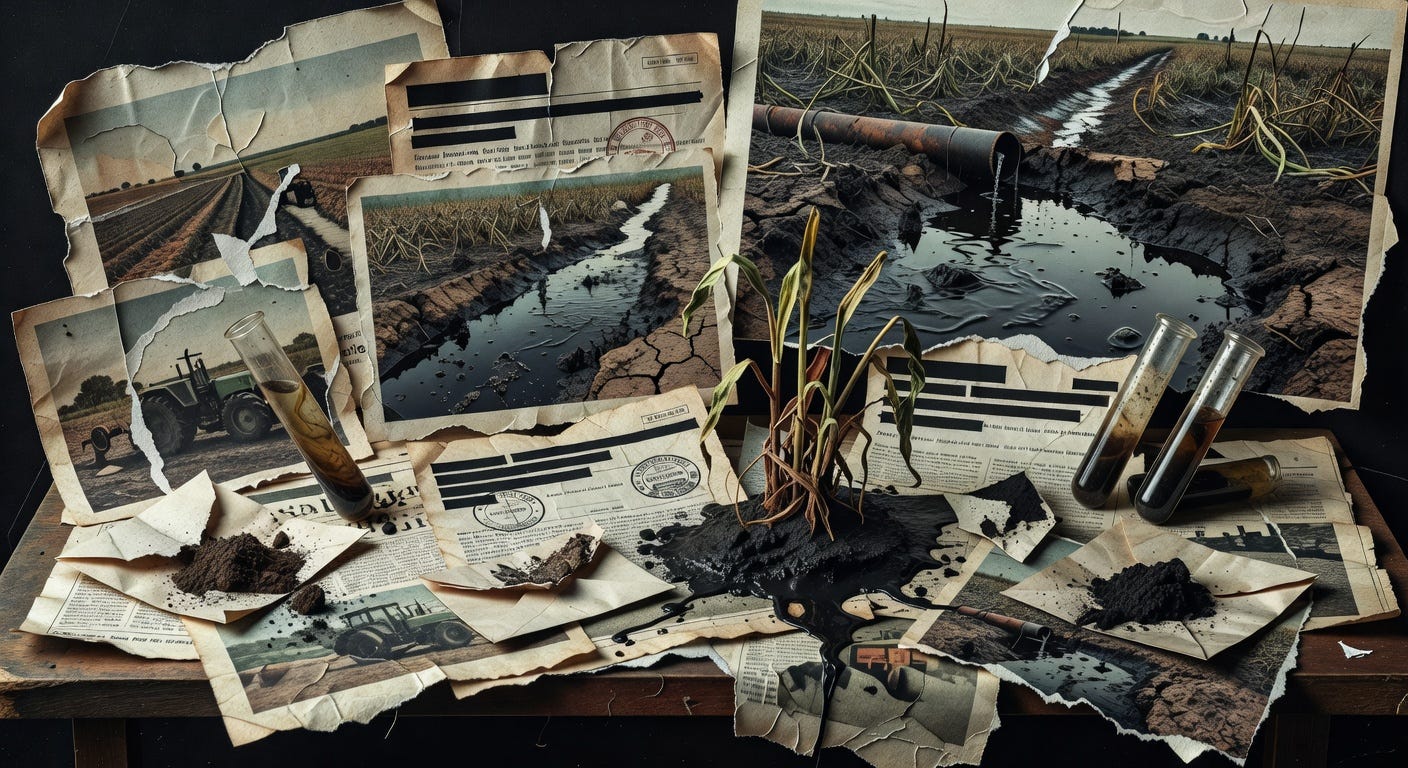
Here’s a question that sounds like it should have an obvious answer: What happens to everything you flush down the toilet?
It gets treated at a wastewater plant. The liquids get discharged (hopefully cleaned up) into rivers and lakes. The solids, the concentrated residue of everything that went down every drain in the service area, get separated out. This sludge contains whatever the population contributed: human waste, sure, but also pharmaceutical residues, heavy metals, industrial chemicals, PFAS, microplastics, synthetic hormones, and pathogens. It’s essentially a chemical snapshot of modern civilization’s output.
So where does it go?
Municipalities spread about 43% of it on farmland as fertilizer. The EPA calls it “beneficial use.” The industry calls it “biosolids.” What it actually is: “treated” sewage sludge applied to the soil where your food grows.
In 2023 alone, nearly 4.5 billion pounds of sludge were applied to farm fields or used in compost, according to state reports filed with the EPA. The Environmental Working Group estimates that sludge may have contaminated nearly 70 million acres of US farmland with PFAS, the indestructible “forever chemicals” that accumulate in human tissue and never break down. The National Biosolids Data Project estimates roughly 18% of all US agricultural land could be receiving biosolids as fertilizer.
No federal agency requires testing this sludge for PFAS. No label tells you whether your food grew in it. The stuff is too toxic to dump in the ocean (Congress banned that in 1988). But spreading it on the fields that grow your lettuce? Totally fine. The EPA says so.
One piece of good news: food labeled “organic” is not allowed to be grown in soil treated with biosludge. That, and growing your own food, is currently the only way to avoid biosludge from entering your body.
What’s Actually in It
The EPA’s Part 503 rule, established in 1993, sets the standards for biosolids quality. It regulates exactly nine metals: arsenic, cadmium, copper, lead, mercury, molybdenum, nickel, selenium, and zinc. It sets requirements for pathogen reduction and “vector attractiveness” (a polite way of saying “how much does it attract flies and rats”).
That’s it. Nine metals, some pathogens, and flies.
No standards for pharmaceuticals. No standards for synthetic hormones. No standards for PFAS. No standards for microplastics. No standards for any of the thousands of synthetic organic chemicals that flow through a modern sewage system every day. The EPA wrote these regulations in 1993 and has not meaningfully updated them since, despite the introduction of roughly 80,000 synthetic chemicals into commercial use.
The EPA’s own Inspector General confirmed this is a problem in 2018. Report #19-P-0002 found that the EPA had identified 352 pollutants in biosolids but could not assess their impact on human health or the environment “due to either a lack of data or risk assessment tools.” Of those 352, 61 appeared on lists of hazardous substances. The IG’s conclusion: “without risk assessments on each chemical, it is unknown whether the pollutants in biosolids are harmful.”
Read that again. The EPA’s own watchdog found that the agency regulating this practice couldn’t tell you whether the stuff it was approving for farmland use was safe. The response? Nothing changed. The Part 503 rule still regulates nine metals and some pathogens. The other 352 known pollutants remain unaddressed. And what about the unknown ones?
A USGS study of an eastern Colorado wheat field that had received treated sludge found something equally “reassuring”. Researchers tested for 57 “emerging” contaminants and detected 10 of them at depths of 7 to 50 inches, including Prozac, the blood thinner Warfarin, and the antibacterial triclosan (measured at 156 parts per billion at 7-14 inches). The field had been tested before application and was clean. Eighteen months after sludge application, the drugs had migrated deep into the soil column, potentially reaching groundwater and private wells.
Your food is being fertilized with a cocktail of antidepressants, blood thinners, industrial chemicals, and synthetic estrogens.
The Name Game
How did “sewage sludge” become “biosolids”? The PR campaign behind the rebrand is a masterclass in government-industry euphemism.
In 1990, the Water Environment Federation (WEF), the trade association for the sewage industry, assembled something called the “Name Change Task Force.” Their job was to come up with a more marketable name for sewage sludge. A name that didn’t make people think about what the product actually was. They held a contest. Among the rejected candidates: “all growth,” “purenutri,” “biolife,” “bioslurp,” “black gold,” “geoslime,” “sca-doo,” “the end product,” “humanure,” “hu-doo,” “bioresidue,” “urban biomass,” “powergro,” “organite,” and (this one’s amazing) “nutri-cake.”
In 1991, the task force settled on “biosolids.” A word designed to evoke biology and solidity, two things that sound vaguely beneficial and reveal nothing about origin.
The timing was not coincidental. In 1988, Congress passed the Ocean Dumping Ban Act, which took effect in 1992, making it illegal to dump sewage sludge in the ocean. The industry suddenly had millions of tons of waste that could no longer go into the water. It needed somewhere else to put it. Farmland was cheap. The Part 503 rule, which codified the standards for land application, was finalized in 1993. The PR campaign to make it palatable launched in parallel.
Powell Tate, a blue-chip Washington PR and lobby firm with clients in the tobacco, pharmaceutical, and airline industries, was hired by WEF to create the “National Biosolids Public Acceptance Campaign.” Charlotte Newton, a Powell Tate representative, advised the industry on dealing with opponents: “Attack them in a way that does not demonize them... You can’t play to those who act weirdest.”
The sequence is clean: ban ocean dumping → need cheap land disposal → rebrand the product → hire tobacco-industry PR firm → get EPA to write permissive rules → profit.
SourceWatch calls “biosolids” an “Orwellian PR euphemism for toxic sewage sludge.” That’s accurate. The word doesn’t appear in any dictionary that predates the PR campaign. It was invented by an industry lobby group, focus-tested against alternatives like “nutri-cake,” and then adopted into regulatory language by the very agency that was supposed to be protecting the public. The EPA’s own website now uses “biosolids” as the default term.
This is what regulatory capture looks like at the linguistic level. You don’t just capture the agency. You capture the vocabulary.
Follow the Money
Spreading sludge on farmland is cheap. That’s the whole point.
Land application costs municipalities roughly $50-200 per dry ton, compared to $175-650 per dry ton for landfill disposal and $90-130 per metric ton for incineration, making it competitive on price, but it doesn’t create a product you can sell to farmers. Land application turns a disposal cost into a revenue stream.
Some municipalities save $36 per ton or more just by sending sludge to farms instead of landfills. In many arrangements, farmers receive the sludge for free as “fertilizer,” and the municipality avoids paying disposal costs entirely. Everyone profits, except the people eating the food.
The industry has attracted serious capital. Synagro Technologies, the North American market leader for biosolids management, has managed over 16 million tons of residuals and operates with a footprint “multiple times larger than its closest competitor.” Synagro was formerly part of the Waste Management family and is now owned by EQT, a Swedish private equity firm. The global “biosolids” management market was valued at roughly $1.4 billion in 2024 and is projected to reach $2.4 billion by 2034.
That’s not a cottage industry. That’s a billion-dollar market built on the economic logic that it’s cheaper to put toxic sludge on farmland than to dispose of it properly.
And if you think the retail angle can’t get worse: the sludge is also packaged and sold directly to consumers as garden fertilizer. Milorganite, produced from Milwaukee’s sewage system, is one of the most popular turf fertilizers in America, sold at hardware stores nationwide. Other sludge-based products include TAGRO (Tacoma, WA), Greenedge (Jacksonville, FL), and products from Synagro (Sacramento, CA). These products are marketed as “eco-friendly” and “natural.”
Here’s the kicker, this stuff is ending up on front yards and lawns, in playgrounds and dog parks. Look at this Home Depot listing: Milorganite markets itself as “organic”. 4.7 stars. 6,000+ reviews. Unless you dig into the Q&A section or look at the manufacturer’s website, you’d never know it’s made from biosludge and contaminated with PFAS. The word organic is becoming increasingly meaningless.
Homeowners spread it on the grass where their kids play barefoot, where their dogs roll, where their toddlers put their hands and then put their hands in their mouths. Dozens of cities also give away “free compost” to residents that’s made from the same municipal sludge. The PFAS, heavy metals, and pharmaceutical residues don’t care whether they’re on a 500-acre farm or your front yard. If you’ve ever fertilized your lawn without reading the ingredient list, you may have already volunteered for the program.
In 2022, the Sierra Club and the Ecology Center tested nine retail fertilizers made from sewage sludge. PFAS was found in all nine. Eight of the nine exceeded the screening guidelines set by Maine, which had the strictest state limits at the time. The products were labeled with terms like “eco,” “natural,” and “organic.” Milorganite previously carried labels warning against use on food-producing soil. That warning was removed. In 1992, the Federal Trade Commission investigated the claim that Milorganite was a “natural, organic and/or safe” product, calling it deceptive. By 2000, the USDA had banned all biosolids from the organic label.
So to recap: the USDA says it’s not organic. The FTC investigated it as deceptive marketing. The federal government says it’s too toxic for the ocean. But it’s perfectly legal to spread on your dinner, and the brands continue to market themselves as “organic”.
The Farms That Got Destroyed
The human cost of this program isn’t theoretical. Families and livelihoods have been destroyed, and the people responsible haven’t paid a dime.
Fred Stone, Stoneridge Farm, Arundel, Maine. In the 1980s, Maine had a state program encouraging farmers to use treated sewage sludge as fertilizer. Stone’s dairy farm was one of the participants. Decades later, testing revealed that his soil, water, hay, and the milk from his cows contained extremely high levels of PFAS chemicals. Some locations on the farm tested as high as 800,000 parts per trillion. Stoneridge Farm was forced to shut down. The majority of Stone’s Brown Swiss and Holstein cows had to be put down. Stone hasn’t been able to make a living from his farm since 2017. The state program that assured him the sludge was safe has never made him whole.
Adam Nordell and Johanna Davis, Songbird Farm, Unity, Maine. Organic vegetable farmers who bought their farm without knowing it had been previously treated with sewage sludge. They only learned about the sludge history when the Maine DEP published a sludge application map in 2021. Subsequent testing revealed severe PFAS contamination in the farm’s water, soil, and crops, as well as in their own bodies. They closed their business, moved off the land, and suspended plans to sell the organic spinach they’d been growing. An organic farm, destroyed by contamination from a government-endorsed practice that happened before they owned the property. The PFAS don’t care about property lines or ownership dates.
Tozier Dairy Farm, Fairfield, Maine. In 2020, milk testing revealed PFOS levels more than 150 times the state’s threshold for contamination, likely the highest PFAS concentration ever recorded in milk. Hunters in the greater Fairfield area were told not to eat the deer due to elevated PFAS found in liver and tissue, traced back to historical sludge application on nearby fields.
These aren’t isolated cases. Maine has been the tip of the spear because it was one of the first states to actually test for PFAS on farmland. The contamination isn’t unique to Maine. It’s just that Maine looked. Most states haven’t.
The Whistleblower They Fired
The EPA hasn’t just been passively negligent. When scientists inside the agency raised alarms, the agency destroyed their careers.
Dr. David Lewis, a senior-level microbiologist who spent 31 years in the EPA’s Office of Research and Development, published two articles in Nature raising serious concerns about the agency’s Part 503 sludge rule. His research linked the agricultural use of processed sewage sludge to illnesses and deaths. Rather than investigating his findings, EPA officials who had developed the biosolids program smeared Lewis with a scientific misconduct charge and ultimately fired him.
Lewis’s work did prompt the CDC to issue guidelines protecting workers who handle processed sewage sludge. Think about that for a second: the health risks were serious enough that the CDC created worker protections for the people handling the stuff. But spreading it on the fields that produce your food remained perfectly legal.
The message to any other EPA scientist who might question the biosolids program was received loud and clear.
What Switzerland Knows That We Don’t
Not every country has decided this is a good idea.
Switzerland and the Netherlands have banned the use of sewage sludge on farmland altogether. Malta, Slovakia, and Slovenia don’t select agricultural disposal as an option for sewage sludge. Multiple EU countries have adopted standards significantly stricter than the US Part 503 rule.
In the US, the movement is growing but remains tiny. Maine became the first state to completely ban the land application of biosolids and the sale of sludge-derived compost in 2022, passing LD 1911 with bipartisan support after the PFAS crisis destroyed farms across the state. Michigan has restricted highly contaminated sludge but still allows higher PFAS levels than Maine did. New Hampshire is debating a moratorium as of early 2026. New York has introduced bills to ban the practice.
Forty-nine states have not banned it. The federal government, which created the permissive framework in the first place, shows no inclination to change course. The EPA announced plans for a new National Sewage Sludge Survey to collect “current national concentration data on PFAS” in sewage sludge. They’re still in the data-collection phase. The same agency that couldn’t assess 352 pollutants in 2018 is now promising to get around to studying PFAS. Eventually.
Meanwhile, the stuff that’s too toxic for the ocean is still going on your food, every day, in 49 states.
The Food Chain You Can’t See
The danger isn’t just what’s in the sludge. It’s what happens after it hits the soil.
PFAS are called “forever chemicals” because they don’t break down. When sludge containing PFAS is applied to farmland, the chemicals persist in the soil, leach into groundwater, and get taken up by crops. They move through the food chain: soil to plants, plants to livestock feed, feed to cattle, cattle to milk and meat, meat and milk to your dinner table.
The EPA’s own January 2025 draft risk assessment acknowledged that PFAS in sludge poses health risks through food grown on contaminated land. The assessment identifies specific high-risk scenarios: farms where animal feed has biosolids application, pasture-raised hens or cattle on treated fields, farms growing leafy greens like lettuce or spinach, and farms with home drinking water wells.
In other words, the EPA now admits the food pathway is real. Their solution is a fact sheet suggesting farmers check their history and maybe get their soil tested. No ban. No mandatory testing. No labeling. Just a suggestion to look into it, while 4.5 billion pounds per year keep going on the fields.
Microplastics are another vector. A Cardiff University study estimated that 31,000 to 42,000 tonnes of microplastics are applied to European soils annually through sewage sludge. European farmland may now be one of the biggest global reservoirs of microplastic contamination. The US doesn’t even track this number.
Sewage sludge is one of the primary delivery vehicles for the endocrine-disrupting chemicals destroying reproductive health. Every pharmaceutical flushed down a toilet, every PFAS compound from a nonstick pan, every synthetic estrogen from birth control pills, all of it concentrates in the sludge, gets spread on fields, enters the food chain, and ends up in the bodies of people who never consented to the exposure.
This is the pipeline. The chemical castration doesn’t just happen through plastic containers and food packaging. It happens through the soil itself.
What You Can Do
The bad news: there are no labeling requirements, so you can’t tell from a package whether your food was grown in sewage sludge. The good news: you’re not powerless.
Buy USDA Organic. The National Organic Program explicitly prohibits the use of sewage sludge on certified organic crops. This is one of the few cases where the USDA Organic label provides a concrete, verified protection against a specific contaminant pathway. It won’t catch historical contamination (Songbird Farm was organic on contaminated land), but it eliminates ongoing application.
Know your farmer. Buy direct from farmers who can tell you their soil history and practices. Ask whether biosolids have ever been used on the land. At a farmers’ market, this is a two-minute conversation. At a grocery store, it’s impossible.
Check your state’s sludge maps. Maine published a sludge and septage application map in 2021 that helped identify contaminated farms. Some other states maintain similar records. If you own land, check whether it has a history of sludge application before you grow food on it.
Test your soil. If you’re buying property for homesteading or food production, test for PFAS before you invest your life savings. The University of Maine Extension has published a detailed guide for investigating PFAS risk on farms.
Avoid retail sludge fertilizers. Products containing “biosolids” in their ingredients include popular brands like Milorganite, TAGRO, and numerous products marketed as “natural” or “eco-friendly” or “organic” (but not USDA certified organic). Read the label. If it says “biosolids,” it’s sewage sludge, though unfortunately they often don’t even put it on the label.
Filter your water. If you live near agricultural land that has received biosolids, particularly if you use well water, invest in reverse osmosis or activated carbon filtration. PFAS doesn’t break down, but it can be filtered out of drinking water.
Grow your own. The most reliable way to know what’s in your food is to produce it yourself, on clean soil, with known inputs. This is not a complete solution to the biosolid problem, but it’s the highest-certainty approach available for your own household. Start with raised beds and tested soil if you’re unsure about your land.
Support companies that refuse sludge-grown crops. Whole Foods, Heinz, Del Monte, and Dole have policies prohibiting crops grown with sewage sludge. Buy from companies that care enough to set that standard, and tell them why.
The Bottom Line
The “biosolids” program is one of the most straightforward cases of regulatory capture you’ll find. An industry needed a cheap place to dump toxic waste. A PR firm gave the waste a new name. The EPA wrote permissive rules. A billion-dollar market formed around the arrangement. When an EPA scientist connected it to illnesses and deaths, the agency fired him. When 352 unregulated pollutants were found in the product, nothing changed. When PFAS destroyed farms across Maine, one state banned it and 49 kept going.
Part 4 of this series, “What They Spray While You Sleep,” will cover the exposure vector you can’t opt out of: what’s in the air above your home, and why you don’t know.
This is Part 3 of the Biology & Survival series, which covers the science showing that by 2045 the average person will become infertile, and explains all the reasons why, so that you can protect yourself, your children, and your grandchildren.


Sources
1. EPA Part 503 Biosolids Rule (1993). Link
2. EPA Office of Inspector General Report #19-P-0002, November 15, 2018. “EPA Unable to Assess the Impact of Hundreds of Unregulated Pollutants in Land-Applied Biosolids.” Link
3. EWG, “Forever Chemicals in Sludge May Taint Nearly 70 Million Farmland Acres,” January 2025. Link
4. Gonzalez et al. “Emerging environmental health risks associated with the land application of biosolids: a scoping review.” Environmental Health, 2023. Link
5. USGS study on pharmaceutical contamination in sludge-treated fields, via Scientific American. Link
6. Sierra Club / Ecology Center, “Sludge in the Garden: Toxic PFAS in Home Fertilizers,” 2022. Link
7. SludgeNews.org, “Timeline” (biosolids name change history). Link
8. SourceWatch, “You Say Biosolids, I Say Sewage Sludge.” Link
9. Ocean Dumping Ban Act of 1988 (Public Law 100-688). Link
10. Powell Tate PR campaign documentation, via SourceWatch. Link
11. EJNet, “The Sludge Hits the Fan.” Link
12. Synagro Technologies / EQT portfolio. Link
13. Precedence Research, “Biosolids Management Market Size.” Link
14. Land application cost comparison ($50-200/ton vs. $175-650/ton), The Cattle Site. Link
15. Reuters, “The Curious Case of Tainted Milk from a Maine Dairy Farm,” March 2019. Link
16. IATP, “With a second farm shuttered due to massive PFAS contamination,” July 2020. Link
17. Press Herald, “These Maine farmers know what PFAS can do,” October 2023. Link
18. Washington Post, “PFAS devastate a Maine farm,” April 2022. Link
19. Adam Nordell testimony to Maine Legislature, 2024. Link
20. Down East Magazine, “Maine Is Only Beginning to Grapple With the PFAS Crisis.” Link
21. AEI Consultants, “Terrifying PFAS Nightmares on Small Maine Farms.” Link
22. Dr. David Lewis, National Whistleblower Center. Link
23. Independent Science News, “How EPA Faked Sewage Sludge Safety: A Whistleblower’s Story,” 2019. Link
24. Kohn, Kohn & Colapinto (KKC), David Lewis whistleblower profile. Link
25. Greenpeace Unearthed, “No Plan B: Water companies fear pollution crackdown,” June 2025. Link
26. NACWA, “Maine Legislature Passes Bill Prohibiting Land Application of Biosolids,” April 2022. Link
27. Safer States, “Maine Governor Signs First-in-Nation Law,” 2022. Link
28. Guardian, “Maine bans use of sewage sludge on farms,” May 2022. Link
29. New Hampshire Bulletin, “Farm use of PFAS-laden sludge raises health concerns,” February 2026. Link
30. NY State Senate, “Legislators, Advocates and Farmers Call for Ban of Toxic Sewage Sludge on Farmland,” 2025. Link
31. EPA PFAS in Sewage Sludge information page. Link
32. EPA Draft Sewage Sludge Risk Assessment for PFOA and PFOS fact sheet, January 2025. Link
33. Cardiff University, “European farmland could be biggest global reservoir of microplastics,” May 2022. Link
34. Beyond Pesticides, “Sewage Sludge Fertilizers Sold at Hardware Stores Found to be Contaminated with PFAS,” June 2021. Link
35. USDA National Organic Program, Federal Register, March 2000. Link
36. Center for Food Safety, “How Do I Know if My Food Was Grown in Sewage Sludge?” Link
37. Solenis, “The Changing Landscape of Sludge Disposal.” Link
38. University of Maine Extension, “Guide to Investigating PFAS Risk on Your Farm.” Link
39. Milorganite, Wikipedia. Link
40. AgWeek, “Biosolids protect landfills, offer free fertilizer.” Link
Excellent article! I first became aware of biosludge around 1990. In Maryland, we bought this lawn fertilizer called "Compro" which was composted sewage sludge. The label explicitly warned not to use Compro for food production. We were dumb back then and didn't understand it was a bad idea to use composted sludge at all (it did make the grass grow, though). Fast forward to today: I've noticed that nearby farms in Virginia receive sewage sludge (I was told it's free) and use it to fertilize their fields. The whole area smells like a toilet when we drive by. The smell is so bad I thought a sewage treatment plant was nearby. I can't imagine why the farmers continue this toxic practice when it obviously ruins their air (and presumably soil) quality.
Wav! This series is beyond impressive!
Personally, I thought quite a lot about the pollution we're facing. But reading your work, I feel I've only finished kindergarten :-D
What I like most is that at the end of your articles you're giving very actionable advice on how to make your life healthier and free.
Once you finish writing the series, I strongly suggest that you spend some time figuring out how you can get the most people to see it. That might mean packaging it up as an e-book, maybe a special website, etc.
Let me know if you need help with this, and I can help you brainstorm ideas. Because I feel like everyone should read this. Since this is not an afternoon tea conversation. We're talking about the survival of the human species.