

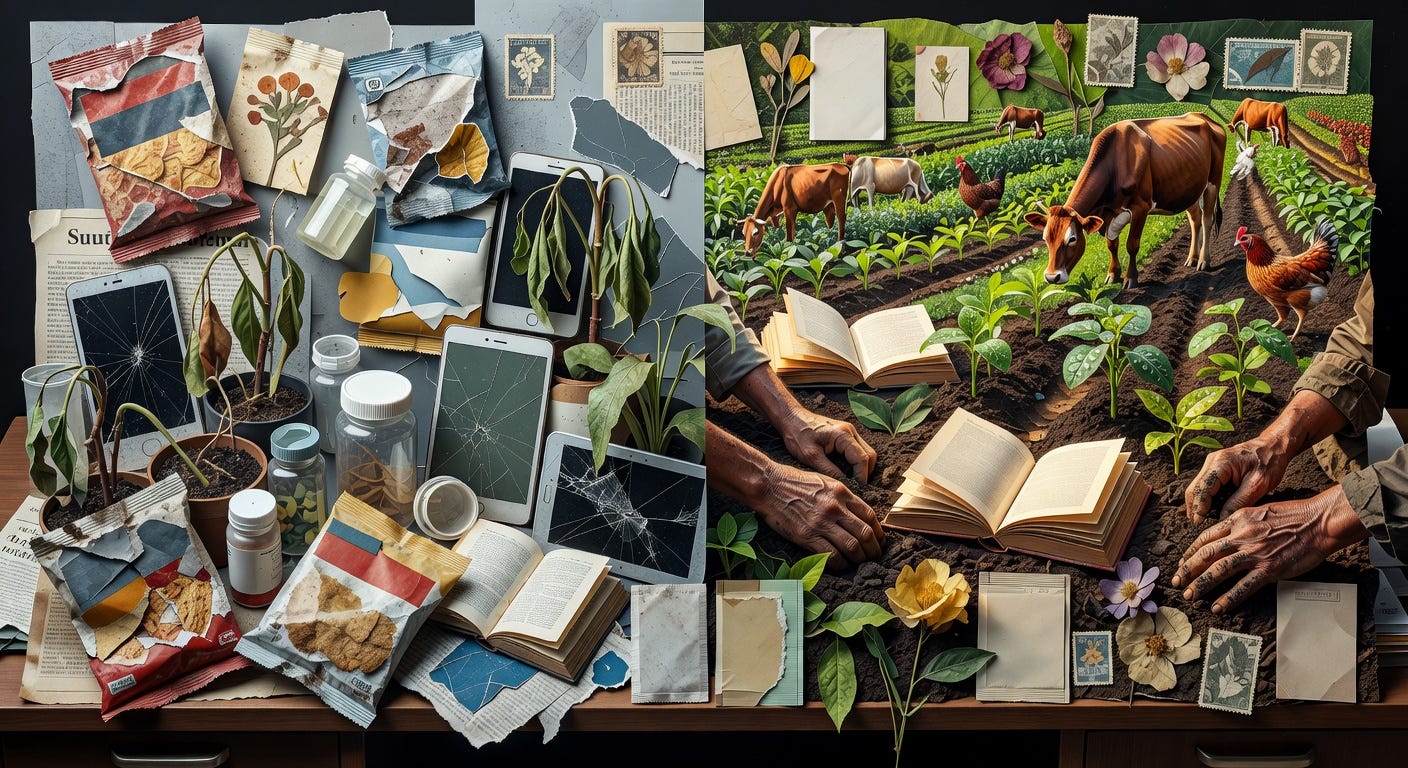
America (and much of the world) is sorting itself into two biological tracks. One keeps moving deeper into the default modern package: ultra-processed food supplying 55.0% of calories overall and 61.9% for youth, record childhood obesity at 21.1%, collapsing fertility, more chronic disease, more screen dependency, less family formation, and less confidence that any of this can be changed.
The other track is smaller, quieter, and much more important. It is built around cleaner food, lower chemical load, educational independence, stronger household economics, more community, and more children. This is the exit & build movement.
The Cultural Default
We already covered the machinery of decline in many of the previous parts of the series, such as Part 1, Part 7, Part 13, and Part 14.
A major meta-analysis published in Human Reproduction Update found that mean sperm concentration fell 51.6% between 1973 and 2018, with the decline accelerating after 2000. As Part 1 laid out, US fertility is well below replacement level, and declining further. Our biological systems are failing at the same time the culture is telling people to delay, medicate, digitize, and outsource the very conditions that make family life possible.
The Exit & Build Movement
Thankfully, people are starting to opt out.
Education is one of the clearest markers. The National Center for Education Statistics reported that 5.2% of US students were homeschooled in 2022-23, up from 3.7% in 2018-19. The National Home Education Research Institute now estimates 3.408 million homeschool students in 2024-25, or about 6.262% of the K-12 population.
That matters because homeschooling is rarely just a curriculum decision. It tends to pull families toward co-ops, church networks, microschools, skill-sharing, family-integrated work, and a very different view of what childhood is for. The move is educational on paper. In practice it often becomes civilizational.
Food shows the same split. The Organic Trade Association says US organic food sales reached $65.4 billion in 2024. USDA data shows $17.5 billion in local and regional food sales in 2022, while small family farms sold more than $2.4 billion directly to consumers in 2023.
A meaningful share of households are no longer accepting conventional pesticide-laden GMO crops as acceptable food.
Geography matters too. USDA researchers found that rural net migration turned positive in 2020-21, hitting 0.47% after a decade of losses. Families are leaving high-cost urban life for small towns, acreage, or semi-rural communities are not just changing scenery. They are changing stress load, food access, air quality, noise, social norms, and the practical feasibility of children.
The Gap Compounds
In a 2019 organic-diet intervention study, researchers found that pesticide metabolites fell by an average of 60.5% in just six days. A 2020 study found that glyphosate levels dropped 70% after one week on an organic diet.
That is a big deal. It means the difference between two households is not merely philosophical. One family can keep eating, wiping, spraying, and washing itself in the default chemical soup. Another can start shifting inputs and produce measurable changes inside a week.
Stretch that over a year.
Then ten.
Then one generation handing over to the next.
The Gap Can Become Inheritance
Epigenetics shows us that preconception conditions matter more than modern culture wants to admit. A 2025 review in Clinical Epigenetics found that paternal diet and lifestyle before conception can influence offspring health through sperm DNA methylation, histone modification, and small non-coding RNA. A 2021 review in Frontiers in Endocrinology found that obesogen and endocrine-disrupting exposures can have transgenerational epigenetic effects.
One small decision at a time, and you start to see things compound. Parents are not handing children only genes. They are also handing them metabolic conditions, toxic burdens, stress loads, and developmental starting points. And perhaps more importantly than ever: actual inheritance of value. Not just a bank account denominated in a currency that’s being debased to pay for bombs and welfare checks, or a cookie cutter home in a suburb - but real inheritance. Things you can’t just build quickly or take out debts to buy.
I’m talking about homesteads. A productive homestead that’s got 20 year-old fruit trees and decades of soil building looks very different from unimproved acreage. Biology cannot be rushed and investment here matters more than anything else you can pass on to your children. But that means you have to plant your flag somewhere and then choose not to leave, which is very different from the average American household moving every 6-7 years.
“A society grows great when old men plant trees whose shade they know they shall never sit in.”
The Amish Story
If you want proof that this split is not imaginary, look at the Amish.
This is not an argument for copying every Amish belief or technology choice, and unfortunately the Amish have fallen in the trap of many bad habits like many Americans - believe it or not they drink sodas and eat junk food too. But the point stands: the Amish population grew from 177,910 in 2000 to 410,955 in 2025. Their population has long doubled roughly every twenty years.
This proves that the entirety of society doesn’t just have to mindlessly plod along a doomed technological and sociocultural path. We can choose a different way.
I’m not saying go and be Amish, but we can learn much from them. A family-centered population with a working culture can keep growing at the same time as the mainstream declines below replacement rates and eventually slides into extinction.
The Good News is We Don’t Need To Convince Everyone
The people choosing to exit & build do not need to reform the entire mainstream. We don’t need every school fixed, every grocery store cleaned up, every city redesigned, or every institution suddenly rediscovering basic competence. That’s impossible and futile, and frankly a waste of our time and energy.
All we need to save civilization and humanity is for enough families to start and keep moving in the right direction.
Cleaner food. Better water. Lower toxic burden. Less screen sedation. More local trust. More household competence. More children raised inside environments that do not treat them as an economic error.
For the next and final part, we’re going to focus on the blueprint for biological survival - all the things you and your family can do to literally help save humanity from extinction. While everyone else keeps eating nachos and irradiating themselves with sterilizing EMFs.
This is Part 17 of the Biology & Survival series, which covers the science showing that by 2045 the average person will become infertile, and explains all the reasons why, so that you can protect yourself, your children, and your grandchildren.
Next up: Part 18 will focus on solutions you can implement.


