

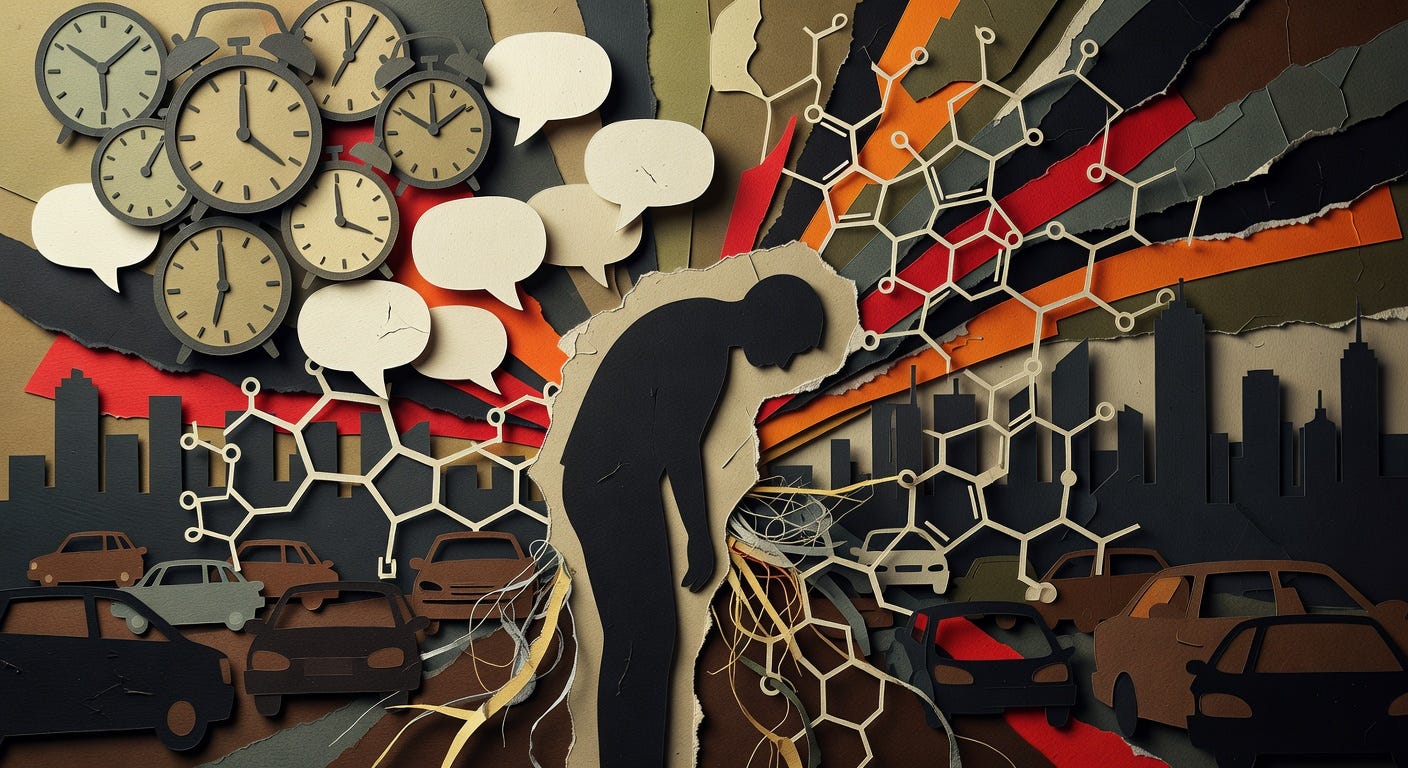
Right now, as you read this sentence, your adrenal glands are probably producing cortisol. Not because a predator is stalking you through the brush. Not because your village is under siege. Because your phone buzzed, or your rent is due, or you’re sitting in traffic, or you scrolled past a headline about something terrible happening somewhere far away.
Your body doesn’t know the difference. That’s the problem.
The stress response you’re living in was engineered by millions of years of evolution for encounters lasting seconds to minutes. A predator appears. Your hypothalamus fires an alarm. Adrenaline floods your system. You fight or run. The threat resolves. Cortisol drops. Your body repairs itself while you rest.
That sequence was never meant to run for 16 hours straight. It has no setting for “threat that never ends.” In the ancestral environment, a threat lasting hours meant you were dead. There was no need for an off switch because the off switch was the resolution of the event: you either escaped or you didn’t.
Modern life has taken this two-minute emergency system and jammed the throttle wide open. Permanently.
And it’s not just making you anxious. It’s destroying every biological system this series has covered.
The Two-Minute System Running All Day
Here’s what actually happens inside your body during a stress response.
When your brain perceives a threat (any threat, real or imagined, physical or psychological), the hypothalamus releases corticotropin-releasing hormone (CRH). This travels to the pituitary gland, which responds by secreting adrenocorticotropic hormone (ACTH) into the bloodstream. ACTH reaches the adrenal glands sitting on top of your kidneys, which then produce the stress hormones: cortisol and adrenaline.
This cascade is called the HPA axis (hypothalamic-pituitary-adrenal axis), and it’s one of the most studied systems in endocrinology. The whole sequence takes about 20 seconds. In acute situations, it’s a masterpiece of biological engineering: blood pressure rises, heart rate increases, glucose floods the bloodstream, digestion shuts down, immune inflammatory responses are suppressed, and every ounce of energy is redirected toward survival.
The problem isn’t the system. The problem is what happens when it never turns off.
What Chronic Cortisol Does to You
The following effects are peer-reviewed and well-documented:
Your immune system shuts down. Cortisol downregulates the inflammatory response. Short-term, this makes sense: if a lion is chasing you, this isn’t the time for your body to fight an infection. It needs all resources for the sprint. But long-term, this is catastrophic. A landmark 1991 study by Sheldon Cohen at Carnegie Mellon deliberately exposed 394 healthy volunteers to five different respiratory viruses after measuring their psychological stress levels. The results were unambiguous: psychological stress predicted cold susceptibility in a dose-response relationship. More stress, more illness. Not because stressed people took worse care of themselves, but because stress directly suppressed immune function.
Your sleep architecture collapses. Cortisol and melatonin exist in a carefully choreographed inverse relationship: cortisol peaks in the morning (waking you up) and bottoms out at night (letting you sleep), while melatonin does the opposite. Chronic stress disrupts this rhythm. Elevated evening cortisol suppresses melatonin production, fragments deep sleep and REM sleep. These aren’t just the phases where you dream. They’re when tissue repair, memory consolidation, and detoxification happen. You’re not just tired. You’re not repairing.
Your fertility tanks. Cortisol and your sex hormones (testosterone, estrogen, progesterone) all originate from the same precursor molecule: pregnenolone. Under chronic stress, the body diverts pregnenolone toward cortisol production at the expense of sex hormone synthesis. Endocrinologists call this “pregnenolone steal.” Your body is literally choosing survival over reproduction. If your body believes it’s in danger, making babies is deprioritized at the molecular level.
You store fat in the worst possible places. Cortisol specifically promotes visceral fat storage, the fat deposited around your internal organs rather than the subcutaneous fat beneath your skin. Visceral fat isn’t just aesthetically unwelcome. It’s metabolically active tissue that releases inflammatory cytokines and free fatty acids directly into the portal vein feeding your liver. Visceral fat is an inflammation engine running 24/7, producing the very molecules that drive chronic disease.
Your DNA literally ages faster. In 2004, Elissa Epel and Elizabeth Blackburn (who would later win the Nobel Prize for her telomere research) published a groundbreaking study in PNAS examining 58 premenopausal women, 39 of whom were caregivers for chronically ill children. Women with the highest levels of perceived stress had telomeres shorter by the equivalent of at least one decade of additional aging compared to low-stress women. Their cells were biologically older than their birth certificates said. Chronic stress wasn’t just wearing them down. It was accelerating cellular senescence, the process by which cells stop dividing and begin deteriorating.
Your brain rewires itself against you. This is perhaps the most insidious effect. Chronic cortisol exposure weakens the prefrontal cortex (the brain region responsible for critical thinking, long-term planning, impulse control, and rational decision-making) while simultaneously strengthening the amygdala (the region that processes fear, reactivity, and snap judgments). In plain language: chronic stress makes you dumber and more fearful.
Your gut lining breaks down. Cortisol increases intestinal permeability by stimulating the release of zonulin, a protein that loosens the tight junctions between cells in your intestinal wall. The result is what researchers call increased gut permeability (i.e. “leaky gut”): undigested food particles, bacterial endotoxins, and inflammatory molecules pass through the intestinal barrier into the bloodstream, triggering systemic inflammation.
Your blood sugar goes haywire. Cortisol raises blood glucose because in a survival scenario, you need energy for your muscles. This makes perfect sense if you’re running from a predator. It makes no sense if you’re sitting in a cubicle worrying about your mortgage. The glucose floods in, but you never burn it with physical exertion. Insulin rises to manage it. Repeat this cycle daily for years and you get insulin resistance, metabolic syndrome, and eventually the diabetes pipeline. Your body prepared you for a sprint that never happened, over and over, until the emergency fuel system burned out.
Your memory literally shrinks. Lupien et al. demonstrated in Nature Neuroscience that prolonged cortisol elevations produced reduced hippocampal volume and deficits in hippocampus-dependent memory tasks. The hippocampus is where memories are consolidated and spatial navigation is processed. Shrink it, and you lose the ability to learn, remember, and think clearly. Worse: the hippocampus is also a key brake on the HPA axis. Damage it, and the stress response loses its own off switch. Hippocampal atrophy from cortisol creates a vicious cycle: more stress produces brain damage that produces more stress.
The Modern Stress Stack
Chronic stress isn’t a personal failing. It’s the default operating environment of modern civilization. Each of the following stressors was rare or nonexistent for most of human history. Now they’re simultaneous and constant.
The Information Assault
Your nervous system cannot distinguish between a lion standing in front of you and a war playing on your phone. Neuroimaging research confirms that the amygdala responds to all manner of information that signals threat or personal relevance, regardless of whether the threat is physically present. Every push notification is a micro-stress event. Every “BREAKING” banner triggers a cortisol micro-dose. Every outrage cycle your feed serves you activates the exact same neural pathways that would fire if the threat were in the room.
Then there’s social comparison. Ancestral humans compared themselves to roughly 150 tribe members. You’re comparing yourself to millions of curated highlight reels simultaneously. Vogel et al. (2014) demonstrated that social media exposure lowered self-esteem through increased social comparison, and people with high social comparison orientation experienced more negative emotions after browsing. The comparison is also rigged: you’re measuring your behind-the-scenes against everyone else’s front stage. And the platforms know it. Outrage is the most engaging emotion, so the algorithms serve you more of it. You’re being deliberately provoked multiple times per hour by systems designed to maximize your stress response, because stressed people scroll more.
The Economic Trap
According to PNC Bank’s 2025 Financial Wellness Report, 67% of Americans are living paycheck to paycheck. That’s a lot of people living in perpetual financial threat activation. Every month is a survival calculation. Credit card debt at record highs. Medical bankruptcy always one emergency room visit away. Student loans stretching into middle age.
Financial precarity is a chronic stressor with no resolution, which makes it the worst kind: your body mounts the stress response, but there’s no lion to fight and no direction to run.
Job insecurity compounds the pressure. At-will employment, layoff culture, and the gig economy mean no stability, no loyalty, no predictability. The ancestral equivalent would be never knowing whether your tribe will exile you tomorrow. Your body doesn’t distinguish between “might lose my job” and “might lose access to food and shelter.” To the HPA axis, they’re the same signal.
Then consider food security. Most urban Americans have three to seven days of food in their homes, entirely dependent on just-in-time supply chain deliveries they don’t control. Historically, homesteaders kept a full year of preserved food. Your nervous system registers this vulnerability even when your conscious mind doesn’t. The pantry is thin. The garden doesn’t exist. Every meal depends on a fragile system arriving on time. The homesteader’s nervous system can actually relax because the threat is genuinely handled. The city dweller’s can’t, because it isn’t.
The Environmental Assault
The average American commute is roughly 55 minutes a day. Gottholmseder et al. (2009) documented elevation in salivary cortisol, perceived stress, and affective reactions to crowding in commuters, particularly on rail. Road rage is less a personality flaw and more a stress response in a body that interprets gridlock as being trapped. You can’t fight and you can’t flee, the worst possible combination for the HPA axis.
Urban noise triggers stress hormones even during sleep. The WHO Environmental Noise Guidelines document that persistent noise exposure causes a pathophysiological cascade: increased stress hormone levels, blood pressure, and heart rate, favoring the development of cardiovascular disease, hypertension, and arrhythmia. Your body responds to noise as threat even when you’re unconscious. Aircraft noise near airports is linked to cardiovascular disease independent of other factors. Even “acceptable” urban noise levels exceed what the human auditory system evolved to process as baseline.
Then there’s light pollution. Blue light from screens suppresses melatonin and disrupts the cortisol circadian rhythm. Cortisol is supposed to peak at dawn and bottom out at night. A screen at midnight tells the body it’s noon. The body never fully enters rest-and-repair mode. Shift workers, who live in permanent circadian disruption, have elevated rates of nearly every chronic disease: cardiovascular disease, metabolic syndrome, cancer. The rest of us are running a milder version of the same experiment every evening we stare at a backlit screen.
Sedentary confinement adds another layer. Eight or more hours of sitting per day isn’t the same as resting. Your body interprets prolonged stillness in a confined space differently than active rest in an open environment. Movement signals safety: you can move freely. Stillness in a small space signals hiding or being trapped. Sitting in a cubicle under fluorescent lights does not register the same way as sitting by a river.
Then there’s what researchers call “nature deficit.” Park, Miyazaki, and colleagues (2010) conducted field experiments across 24 forests in Japan with 280 subjects, measuring salivary cortisol, blood pressure, pulse rate, and heart rate variability. Forest environments promoted lower cortisol concentrations, lower pulse rate, lower blood pressure, greater parasympathetic nerve activity, and lower sympathetic nerve activity compared to city environments. Separate research by Li et al. found that forest exposure significantly increased natural killer cell activity (these are a type of anti-cancer white blood cells) while significantly decreasing cortisol and adrenaline levels. The absence of nature is the absence of the environment your nervous system was calibrated for. A city dweller’s baseline stress is elevated simply by being in a city, before anything else happens to them.
And density itself is a stressor. Starting in the late 1950s, ethologist John B. Calhoun ran a series of behavioral sink experiments that became some of the most referenced studies in population biology. His early rat colonies, described in a landmark 1962 Scientific American article, showed that increasing population density produced increased aggression, abnormal behavior, infant neglect, maternal failure, and social withdrawal, even with unlimited food and water. His later mouse utopias (Universe 25, begun in 1968) pushed the findings further: males split into aggressive and completely withdrawn groups. The withdrawn ones, which Calhoun called the “beautiful ones,” did nothing but eat, sleep, and groom. Females couldn’t carry pregnancies to term. The behavioral breakdown occurred despite unlimited resources. Every population eventually collapsed into terminal decline and extinction. Calhoun drew explicit parallels to human urban environments, and while rodent analogies have limits, the stress physiology is remarkably similar across mammals.
The Collapse of Communities
Perhaps the most devastating modern stressor is the one that receives the least attention: the disintegration of community.
The percentage of U.S. adults reporting no close friends has quadrupled since 1990. The percentage with ten or more close friends has dropped to roughly a third of what it was. The average American now maintains just 3.6 close friendships, reportedly losing 9 friends over the last decade, almost one friend per year.
This isn’t just sad. It’s physiologically dangerous.
John Cacioppo’s pioneering research at the University of Chicago demonstrated that loneliness predicts higher blood pressure, increased cortisol, less restful sleep (even when sleep duration is unchanged), and elevated inflammatory markers. Perceived social isolation triggers the same cortisol and inflammatory cascades as physical threat. Loneliness doesn’t just feel bad. Your body interprets it as danger.
Holt-Lunstad et al. (2010) conducted a meta-analysis of 148 studies spanning 308,849 participants and found that people with stronger social relationships had a 50% greater likelihood of survival over the follow-up period. The magnitude of the effect was comparable to quitting smoking. Insufficient social connection carried mortality risk equivalent to smoking approximately 15 cigarettes per day. Loneliness kills at a rate comparable to a pack-a-day habit.
No village. No extended family nearby. No shared labor. No communal childcare. Every problem is yours alone. The nuclear family was already an isolation from extended kin networks. Now even that is fracturing. And the “connections” offered as surrogates (social media followers, parasocial relationships with content creators, political tribal affiliations) don’t reduce cortisol. They often increase it.
Add to this the pressure of performative living: the expectation to project success, happiness, and productivity at all times. Social media turns every interaction into a performance review. There’s no space for genuine vulnerability, no acceptable way to simply be struggling. The constant performance itself is a stressor, and the gap between the curated self and the real self generates its own chronic cortisol load.
Why Governments Love This: Stressed Populations Are Compliant Populations
Everything described above has a political dimension that is rarely discussed but critically important. A chronically stressed population is, neurologically, a compliant population.
Chronic cortisol suppresses the prefrontal cortex (where critical thinking, long-term planning, and independent judgment live) while amplifying the amygdala (where fear, obedience, and short-term reactivity live). A person in this state is neurologically shifted toward compliance. They’re more fearful, more reactive, less capable of evaluating claims critically, and less willing to take risks. In other words: more controllable.
Now look at the “information assault” again. The 24-hour news cycle isn’t broken. It’s optimized. Every “BREAKING” alert, every threat narrative, every political outrage cycle keeps the population in chronic amygdala activation. People who are afraid don’t think clearly. They look to authority figures for safety. They accept restrictions they’d otherwise question. They trade liberty for the feeling of security.
Financial precarity serves the same function. People living paycheck to paycheck can’t afford to take risks, question employers, or walk away from systems that degrade them. Debt is a leash. Not just a metaphorical one: a biochemical one. The cortisol produced by financial insecurity physically impairs the prefrontal reasoning you would need to plan an alternative.
Food dependency serves the same function. People who can’t feed themselves can’t defy the system that feeds them. A population with three days of food and no ability to produce more is a population that will comply with whatever is required to keep the supply chain running, including things they’d refuse if their pantry were full and their garden was producing.
Stress isn’t a bug of the system. It’s a feature.
This is why political solutions (voting for the right candidate, passing the right legislation, “raising awareness”) don’t address the underlying dynamic. You can’t reform a system whose basic operating incentive is to keep you stressed. You can only leave it.
Solutions
Every exit & build recommendation this series has made isn’t just a political philosophy or a lifestyle preference. It’s a medical intervention. Every single one reduces cortisol. That’s not a coincidence. The ancestral environment we’re trying to rebuild is the environment your stress response was calibrated for.
Get into nature. The Park and Miyazaki (2010) research measured cortisol reduction after just 20 minutes in a forest environment. Li’s studies found that forest exposure increased natural killer cell activity (boosting the immune system cortisol was suppressing) while simultaneously reducing stress hormones. The sights, sounds, and chemical signals (phytoncides) of natural environments signal “safe” to a nervous system calibrated for exactly this setting. Trees are medicine.
Move your body. Not “exercise” as obligation, but movement as the body’s natural stress completion cycle. When you fight or flee, the stress hormones get burned and the cycle completes. When you sit in traffic, it doesn’t. Your body prepared for explosive action, the action never came, and the chemicals just sit in your bloodstream dysregulating everything. Movement closes the loop. Chopping wood. Walking a field. Digging a garden bed. Building a chicken coop. The homestead lifestyle is a built-in stress completion system. Every physical task that serves a purpose also serves your biochemistry.
Touch the earth. Chevalier et al. (2012) found that sleeping grounded (direct electrical contact with the earth’s surface) normalized diurnal cortisol profiles over eight weeks. Participants’ cortisol patterns, which had been scattered and dysregulated, realigned into the healthy pattern of lowest-at-midnight, highest-at-morning. Most subjects reported improved sleep and reduced pain and stress. Electron transfer from the earth’s surface reduces inflammation markers. Walking barefoot in the grass isn’t just pleasant. It recalibrates your endocrine system.
Build real community. Cacioppo’s research demonstrated that the antidote to loneliness as a physiological stressor is genuine social connection. Not social media followers. Not parasocial relationships with podcasters. Face-to-face, reciprocal, vulnerable human connection. The kind that happens naturally in intentional communities, churches, homestead cooperatives, and neighborhoods where people actually know each other’s names.
Grow your food sovereignty. A full pantry. A producing garden. Preserved food on shelves. The knowledge and tools to feed yourself independent of any supply chain. This is the single most effective anxiolytic (anti-anxiety intervention) available, and no pharmaceutical company will ever tell you that. Your nervous system can finally stand down when the food question is genuinely answered. Not “I can afford groceries this week” but “I have months of food stored and the skills to produce more.” The homesteader’s cortisol drops for reasons no meditation app can replicate: the threat of starvation (something humans contended with for millennia) is actually handled.
Set screen boundaries. News fasting. Social media time limits. No screens after dark. Your amygdala can’t tell the difference between a real threat and a headline. Every hour of news you don’t watch is an hour your cortisol can drop. Every doom-scroll session you skip is a micro-dose of adrenaline your body doesn’t have to process. Every dark, quiet evening gives your melatonin a chance to do its job.
Eliminate debt and build skills. Every dollar of debt eliminated is a chronic stressor removed. Every skill learned (food preservation, basic construction, first aid, mechanical repair) is a dependency removed and a cortisol trigger disarmed. The goal isn’t as much wealth as the elimination of vulnerability.
Protect your sleep. Blackout curtains. No screens in the bedroom. No noise. Cool temperatures. The bedroom should be a sensory deprivation chamber for a nervous system that’s been under assault all day. Deep sleep is where tissue repair happens, where memories consolidate, where the liver detoxifies, where growth hormone releases. Cortisol is the enemy of every one of these processes. Protect the night.
Your body thinks you’re being chased by a lion 16 hours a day. It’s not wrong about the threat level. It’s wrong about the direction to run. The lion isn’t behind you. It’s the environment itself.
The exit is the same exit it’s always been: build the life your biology was designed for, and your biology will stop screaming.
This is Part 21 of the Biology & Survival series, which covers the science showing that by 2045 the average person will become infertile, and explains all the reasons why, so that you can protect yourself, your children, and your grandchildren.


